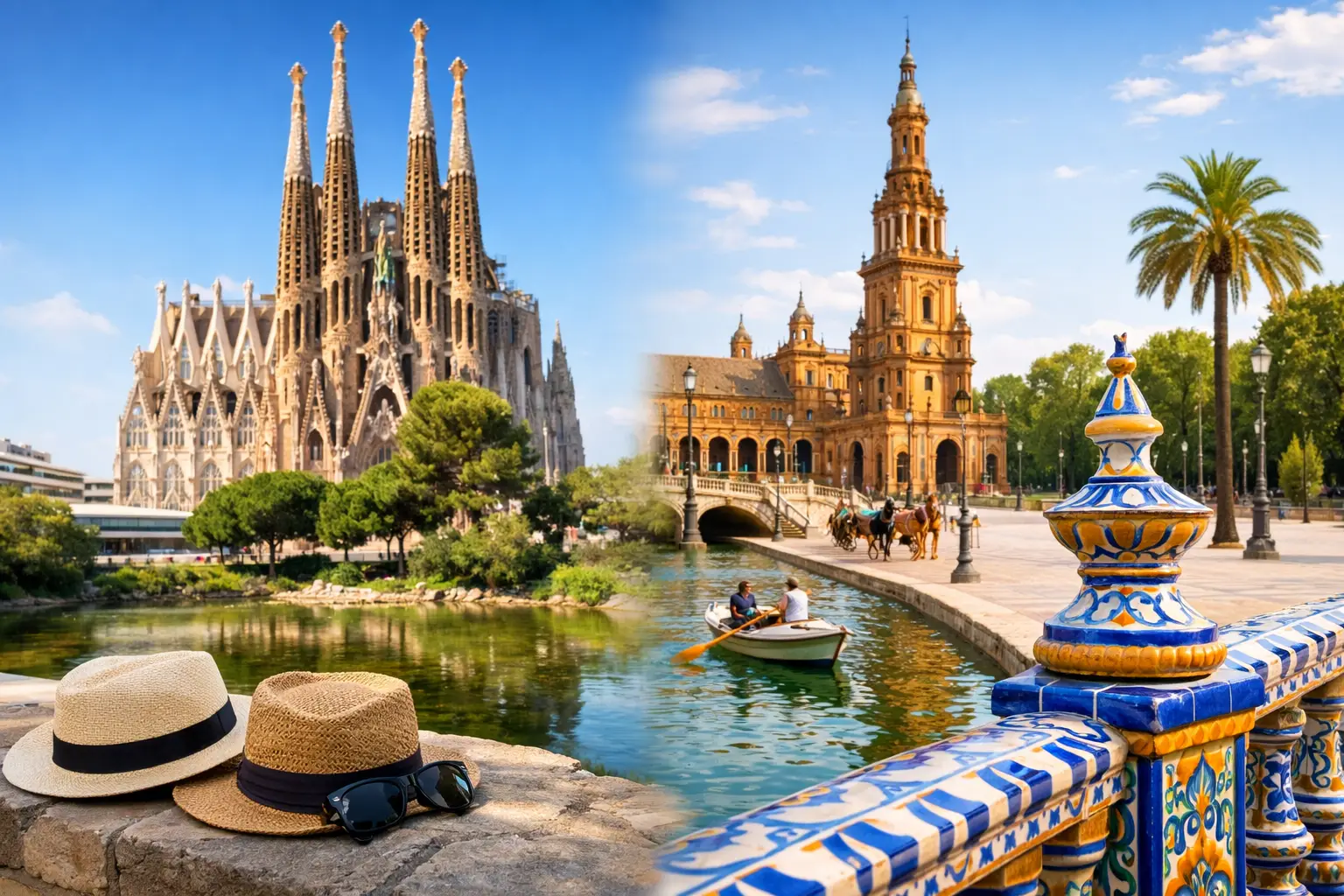
Some city choices are easy. This one is not. A Barcelona or Seville trip means picking between two Spanish heavyweights that deliver entirely different moods – one all big-city energy, beach light and modernist swagger, the other all orange trees, tiled courtyards and late-night charm. Neither is the wrong answer. The trick is knowing which one is right for this particular holiday.
If you are deciding with one eye on flight prices and the other on what you actually want from a few days away, the differences matter. Barcelona tends to suit travellers who want a lot happening at once. Seville is better for those who want atmosphere without quite so much noise around it. Both are cultural powerhouses. Both can eat through your budget if you let them. But they reward different types of traveller.
Barcelona or Seville trip: what kind of city break do you want?
Barcelona feels expansive. You have the sea, broad avenues, famous architecture, serious food, neighbourhoods with their own identities and a sense that the city is always moving. It is brilliant if you like to keep your options open from breakfast to midnight. You can spend the morning in a gallery, the afternoon on the beach and the evening in a wine bar without ever feeling as though you have forced the itinerary.
Seville is more concentrated and, for many people, more romantic. It has grandeur, certainly, but its appeal is often in the details – the sound of heels on old streets, a shaded square filling up for aperitifs, the way a bar can feel both ordinary and unforgettable. It is a city that rewards wandering. If Barcelona often feels like a European metropolis with a Catalan soul, Seville feels intensely Andalusian from the moment you arrive.
That distinction matters because pace shapes everything. In Barcelona, people tend to plan around headline sights, restaurant bookings and neighbourhood hopping. In Seville, you can have a wonderful trip by simply giving each day room to breathe.
Choose Barcelona if you want variety and momentum
Barcelona is the stronger choice if you like a city break with range. Few places combine so many strands so well: architecture, beaches, shopping, nightlife, museums, food markets and easy day-trip potential. If your ideal holiday involves a packed shortlist of things you are genuinely excited to do, Barcelona makes a strong case for itself.
Gaudi alone gives the city an identity unlike anywhere else in Europe. Even travellers who claim not to care much about architecture often find themselves peering up at facades and wondering how a building can look that playful and that precise at the same time. Add the Gothic Quarter, Montjuic, the waterfront and the city’s deep bench of restaurants, and Barcelona starts to look like the safer bet for a first-time visitor to Spain.
It also works well for mixed groups. If one person wants culture, another wants shopping and someone else simply wants sun and sangria, Barcelona can usually keep the peace. That has real value when you are booking a short break and do not want the trip to become a negotiation.
The trade-off is obvious. Barcelona can be crowded, expensive and occasionally exhausting. In peak season, some of the city’s most famous areas feel less like local neighbourhoods and more like an international conveyor belt. If that bothers you, where you stay matters enormously. Base yourself in the wrong area and you may spend the trip dodging crowds. Choose well and the city feels richer, calmer and much more liveable.
Barcelona is best for these travellers
Barcelona usually wins if you are planning a first couples’ getaway to Spain, a long weekend with plenty of restaurant and hotel options, or a trip where beach time genuinely matters. It is also easier if you want slick transport and broad accommodation choice across different budgets, though bargain Barcelona is harder to find than it once was.
Choose Seville if you want atmosphere, history and ease
Seville has a different confidence. It does not need to overwhelm you with options because it knows its atmosphere is enough. The cathedral, the Real Alcazar and Plaza de Espana are headline attractions for good reason, but the city’s real skill is making the time between major sights feel just as memorable.
This is where Seville often edges ahead for travellers who care about mood. There is a sensuality to the city – food, music, light, architecture, the late rhythm of the day – that makes even a simple evening stroll feel like a proper part of the trip rather than dead time between bookings. If Barcelona is a city you can consume quickly, Seville is one you settle into.
It is also remarkably manageable. Much of what most visitors want to see is walkable, and that makes a short stay feel generous. You can fit a lot into two or three nights without the city feeling rushed. For anyone who has ever come home from a break feeling they spent half of it on public transport, Seville is refreshingly straightforward.
The main catch is the heat. Summer in Seville is not merely warm. It can be punishing, especially if you want to sightsee through the middle of the day. Spring and autumn are glorious. High summer requires strategy, stamina and a firm commitment to shade.
Seville is best for these travellers
Seville tends to suit couples, solo travellers and anyone craving a more characterful city break over a high-energy one. If you want tapas-led evenings, beautiful hotels, history that feels woven into daily life and a city that is easy to navigate on foot, Seville is hard to resist.
Budget, hotels and value for money
If price is driving the decision, the answer is not entirely simple. Barcelona often has more flights and more hotel stock, which can help if you book early or travel outside peak periods. But it is also a city where costs rise quickly. Popular central districts, major attractions and beach-season demand all push prices up.
Seville can offer stronger value, especially for boutique stays and mid-range hotels with real character. You often get more charm for your money. Dining can also feel gentler on the wallet, particularly if your ideal evening is built around a run of tapas bars rather than a big-ticket restaurant booking.
That said, value depends on season. Seville in shoulder season can feel like a steal. Barcelona in late autumn can be surprisingly sensible. Barcelona in summer and Seville during major festivals both require a sturdier budget.
For high-intent travellers choosing where to book, this is the useful question: do you want your hotel to be part of the experience or mainly a practical base? Seville often wins the first category. Barcelona often wins the second, simply because the city encourages you to be out and about for long stretches.
Food, culture and evenings out
Barcelona’s dining scene is broader and more international. You can eat exceptionally well across many styles, and the city is very good at the polished modern meal, the market lunch and the late cocktail. It suits travellers who like choice and who may want one or two more ambitious restaurant experiences folded into the trip.
Seville is less about variety and more about pleasure. Tapas culture is not a tourist add-on here. It is part of how the city moves. Hopping from bar to bar, ordering a few things at a time and lingering longer than planned feels natural. If your favourite holidays are organised loosely around what you are eating next, Seville has a powerful argument.
Culturally, Barcelona offers a broader menu, from architecture to contemporary art and major urban events. Seville feels more singular. Flamenco, Moorish influences, Catholic pageantry and Andalusian tradition are more present in the texture of the city. One is not better than the other. It depends whether you want breadth or immersion.
Barcelona or Seville trip for first-time visitors to Spain
For a first trip to Spain, Barcelona is often the easier sell. It is internationally connected, visually immediate and packed with recognisable sights. If you are travelling with limited time and want a city that delivers plenty of obvious highlights quickly, it does that very well.
But Seville may give you the stronger feeling of having been somewhere distinctive. It can feel more rooted in local rhythm and less filtered through global city expectations. For travellers who already know they prefer atmosphere over tick-box sightseeing, that may matter more than having the longest list of famous landmarks.
If you want a little help getting beyond the usual guidebook shorthand, the Destination Unlocked podcast is worth packing alongside your planning. It is as useful as a guidebook and as personal as a chat with your most well-travelled friend, and each 40-minute episode gives you the sort of local insight that can sharpen a good trip into a memorable one.
So which should you book?
Book Barcelona if you want a dynamic city break with iconic sights, beach time, broad hotel choice and the sense that there is always another excellent option around the corner. It is especially good for first-timers, groups and travellers who like a holiday with momentum.
Book Seville if you want elegance, intimacy, easier pacing and evenings that seem to improve by themselves. It is the better choice for travellers who care more about atmosphere than volume, and who would happily swap a beach for a shaded square and another plate of jamon.
If you are still stuck, use the simplest test. When you picture the trip, are you imagining a rooftop by the sea after a day of architecture and neighbourhood wandering? Or are you imagining candlelit tapas, tiled courtyards and warm midnight streets? The answer is probably already doing the booking for you.