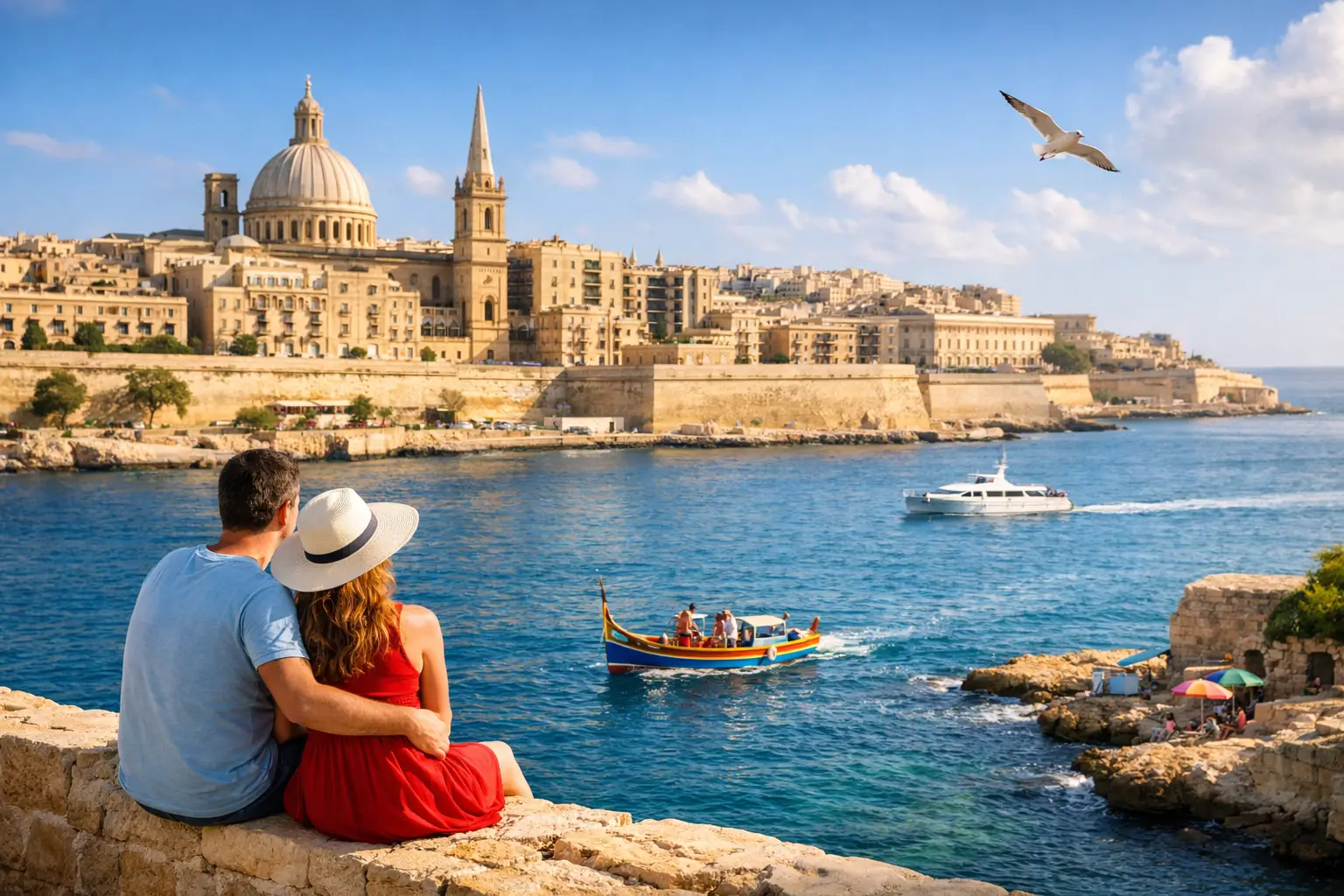
Malta is small enough to feel manageable and layered enough to reward a little planning. The best things to do in Malta are not confined to one old town or one beach: this is an island nation of honey-coloured fortifications, extraordinary swimming spots, lively harbours and restaurants where an unhurried dinner can become the evening’s main event. Give it four or five nights if you can. You will see more, and spend less of the holiday in a taxi.
Start in Valletta, Malta’s compact capital
Valletta makes an excellent base for a first visit. It is walkable, handsome and particularly useful if you want restaurants and ferry connections within easy reach. Its grid of steep streets ends abruptly at the sea, so even a short wander produces grand harbour views and unexpected glimpses of church domes.
Make time for St John’s Co-Cathedral, whose plain exterior conceals an exuberantly decorated interior and Caravaggio’s The Beheading of Saint John the Baptist. Book a timed entry in busy months, then linger around Republic Street and the smaller lanes running off it. The Upper Barrakka Gardens are the obvious viewpoint over the Grand Harbour, but they earn their popularity.
For a more rounded sense of Valletta, visit the National War Museum at Fort St Elmo. Malta’s strategic position has shaped nearly every period of its history, from the Knights of St John to the Second World War, and this is a smart place to put the city’s formidable walls into context.
Take to the Grand Harbour and the Three Cities
A harbour cruise is one of the best value ways to understand Malta’s geography. From the water, the scale of the bastions is far clearer, and the view carries you past marinas, dockyards and fortified promontories that have watched ships arrive for centuries. Choose a shorter cruise if your time is tight, or a sunset sailing if you would rather make an occasion of it.
Then cross from Valletta to the Three Cities by ferry. Vittoriosa, also known as Birgu, is the most rewarding for a leisurely afternoon. Its waterfront has polished itself up, but the narrow streets behind it still feel residential and quietly old-fashioned. The Inquisitor’s Palace and Fort St Angelo add historical substance, while a table by the marina is a fine place to stop for a drink before returning to Valletta after dark.
This is also a useful alternative to staying in the capital. Birgu suits travellers who prefer a calmer evening and characterful boutique hotels, though Valletta is more convenient for early tours and restaurant choice.
See Mdina when the light softens
Malta’s former capital, Mdina, sits on a hill above the centre of the island, enclosed by walls and built from the same warm limestone that gives Malta its distinctive glow. It is often called the Silent City, a description that is a little theatrical by day, when coaches and day-trippers arrive, but rather accurate towards evening.
Arrive in late afternoon, walk through the main gate and allow yourself to get slightly lost. The pleasures are architectural: carved doorways, graceful balconies, shadowy lanes and far-reaching views from the ramparts. The adjoining town of Rabat is worth adding to the visit for St Paul’s Catacombs, a network of Roman-era burial chambers that offers a more intimate encounter with the island’s ancient past.
Mdina can be combined with a half-day tour of central Malta, but it is better not treated as a rushed photo stop. Stay for dinner or a pre-dinner drink, when many visitors have left and the stone takes on a soft amber colour.
Spend a day in Gozo, but do not race around it
Gozo is Malta’s greener, quieter sister island, reached by ferry from Ċirkewwa in the north of Malta. It is a straightforward day trip, although an overnight stay is the better choice for anyone who likes slow mornings, rural views and swimming without a schedule.
Victoria’s Citadel is the natural starting point. Restored ramparts look out across much of the island, giving a useful overview before you head towards the coast. Ramla Bay, with its rust-coloured sand, is one of Gozo’s most appealing beaches, while the salt pans near Marsalforn make a satisfying stop for photographers and curious walkers.
Gozo’s most famous rock formation, the Azure Window, collapsed in 2017. It is worth knowing this before booking a tour that still uses it as a headline. The surrounding Dwejra coast remains spectacular, however, with the Inland Sea and dramatic cliffs making the journey worthwhile. A boat trip may depend on sea conditions, so keep your expectations flexible.
Swim where the water is at its clearest
Malta’s coast is made for a swim stop, but the experience varies wildly by season and location. The Blue Lagoon on Comino has water of almost implausible clarity, but it is no secret. In July and August, boats arrive early and the small shoreline can feel more like a busy lido than a hidden cove.
It can still be wonderful if you choose an early boat, travel outside school holidays, or stay on a boat rather than trying to claim a patch of sand. For a quieter alternative, consider a small-group sailing trip that includes lesser-known coves, or explore the rocky swimming areas around Sliema and St Julian’s if you are based near Valletta.
Golden Bay and Għajn Tuffieħa, on the west coast, are better options for sand and sunset. Għajn Tuffieħa requires a descent down steps and the climb back is not ideal in intense midday heat, but that extra effort often keeps it calmer than neighbouring Golden Bay. Always check the flag conditions: beautiful water does not automatically mean safe water.
Go below the surface at Ħal Saflieni and in Malta’s temples
Malta’s prehistoric sites are among the island’s great surprises. The Ħal Saflieni Hypogeum, an underground complex carved out more than 5,000 years ago, is especially remarkable. Visitor numbers are strictly limited, so it is one of the first activities to reserve once flights are booked. It is not a casual drop-in attraction, but it is unforgettable.
The megalithic temples at Ħaġar Qim and Mnajdra are easier to visit and sit in a beautiful coastal setting. Their immense stone blocks pre-date the pyramids of Egypt, yet the atmosphere is refreshingly unshowy. A guided visit helps here. Without a little context, the sites can look like evocative ruins; with it, they become evidence of a sophisticated prehistoric culture.
Eat Maltese food beyond the obvious
Maltese cooking reflects the island’s position between Sicily, North Africa and the wider Mediterranean. Start with pastizzi, flaky pastries commonly filled with ricotta or mushy peas, ideally bought warm from a local bakery. They are inexpensive, delicious and not quite substantial enough to count as a balanced lunch, however tempting it may be to try.
For dinner, look for rabbit stew, known as fenkata, slow-cooked beef dishes, fresh fish and ftira, a rustic bread often topped or filled with Mediterranean ingredients. In Marsaxlokk, the south-coast fishing village, seafood lunches are the obvious draw. Sunday is the busiest market day, which suits those who enjoy bustle; visit on another day for a gentler waterfront meal.
Valletta has the greatest concentration of smart dining rooms, while Sliema and St Julian’s offer more modern, international options. It depends on the kind of night you want. Valletta has atmosphere, but booking ahead is sensible in peak season.
Make your Malta itinerary work harder
The most satisfying Malta holidays mix city, coast and one outward-looking day on Gozo. Base yourself in Valletta or nearby Sliema for easy access to restaurants, ferries and tours. Choose Mellieħa if beaches and a slower pace matter most. St Julian’s is convenient for nightlife, but its busier atmosphere will not suit everyone.
Public buses cover much of the island, though journeys can be slow in summer traffic. Ferries are often the pleasantest way between Valletta, Sliema and the Three Cities. For temple visits, Gozo or remote beaches, a guided excursion or hired car can save valuable holiday time. Malta drives on the left, which will feel familiar to British visitors, but the narrow roads and confident local driving call for patience.
If you would like the human detail behind the itinerary, the Destination Unlocked podcast is as useful as a guidebook and as personal as a chat with your most well-travelled friend. Each 40-minute episode brings together the practical information and local perspective needed for a great trip.
Malta rewards the traveller who leaves room for the unscheduled moments: a ferry ride when the harbour light changes, a swim before supper, or one more turn through Mdina’s quiet lanes. Book the essentials early, particularly the Hypogeum and peak-season boat trips, then let the island’s compact scale make the rest feel pleasantly possible.