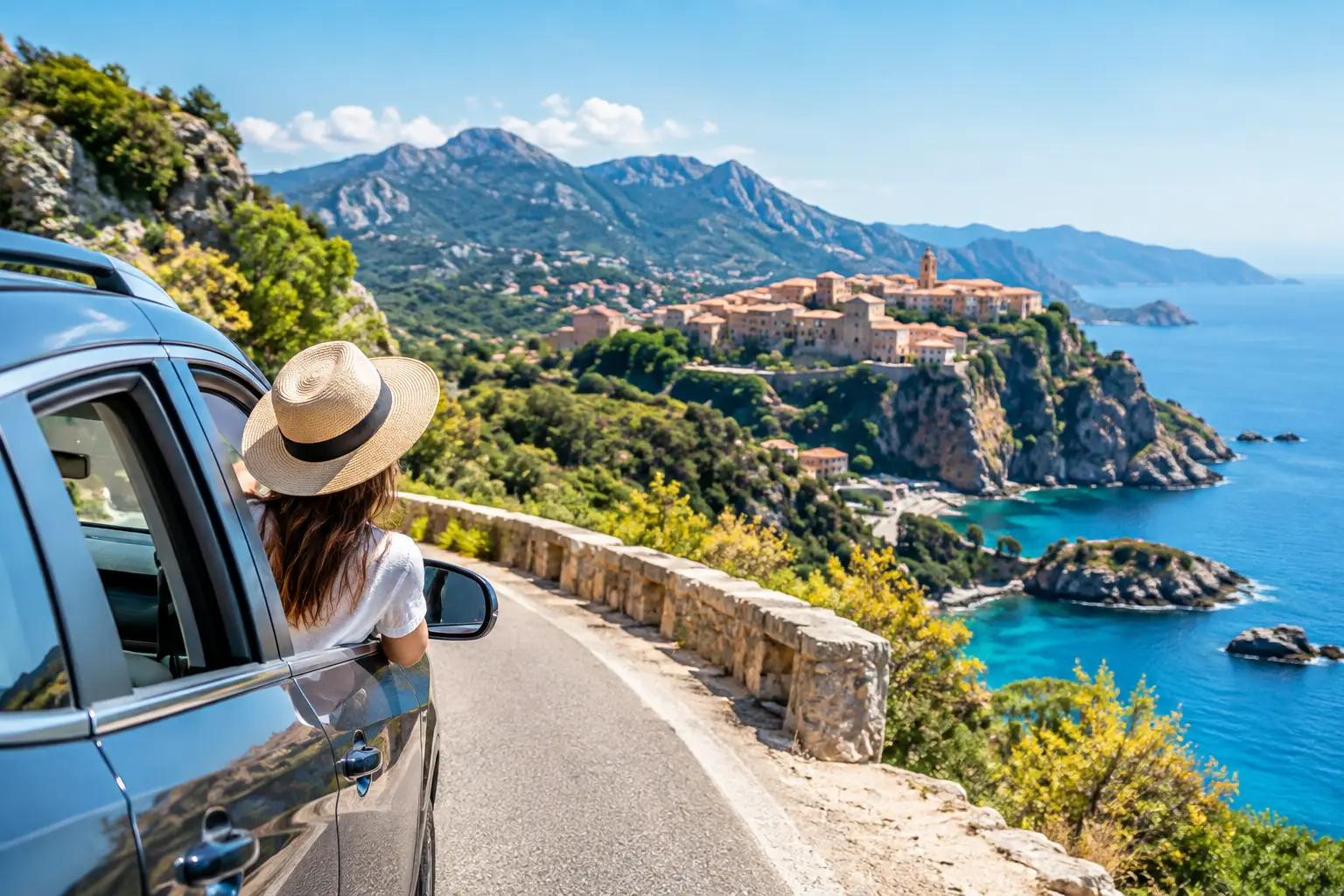
Corsica rewards travellers who resist the urge to tick off every beach, citadel and mountain pass in one heroic lap. A Corsica road trip is at its best when it has room for a long lunch in a harbour town, an unscheduled swim beneath red granite cliffs and the occasional slow-going road that turns a two-hour journey into an afternoon.
This is an island of dramatic contrasts: Genoese watchtowers above cobalt water, pine-scented mountain valleys, handsome old towns and a distinctly Corsican culture that deserves more than a passing glance. For a first visit, seven days is enough to connect the island’s northern coast, wild west, interior and southern shore without treating the car as your main holiday companion.
Planning a Corsica road trip
The most satisfying route runs from Bastia in the north-east to Figari in the south, with stops around Cap Corse, Calvi, Porto, Corte, Ajaccio and Bonifacio. Booking an open-jaw flight and one-way car hire makes this route far more relaxed than doubling back to your arrival airport. It can cost more, so compare the surcharge against the value of gaining an extra day on the island.
If your flights require a return to Bastia, either allow nine or 10 days or simplify the itinerary. Corsica looks compact on a map, but its spine is mountainous and the coastal roads are wonderfully scenic precisely because they are slow. Do not plan on averaging more than 40 to 50 kilometres per hour once you leave the main corridors.
A small or medium car is the sensible choice. It is easier to park in citadels, less stressful on narrow bends and generally more economical. An SUV may sound tempting for the terrain, but most visitors do not need one. Check excess cover carefully, photograph the car at collection and avoid arriving at a rural hotel after dark if you can: some final approaches are steep, unlit and rather less forgiving than the glossy photographs suggest.
May, June, September and early October offer the best balance of warm sea, manageable roads and more availability in characterful hotels. July and August are lively, but book well ahead and expect popular beaches, boat trips and old-town parking to be busy. Spring suits walkers and food-minded travellers; the sea may be brisk, but the maquis is at its most fragrant.
A seven-day Corsica road trip route
Day 1: Bastia and Cap Corse
Arrive in Bastia, collect your car and spend your first night either in the old port area or in Erbalunga, a handsome fishing village 20 minutes north. Bastia is often treated as a gateway, which does it a disservice. Its old port, Terra Vecchia lanes and Place Saint-Nicolas make an elegant introduction, particularly when the ferries and café tables begin to fill at dusk.
If your flight lands early, drive north around Cap Corse. The peninsula feels like Corsica in miniature: vineyards, tiny marinas, stone hamlets and watchtowers appearing around every bend. Do not attempt the full circuit if you are tired. A leisurely out-and-back to Erbalunga or Macinaggio is plenty for day one.
Day 2: Cap Corse to Calvi
Continue around Cap Corse’s western side, where the road becomes more exposed and the views more theatrical, then head south through Saint-Florent towards the Balagne region. Calvi is a fine base for two nights, combining a broad sandy beach with a citadel that catches the evening light beautifully.
The route is not short, so treat it as a driving day with good stops rather than a race. Saint-Florent is useful for lunch, while the Balagne villages of Pigna, Sant’Antonino and Lumio offer a quieter counterpoint to the coast. Stay within walking distance of Calvi’s harbour if you want restaurants and a car-free evening, or choose a rural hotel outside town for space, views and easier parking.
Day 3: Calvi, the Balagne and the sea
Keep the car parked for much of today. Calvi’s beach is easy and sociable, but the greater pleasure lies in combining a morning around the citadel with an afternoon boat trip, paddleboarding session or a drive to one of the coves west of town. Families and first-time visitors may prefer the convenience of Calvi; couples seeking quiet should look towards the smaller beaches around Lumio.
This is also a sensible day to indulge in a proper Corsican meal. Look for local charcuterie, brocciu cheese and seasonal produce rather than assuming every menu will be French in the mainland sense. Corsican identity is strong, and the island’s food, language and history give it a character all of its own.
Day 4: Calvi to Porto via Piana
Leave Calvi after breakfast and follow the coast south towards Porto. This is one of Europe’s great drives, but it demands concentration. The road threads through the red rock formations of the Calanques de Piana, with sheer drops, tight corners and regular pull-ins where everyone has the same excellent idea to stop for photographs.
Porto itself is a small, practical seaside base rather than a destination of grand polish. That is part of its charm. Book a room with a terrace or sea view if your budget allows, because sunset turns the Gulf of Porto into something rather special. Arrive in time for a short walk to the Genoese tower and a swim before dinner.
Day 5: Scandola by boat, then into the mountains
Take an early boat excursion from Porto to the Scandola Nature Reserve. Seeing the volcanic cliffs, sea caves and inaccessible headlands from the water explains why this section of coast feels so remote. Conditions can affect departures, so keep your plans flexible and reserve in advance during peak season.
After the trip, drive inland to Corte, usually taking around two to two-and-a-half hours without long stops. The shift is immediate: sea air gives way to high peaks and deep valleys. Corte, once the capital of the independent Corsican republic, is the island’s most compelling mountain town. Stay close to the citadel for atmosphere, but confirm parking arrangements before booking.
Day 6: Corte, Vizzavona and Ajaccio
Begin with a walk in the Restonica Valley if conditions and access permit. Even a short stroll beside the clear river gives a sense of Corsica’s wilder interior. In high season, road access and parking restrictions can apply, so ask your hotel what is current rather than relying on an old itinerary.
Drive south-west through Vizzavona towards Ajaccio. The journey is shorter than the previous days, which leaves time to explore the city’s waterfront, market and old streets. Ajaccio has a more urban, lived-in energy than the smaller coastal bases, and it works well for a final night if you enjoy a choice of restaurants. It also makes a practical stop before the longer southern drive.
Day 7: Ajaccio to Bonifacio and Figari
Set off early for Bonifacio, allowing around three hours with pauses through Sartène or at a beach along the way. Bonifacio’s limestone cliffs and fortified upper town are justly famous, but they are not a secret. Arriving before late morning makes parking and wandering far more pleasant.
Take a boat trip beneath the cliffs if time allows, then explore the citadel on foot and settle in for lunch overlooking the marina. If you have a late flight from Figari, the airport is roughly 25 minutes away. Otherwise, add a night in Bonifacio or nearby, particularly if you want time for the Lavezzi Islands or a final beach day at Palombaggia or Santa Giulia.
Where to spend more on this route
On a road trip, location often matters more than hotel facilities. In Calvi and Bonifacio, paying for a central base can save the daily frustration of driving, parking and choosing a designated driver. Around Porto and Corte, a terrace, pool or mountain view can feel more valuable, because evenings are quieter and the landscape is the entertainment.
For activities, book the Scandola boat trip and any Lavezzi Islands crossing early in summer. Leave beach time looser. Corsica’s best swimming spots are often the ones you find after turning down an unpromising lane, provided you park considerately and never leave valuables in the car.
Before setting off, download offline maps, fill up when you see a convenient petrol station and accept that a journey may take longer than expected. That is not a flaw in the plan. It is the point. For the kind of local perspective that makes those detours worthwhile, the Destination Unlocked podcast is as useful as a guidebook and as personal as a chat with your most well-travelled friend. Each 40-minute episode has the information you need for a great trip.
Corsica is not an island to conquer by itinerary. Leave a little space between the bookings, take the road with the better view when it presents itself, and let the island set the pace.