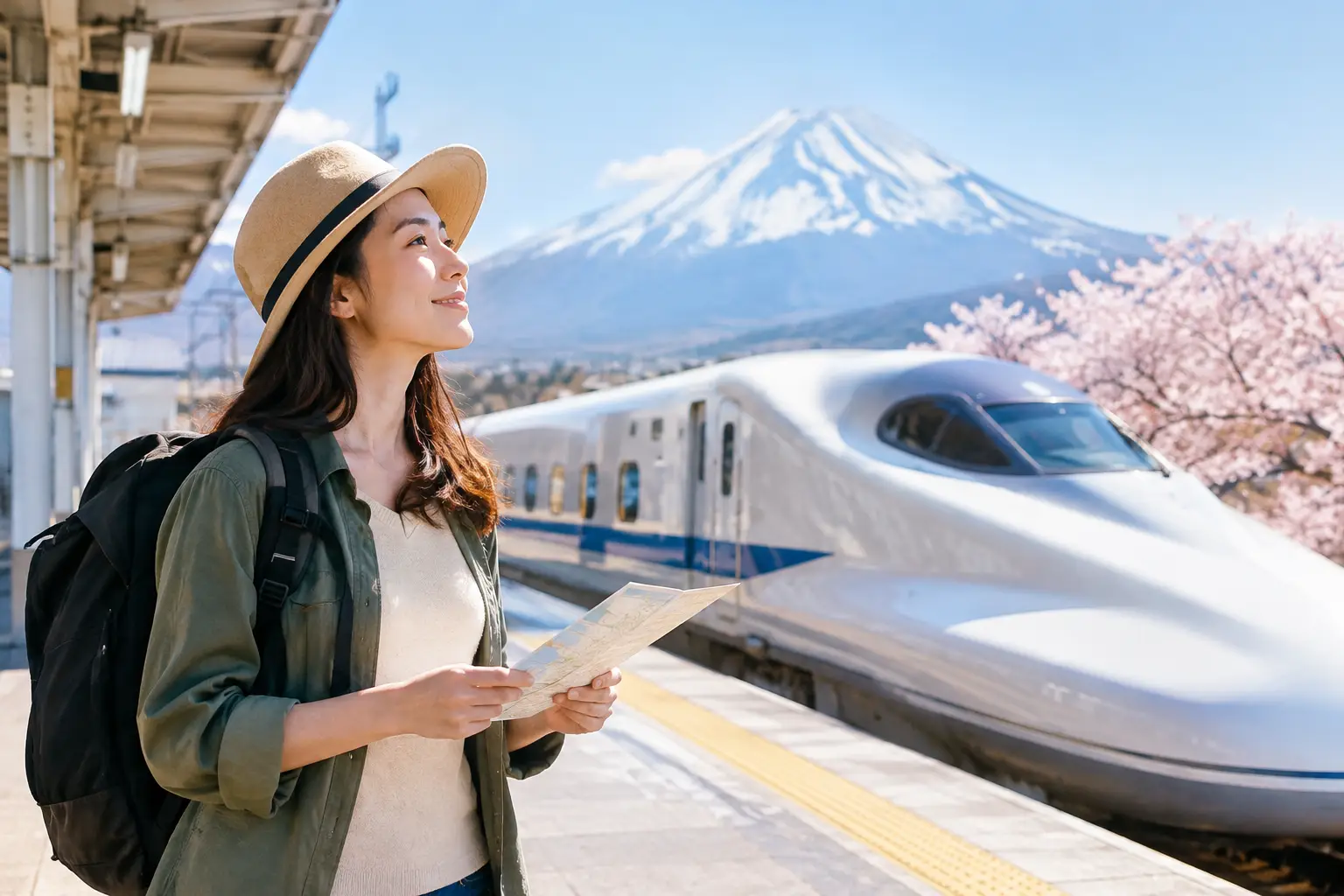
Japan’s stations can feel like small cities: immaculate, busy, brilliantly signposted and stocked with far better meals than a hurried traveller has any right to expect. That is precisely why a solo Japan rail journey works so well. You can change pace without negotiating with anyone, stay one more night in a place that surprises you, and let the train itself become part of the holiday rather than merely transport between bookings.
For a first trip, the temptation is to tick off Tokyo, Kyoto, Osaka and Hiroshima in one energetic sweep. It is possible, of course, but travelling alone gives you a stronger reason to resist the stopwatch. Japan rewards the traveller who leaves room for a long lunch, an unplanned garden, a quiet bar counter and the very particular pleasure of arriving in a new town with only your overnight bag.
Start a solo Japan rail journey with the right rhythm
The best route is not necessarily the one with the most famous names. It is the one that balances fast intercity trains with enough time on the ground to feel the texture of each stop. For most first-time visitors flying from the UK, a 10 to 14-night route through Tokyo, the Japanese Alps or Hokuriku, Kyoto and Osaka is a fine introduction. Add Hiroshima if you have two weeks; leave it out if doing so gives you an extra night in Kyoto or Tokyo.
A satisfying 12-night itinerary might begin with four nights in Tokyo, continue for two nights in Kanazawa, then spend four nights in Kyoto with a day trip to Nara or Uji, before finishing with two nights in Osaka. It is an elegant sequence: Tokyo is stimulating and immense, Kanazawa brings samurai districts, craft traditions and a more manageable scale, Kyoto supplies temples and early-morning lanes, while Osaka sends you home well fed.
If you have travelled in Japan before, head west from Osaka to Okayama, Kurashiki, Hiroshima and Miyajima, or take the shinkansen north towards Sendai and Aomori. Kyushu is particularly rewarding for a return visit, with Fukuoka, Nagasaki, Kumamoto and the hot-spring towns around Beppu offering a gentler, more regional journey. The trade-off is simple: the further afield you go, the less sense it makes to treat Tokyo and Kyoto as compulsory stops.
Choose rail passes only after planning your route
The Japan Rail Pass remains famous, but it is no longer an automatic bargain. Price changes mean many travellers will spend less by buying individual tickets, especially on a classic Tokyo-Kyoto-Osaka trip. Work out your major long-distance journeys first, then compare the total against a national pass and any regional passes that suit your chosen area.
Regional passes can be excellent value when they match a concentrated itinerary. A Kansai-Hiroshima pass, for example, may work well if you are travelling from Osaka through Okayama to Hiroshima and back. In Kyushu, regional passes can make a multi-city trip much more flexible. They are less useful if your plans consist mainly of city exploration, where local metro and bus fares are relatively modest.
For a solo traveller, reserved seats are worth considering on longer shinkansen journeys, at weekends, during school holidays and in peak periods such as cherry blossom season and autumn foliage. Reservations remove one small layer of uncertainty, particularly when you have a suitcase. On quieter routes, the freedom of an unreserved carriage can be more appealing.
An IC card, used by tapping in and out of local rail networks, is equally useful. It makes short journeys feel wonderfully straightforward and can often be used in convenience stores and vending machines too. Keep a little cash available nonetheless, particularly in smaller towns, family-run inns and rural bus networks.
Allow for luggage, not just travel time
Japanese rail journeys are remarkably efficient, but changing trains with a large suitcase is rarely glamorous. If you are travelling alone, pack for your own comfort rather than the imagined photograph. A medium case or backpack that you can lift and manoeuvre unaided will give you more confidence on platforms and in hotel foyers.
Luggage forwarding is a very sensible splurge. Send your larger bag from Tokyo to Kyoto, for example, and travel to Kanazawa with a compact overnight bag. It turns a multi-stop route into something lighter and more spontaneous. Do check delivery timings with your hotel, as same-day service is not guaranteed and remote destinations may require extra notice.
Book hotels around the station, then look beyond it
Rail travel makes location matter. In Tokyo, staying close to Tokyo Station, Ueno, Shinjuku or Shibuya can be more valuable than saving a little on a hotel far from a major line. The right base means an easier arrival, less late-night navigation and more time for the city itself. Ueno is particularly practical for museums, Ameya-Yokocho market and northbound trains, while Tokyo Station places you near the Imperial Palace, Ginza and the shinkansen.
In Kyoto, a hotel near Kyoto Station is convenient for day trips and early departures, but it does not offer the most atmospheric evening setting. Gion, Higashiyama and Kawaramachi put you closer to old lanes, restaurants and the Kamo River, although buses and taxis may become more useful. The choice depends on whether your priority is rail efficiency or stepping out into Kyoto after dark.
For a solo stay, business hotels are often an excellent answer. Rooms are compact but efficiently designed, locations tend to be strong, and single occupancy is normal rather than an awkward exception. A ryokan is another memorable option, particularly in a hot-spring town such as Kinosaki Onsen, Hakone or Kaga Onsen. Look for one dinner and breakfast included if you want the full experience, but remember that fixed dining times may not suit a packed sightseeing day.
It is worth booking popular city hotels early for spring and autumn, as well as over Golden Week and the New Year period. For smaller destinations, choose accommodation within walking distance of the station or confirm the final bus timetable before committing. A beautiful rural inn is less relaxing when the only practical arrival involves a costly taxi after sunset.
Build in experiences that reward travelling alone
Japan is unusually comfortable for solo dining. Counter seats at ramen shops, sushi bars, izakaya and department-store food halls make eating alone feel entirely ordinary. In Tokyo, seek out a small bar in Golden Gai or a basement restaurant beneath a station. In Osaka, sit at the counter for okonomiyaki or kushikatsu. In Kanazawa, make time for a seafood breakfast at Omicho Market.
A few planned activities add welcome structure to a self-directed rail trip. A guided food tour on your first evening in Tokyo can ease the slight disorientation of arrival and introduce neighbourhoods you may revisit alone. A tea ceremony, cookery class or craft workshop provides cultural context without filling an entire day. In Kyoto, an early walking tour of Gion or Arashiyama can help you understand the places that crowds often flatten into a checklist.
There is also value in booking one genuinely restorative experience. An onsen stay, a private bath where needed, or an afternoon at a sento can reset the pace after several big-city days. Observe the bathing etiquette carefully and check tattoo policies in advance, as rules vary. Japan is hospitable, but consideration for shared spaces matters.
Enjoy the freedom, but keep a few anchors
Travelling alone does not mean improvising every hour. Reserve key hotels, decide your principal train legs and keep offline maps, booking details and station names in both Roman letters and Japanese where possible. Then leave the rest loose. A rainy afternoon in Kanazawa may be ideal for a museum and a long coffee; a bright morning in Kyoto might persuade you to take the first train to Uji.
The practical details are reassuringly manageable. Stations have lockers, hotels are accustomed to individual guests, and convenience stores make excellent sources of breakfast, picnic supplies and emergency umbrellas. English is not universal, particularly away from major centres, but patience, a translation app and a polite greeting go a long way. Learn a few basics, including arigatou gozaimasu for thank you, and avoid assuming that silence means unfriendliness.
For destination ideas delivered with more personality than a timetable, the Destination Unlocked podcast is as useful as a guidebook and as personal as a chat with your most well-travelled friend. Each 40-minute episode brings together the practical details and local perspective that make a trip feel properly considered.
A solo journey by rail in Japan is not about proving independence or racing through an itinerary. It is a chance to travel with uncommon ease: to watch suburbs turn to rice fields, to order the set lunch that catches your eye, and to stay curious enough to get off where the journey becomes interesting.