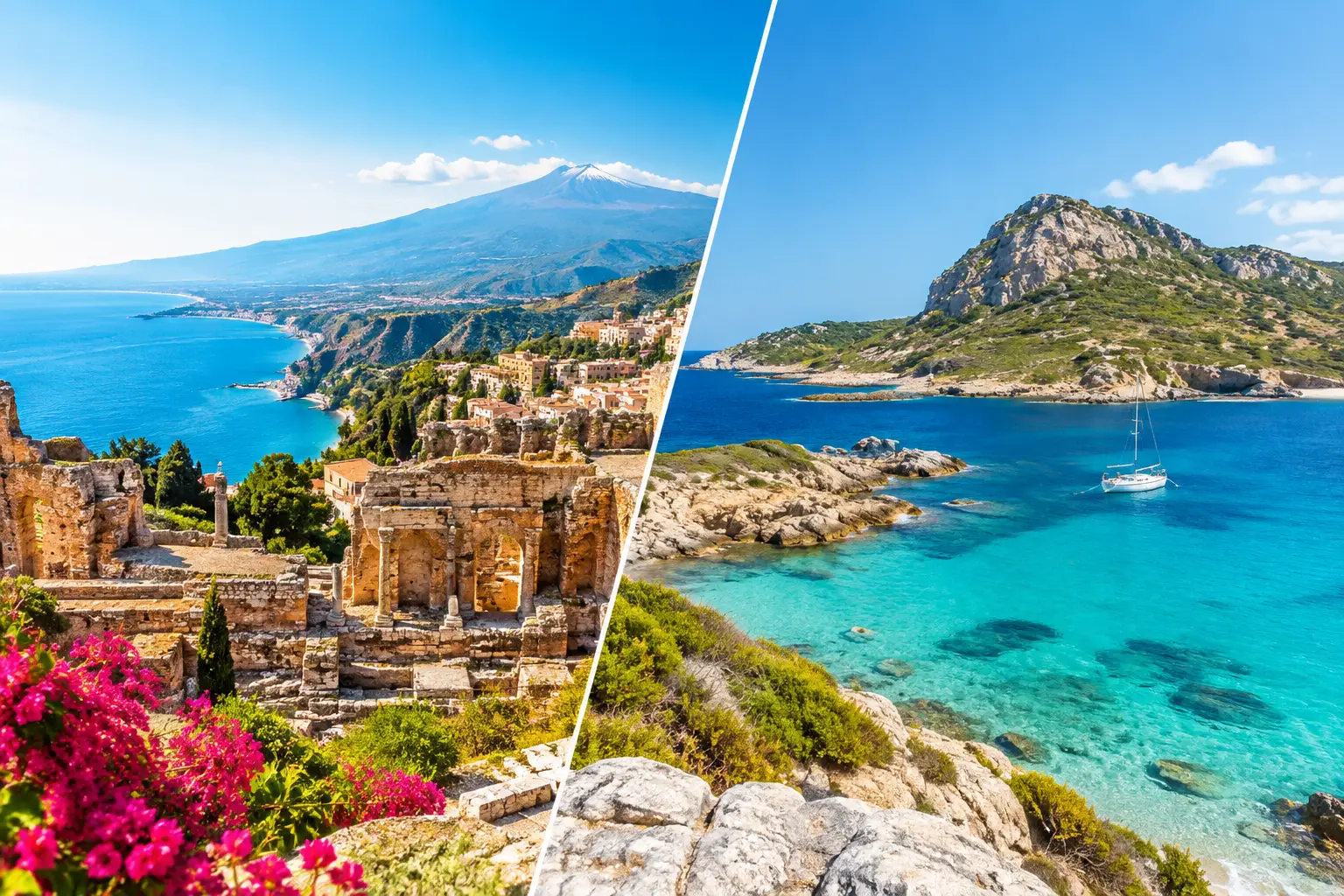
The choice often comes down to the first image in your head. Is it a table in Palermo piled with arancine and grilled fish, with Baroque streets a short walk away? Or a dazzling Sardinian cove, reached by boat or a winding road, where the sea appears almost implausibly blue? This Sicily Sardinia comparison is for travellers ready to turn that image into a booked Italian island holiday.
Both islands reward a week or two far more generously than a rushed long weekend. Both have extraordinary coastlines, strong regional identities and food worth travelling for. Yet they create very different holidays: Sicily is intense, layered and city-rich; Sardinia is spacious, beach-led and often more deliberately slow.
Sicily Sardinia comparison: the essential difference
Sicily feels like a crossroads made visible. Greek temples, Arab-Norman architecture, Spanish Baroque towns and busy markets all sit within a landscape shaped by Etna. It suits travellers who want their sun holiday to include proper sightseeing, a memorable meal every evening and the occasional glorious logistical complication.
Sardinia is more elemental. Its headline act is the coast, from the polished glamour of the Costa Smeralda to quiet coves in the east and wild beaches around the south-west. Inland, there are nuraghi, mountain villages and a food culture of roast suckling pig, pecorino and Cannonau, but the rhythm is generally calmer. Choose Sardinia when swimming, sailing, beach-hopping and long lunches are the point, not simply the gaps between museums.
Neither description is absolute. Sicily has superb beaches, especially around San Vito Lo Capo, Cefalù, the Vendicari reserve and the Aeolian Islands. Sardinia has serious history at sites such as Su Nuraxi and the atmospheric old towns of Cagliari, Alghero and Bosa. The distinction is one of emphasis: Sicily gives you more cultural variety close together, while Sardinia gives you more room to switch off.
Beaches, boats and time by the water
For the most consistently spectacular swimming, Sardinia has the edge. The Gulf of Orosei, La Maddalena archipelago, Chia and the beaches near Villasimius have water that is clear, shallow and startlingly bright. A boat trip is not an optional extra here; in many parts of the island, it is the best way to reach coves that roads cannot improve upon.
The trade-off is popularity. The best-known Sardinian beaches can feel very busy in July and August, and parking can be restricted or pre-booked. Beach clubs and smart coastal restaurants around the north-east also raise the price of a day by the sea. Travellers seeking a quieter Sardinia should look towards the Ogliastra coast, the north-west near Stintino outside peak hours, or the less-developed south-west.
Sicily’s coastline is more varied. You might spend one day on a sandy beach, another swimming below Taormina, and another on a volcanic shore around Acireale or the Aeolian Islands. Cefalù is particularly appealing for first-time visitors because its beach, historic centre and restaurant scene are all within easy reach. For a more nature-focused stay, south-east Sicily combines golden beaches with handsome towns such as Noto, Modica and Ragusa.
If your ideal day is built around a sunbed, a swim and a sunset boat ride, book Sardinia. If you want sea time alongside markets, ruins and a different town for dinner each night, Sicily offers more range.
Culture and food: where Sicily pulls ahead
Sicily is arguably Italy’s most rewarding island for travellers who plan holidays around what they will eat and see. Palermo alone can fill several days, from the Capuchin Catacombs and Norman palace to Ballarò market and street-food stops serving panelle, sfincione and cannoli. In the east, Catania brings Etna, exuberant Baroque architecture and a lively evening scene; Syracuse and Ortigia add ancient Greece and a waterfront made for aperitivo.
It is also an island where the drive between bases becomes part of the story. The Valley of the Temples near Agrigento, the mosaics at Villa Romana del Casale, hilltop Enna and the south-eastern Baroque towns make a road trip feel richly populated rather than merely scenic. Book a guided food walk in Palermo or Catania, an Etna excursion, or a small-group visit to wineries on the volcano’s slopes, and Sicily becomes much easier to read.
Sardinian food is distinctive but less familiar to many British travellers. It is deeply regional, shaped by pastoral inland traditions and exceptional seafood. Seek out culurgiones, the neat potato-filled pasta parcels; fregola with clams; bottarga; and porceddu, slow-roasted suckling pig. A meal at an agriturismo in the interior can be one of the island’s most memorable experiences, particularly if you have spent the day on the coast.
Cagliari is Sardinia’s strongest city break option, with the old Castello district, Roman amphitheatre, marina restaurants and Poetto beach nearby. Alghero feels noticeably different again, with Catalan influences and a handsome walled centre. But travellers looking for museum-hopping and late-night urban energy will find Sicily more compelling.
Getting around and choosing a base
A hire car is helpful in both places, but it changes the experience differently. In Sardinia, it is close to essential outside Cagliari, Alghero and a few resort areas. Distances can be greater than they appear on a map, especially across the mountainous interior, so resist the temptation to book one hotel at each end of the island for a seven-night stay.
For a first Sardinian holiday, choose one region and stay put. The south around Cagliari and Villasimius works well for beaches plus city dining. The north-east suits those after boat trips, polished hotels and easy access to La Maddalena. The east is the choice for hikers, coves and a more rugged atmosphere. A coastal hotel with breakfast, parking and a pool is often worth paying for, as daily driving and summer heat can make a convenient base feel like a luxury.
Sicily can be done without a car if you focus on Palermo, Cefalù, Catania, Taormina and Syracuse, using trains and organised day trips. That said, a car opens up the south-east and western coast. Driving in Palermo or central Catania is not for the faint-hearted, and restricted traffic zones can catch out even experienced drivers. Collect the car after leaving the city, rather than immediately on arrival.
A two-base Sicily itinerary works especially well. Pair Palermo with Cefalù or the west coast, or combine Ortigia with Taormina or a countryside hotel near Noto. For Sardinia, one excellent base is usually better than two merely adequate ones.
Price, season and the holiday you actually want
Peak-season Sardinia can be surprisingly expensive, particularly in Costa Smeralda, around La Maddalena and at well-designed beach hotels. August is when much of Italy takes its holiday, so availability tightens, prices rise and roads lead steadily towards the sea. June and September are the sweet spots: warm water, better value and a little more breathing space.
Sicily can also be costly in sought-after places such as Taormina, but it offers more choice across different budgets. Palermo and Catania are often better value for food and accommodation than Sardinia’s fashionable coast, while smaller towns can deliver excellent guesthouses and characterful boutique hotels. The compromise is that Sicily’s high summer temperatures can be punishing, particularly inland. May, early June, late September and October are excellent for mixing culture with beach time.
Families with young children may favour Sardinia’s gentler sandy beaches and resort-style accommodation. Couples who want a food-first escape with theatre, architecture and atmospheric towns will often prefer Sicily. Active travellers can make a strong case for either: Sardinia for hiking, kayaking and sailing; Sicily for Etna walks, cycling, archaeological sites and island-hopping.
There is one final practical consideration. If you dislike frequent changes of plan, Sardinia is easier to enjoy slowly. If you are energised by a place that gives you one more reason to stop, taste or detour, Sicily is likely to feel more generous.
So, Sicily or Sardinia?
Book Sicily if you want an island holiday with the density of a grand tour: ancient sites in the morning, a swim in the afternoon and a city that still has something to say after dinner. It is the stronger choice for first-time visitors to southern Italy who want culture and cuisine alongside the coast.
Book Sardinia if your non-negotiable is beautiful water, a handsome hotel near the beach and days that can unfold without an agenda. It is especially good for couples, families and friends who value time on a boat as highly as time at a table.
Whichever island wins, give yourself enough time to stay rather than merely tick off. And for the sort of local perspective that makes a booking feel more considered, the Destination Unlocked podcast is as useful as a guidebook and as personal as a chat with your most well-travelled friend: each 40-minute episode has the information you need for a great trip.