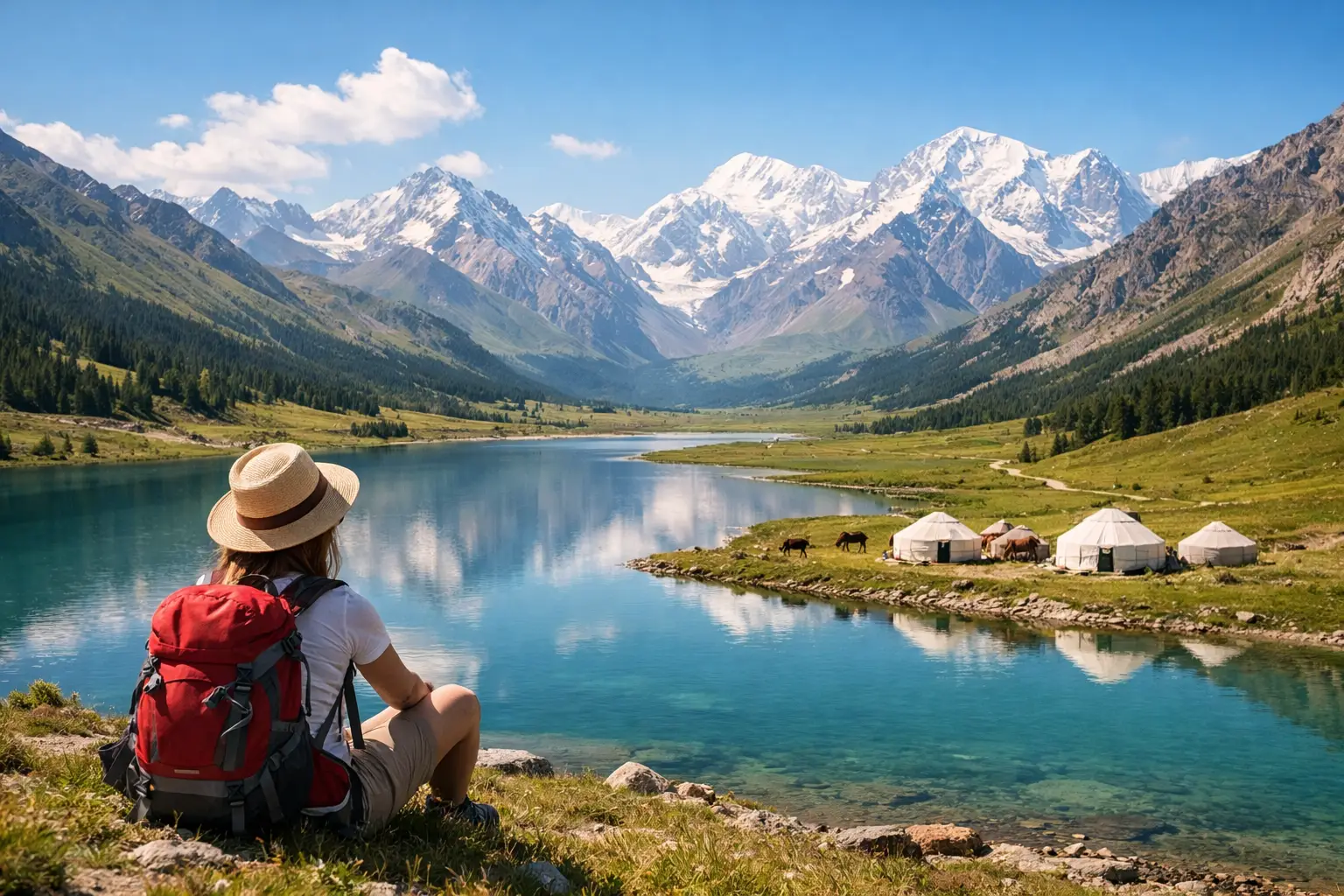
If you’re asking is Kyrgyzstan worth visiting, the short answer is yes – but not for the reasons that make more familiar destinations easy to sell. Kyrgyzstan is not polished in the way Switzerland is polished, nor does it package its landscapes for effortless consumption. What it offers instead is space, altitude, warmth, and a sense that travel can still feel genuinely open-ended.
For the right traveller, that is precisely the appeal. This is a country of high pastures, sharp ridgelines, horse trails, roadside tea, Soviet-era edges, and lake scenery that can stop you mid-sentence. It rewards curiosity more than checklist tourism, which is why it stays with people.
Is Kyrgyzstan worth visiting for scenery alone?
Very possibly. Even among travellers who have spent time in mountain regions elsewhere, Kyrgyzstan has a way of feeling unusually expansive. The landscapes are not just beautiful – they feel untamed and lived in. You might drive for hours past grazing horses, broad valleys and snow-dusted peaks, then arrive at a yurt camp where the evening is quiet enough to hear the wind move across the grass.
Issyk-Kul is often the image people encounter first, and with good reason. It is vast, blue and framed by mountain ranges, giving it a presence that feels closer to an inland sea than a lake. Around it, the scenery shifts quickly. One stretch feels beach-like in summer light, another opens into red-rock canyons, and another leads towards alpine meadows and trekking routes.
Then there are places such as Song-Kul, where the attraction is as much atmosphere as geography. At that altitude, with open grassland and a ring of mountains around the lake, the experience is stripped back in the best way. It is not about big-ticket sights every hour. It is about being in the landscape rather than passing through it.
What makes Kyrgyzstan different from other mountain destinations?
Part of the answer is access to nomadic culture that still feels present rather than staged. Yurts are not decorative add-ons here. Horse culture is real, and so is the rhythm of summer jailoos, the high pasture migrations that shape life in the mountains. For visitors, that can make even a simple overnight stay feel more connected to local life than many carefully designed “authentic” experiences elsewhere.
The other difference is that Kyrgyzstan still feels underexposed. That does not mean unknown, especially among trekkers and overland travellers, but it has not been smoothed into a highly standardised tourism product. There is room for improvisation. Journeys can feel slightly unpredictable. Plans may shift with the weather, road conditions or local advice. For many travellers, that is a drawback. For others, it is exactly what makes the country memorable.
There is also a distinct blend of influences – Central Asian traditions, Russian language presence, Soviet architecture, Muslim heritage, and strong regional identities. Bishkek itself can surprise first-time visitors. It is leafy, broad and pragmatic rather than theatrical, a city where monumental squares and everyday cafés sit alongside a mountain backdrop that never feels far away.
The best reasons to go
For some, Kyrgyzstan is about trekking. The country has routes for different levels, from day walks to serious multi-day hikes in the Tian Shan. The appeal is not only the scale of the mountains but the relative sense of freedom. Trails often feel less crowded than in Europe’s best-known walking regions, and the scenery has a rawness that is hard to fake.
For others, the draw is slow travel. Sleeping in yurts, drinking fermented mare’s milk if you are feeling brave, eating laghman or plov, and spending long stretches on the road can be the point. Kyrgyzstan suits people who are comfortable letting a destination unfold gradually.
It is also a strong choice for travellers who want somewhere that still feels like a discovery without requiring expedition-level commitment. You can have a genuinely distinctive trip here without being a mountaineer. A well-planned route might combine Bishkek, Issyk-Kul, Karakol and a high-lake stay, giving you culture, scenery and outdoor time in one journey.
Is Kyrgyzstan worth visiting if you don’t love rough travel?
This is where the honest answer becomes more conditional. Kyrgyzstan can be comfortable, but it is not uniformly comfortable. Roads vary. Long drives are common. Rural accommodation may be charming and hospitable, yet simple. English is spoken in parts of the tourism sector, but not everywhere. Infrastructure works well enough for many trips, though not always with the frictionless ease some travellers expect.
If your ideal holiday means boutique hotels, tightly run transport connections and a wide range of polished dining options, Kyrgyzstan may feel harder work. If, however, you can tolerate a little unpredictability in exchange for striking landscapes and more personal encounters, the balance shifts quickly in its favour.
This is why expectations matter. Kyrgyzstan is often best approached not as a luxury mountain break, but as an immersive travel experience with moments of real comfort inside a more lightly developed framework. The people are often a huge part of that comfort. Hospitality is a recurring theme in how visitors describe the country.
When Kyrgyzstan is most worth visiting
Summer is the obvious season, particularly from June to September, when mountain access improves and yurt camps are operating. This is when the country opens up most fully. Green pastures, passable roads to high-altitude lakes, and longer daylight hours make a big difference.
Autumn can also be excellent if you prefer fewer people and softer colours, though some high areas become less practical as temperatures drop. Winter brings a different version of Kyrgyzstan, with snow, skiing and a more local rhythm, but it is not the best introduction if your main goal is broad exploration.
The sweet spot depends on what kind of trip you want. For first-time visitors hoping to combine scenic driving, lake landscapes and a few nights in the mountains, late summer is hard to beat.
What catches travellers out
Distance is one factor. Kyrgyzstan is not enormous, but mountain roads make travel slower than maps suggest. A route that looks manageable on paper can become a sequence of long driving days. It is worth resisting the urge to cram too much in.
Altitude can be another surprise. Places such as Song-Kul are high enough for some travellers to feel the effects, especially if they ascend quickly. Nothing dramatic is inevitable, but it is worth building in a little time to adjust.
Then there is the issue of style. Kyrgyzstan is not a destination where every moment feels designed for Instagram neatness. Its appeal is more grounded than that. Some towns are practical rather than pretty. Some transport days are bumpy. Some meals are hearty rather than refined. Yet that lack of polish is often part of the charm. It keeps the destination from feeling over-curated.
So, is Kyrgyzstan worth visiting?
Yes – especially if you care about landscapes, cultural texture and the feeling of reaching somewhere that has not been flattened by mass tourism. Kyrgyzstan offers mountain drama on a grand scale, but also quieter rewards: conversations over tea, roadside views that turn into the highlight of the day, and nights in the high pastures that recalibrate your sense of distance and silence.
It is not for everyone, and that is part of why it works so well for the people who do choose it. The country asks a little more of you than an easy European break might. In return, it gives you a trip with shape, character and story.
For a travel brand like Destination Unlocked, that makes Kyrgyzstan exactly the kind of place worth paying attention to. It is a destination that opens gradually, through local insight as much as landmarks.
If you are looking for a holiday that feels different in substance, not just in postcode, Kyrgyzstan has a strong case. Go for the mountains, certainly. But expect the real answer to arrive somewhere between the road, the lake and the welcome.

[yarpp]