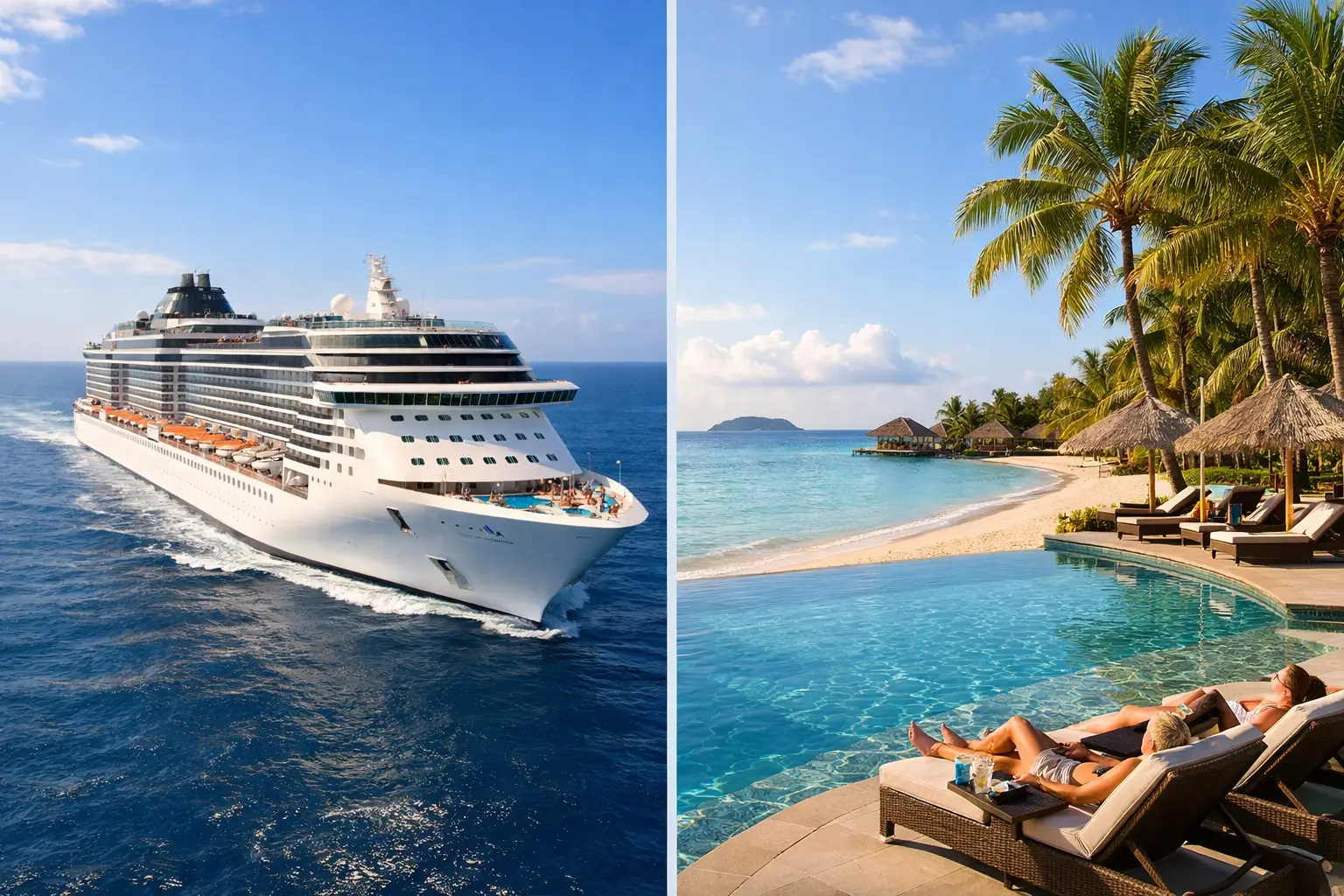
The real choice in a cruise versus resort holiday is not whether you prefer a pool or a porthole. It is about the rhythm you want from your time away. A cruise gives you a changing view and a new place to wake up in; a resort gives you the luxury of staying put long enough to know the beach, the bar staff and perhaps the best table for sunset.
Both can be excellent value, both can make planning pleasantly straightforward, and both come in wildly different styles. The right answer depends on whether your ideal holiday is shaped by movement or immersion.
Cruise versus resort: the central difference
A cruise is a multi-destination holiday with your accommodation, most meals and much of your entertainment travelling with you. You might have breakfast in Sicily, spend an afternoon in Valletta and be on deck as the ship leaves harbour. The appeal is obvious for travellers who want a taster of several places without repeatedly packing, checking out and arranging transfers.
A resort holiday is rooted in one destination. Your days have more room to unfold: a slow breakfast, a morning by the sea, an unhurried lunch, then an evening in a neighbourhood restaurant beyond the gates. A good resort can be wonderfully restorative, particularly when it sits within easy reach of a town, nature reserve or cultural sights.
Neither is automatically more relaxing. A cruise can be remarkably easy once you are onboard, but port days often begin early and reward a little organisation. At a resort, you control the pace completely, although choosing restaurants, activities and day trips takes more effort than simply following a ship’s daily programme.
Choose a cruise if you want variety without logistics
Cruising is at its best when the itinerary itself is the point. The Mediterranean, Norwegian fjords, Greek islands and Caribbean are particularly suited to this kind of travelling, where the distance between places is part of the pleasure rather than a day lost in transit.
For first-time visitors to a region, a cruise can be an intelligent introduction. You can test whether Barcelona deserves a longer city break, see which Greek island has the atmosphere you like, or decide whether the Adriatic is somewhere you want to return to independently. There is a quiet confidence in going somewhere for eight hours, knowing you are not claiming to have ‘done’ it.
It is also a compelling option for mixed groups. One person can spend a sea day at the spa, another can join a cooking class, while a third can find a sunlounger and read. Families often appreciate the range of included facilities, especially on larger ships, while couples may prefer smaller vessels with a more intimate, destination-led feel.
The trade-off is time ashore. A port call can offer a vivid first impression, but it rarely gives you the relaxed drift of staying overnight. Popular ports may also be busy when several ships are in town. If a destination has been on your list for years, it is worth looking closely at arrival and departure times before booking, rather than being seduced by a long itinerary of place names.
What to check before booking a cruise
The headline fare is only the starting point. Compare what is included in drinks, speciality dining, Wi-Fi, service charges and shore excursions. A cheap fare can become less compelling once the extras are added, while a more inclusive line may make budgeting far simpler.
Cabin choice matters more than many first-time cruisers expect. An inside cabin is excellent value if you see it purely as a place to sleep, but a balcony can change the character of a scenic sailing in the fjords, Alaska or the Greek islands. Consider the ship as carefully as the route: a large ship brings choice and energy; a smaller one can reach more characterful harbours and usually feels less like a floating resort complex.
Choose a resort if you want to belong somewhere
Resorts work best when a single place has enough to hold your attention. Think of a beach hotel near a proper Cypriot village, a Mallorcan finca within reach of mountain walks, or a Mauritius resort where the reef, local food and inland markets deserve more than a passing glance.
There is particular pleasure in returning to the same place after a day out. You learn which beach is quietest in the morning, which local wine to order, and where to go when you want something beyond the hotel buffet. This is the kind of holiday that leaves room for serendipity, including the entirely valid decision to do very little.
A resort is often the stronger choice for a milestone break, a honeymoon or a week when genuine rest is the brief. It also suits travellers who dislike fixed dining times, excursions built around a ship’s schedule, or the sensation that each day is a small deadline.
That said, not every resort delivers local character. Some are deliberately self-contained, which can be ideal if you want effortless sun and quiet, but less satisfying if you have flown somewhere specifically to experience its food, history and everyday life. Location is everything. A beautiful hotel an hour from anywhere may be a sanctuary, or it may make every outing feel like a project.
What to check before booking a resort
Look beyond the number of pools. Check the beach situation, particularly whether it is swimmable, private, public or reached by shuttle. Find out how far the property is from a town or restaurant district, and whether a hire car is useful. In some destinations, a resort with half-board is sensible; in others, it can discourage you from eating brilliantly just outside the front door.
Also consider the type of all-inclusive on offer. Drinks, premium restaurants, watersports and airport transfers vary considerably. If you know you will spend most days on site, an all-inclusive rate can be good value. If you intend to explore, a room-only or breakfast-inclusive stay often gives you more freedom and a better reason to venture out.
Which offers better value?
The honest answer is that value depends on how you holiday. Cruises bundle accommodation, transport between destinations, meals and entertainment, so they can look very attractive against a multi-city trip booked independently. They are especially persuasive when hotels in several ports are expensive or when travelling during school holidays.
Resorts can be better value when flights are competitive, you are happy in one destination and you do not need a full schedule of paid activities. A well-chosen hotel can provide a high-quality base without requiring you to buy extras each day. For a couple, it may also be easier to keep costs in check when you can choose local tavernas and public transport rather than rely on organised excursions.
When comparing prices, include the bits that are easy to overlook: flights to the departure port, parking or a pre-cruise hotel, gratuities, transfers, drinks and tours for a cruise; then meals, taxis, car hire, sunbeds and activities for a resort. The fairest comparison is the final holiday budget, not the first number on the booking page.
The destination should make the decision
Some places practically invite a cruise itinerary. Norway’s coast, the Galápagos, the Croatian islands and the Caribbean reward travelling by water, and a ship can make a complex route feel refreshingly simple. Others are better savoured from a fixed base. The Algarve, Crete, Madeira, Bali and much of Italy offer enough texture for repeat beach days, local lunches and worthwhile excursions without moving hotels.
A useful test is to ask what you would regret more. Would it be missing three neighbouring islands, or leaving one lovely town just as it begins to feel familiar? Choose the cruise if the first answer stings. Choose the resort if it is the second.
Before you book either, spend 40 minutes with the Destination Unlocked podcast. It is as useful as a guidebook and as personal as a chat with your most well-travelled friend, with the practical local insight that can turn a pleasant port stop or hotel stay into a much better trip.
For travellers torn between the two, there is a third, often excellent option: combine them. Add two or three nights in the embarkation city before a cruise, or follow a shorter sailing with a few days at a beach hotel. You get the momentum of the voyage and enough stillness to remember where you have been.