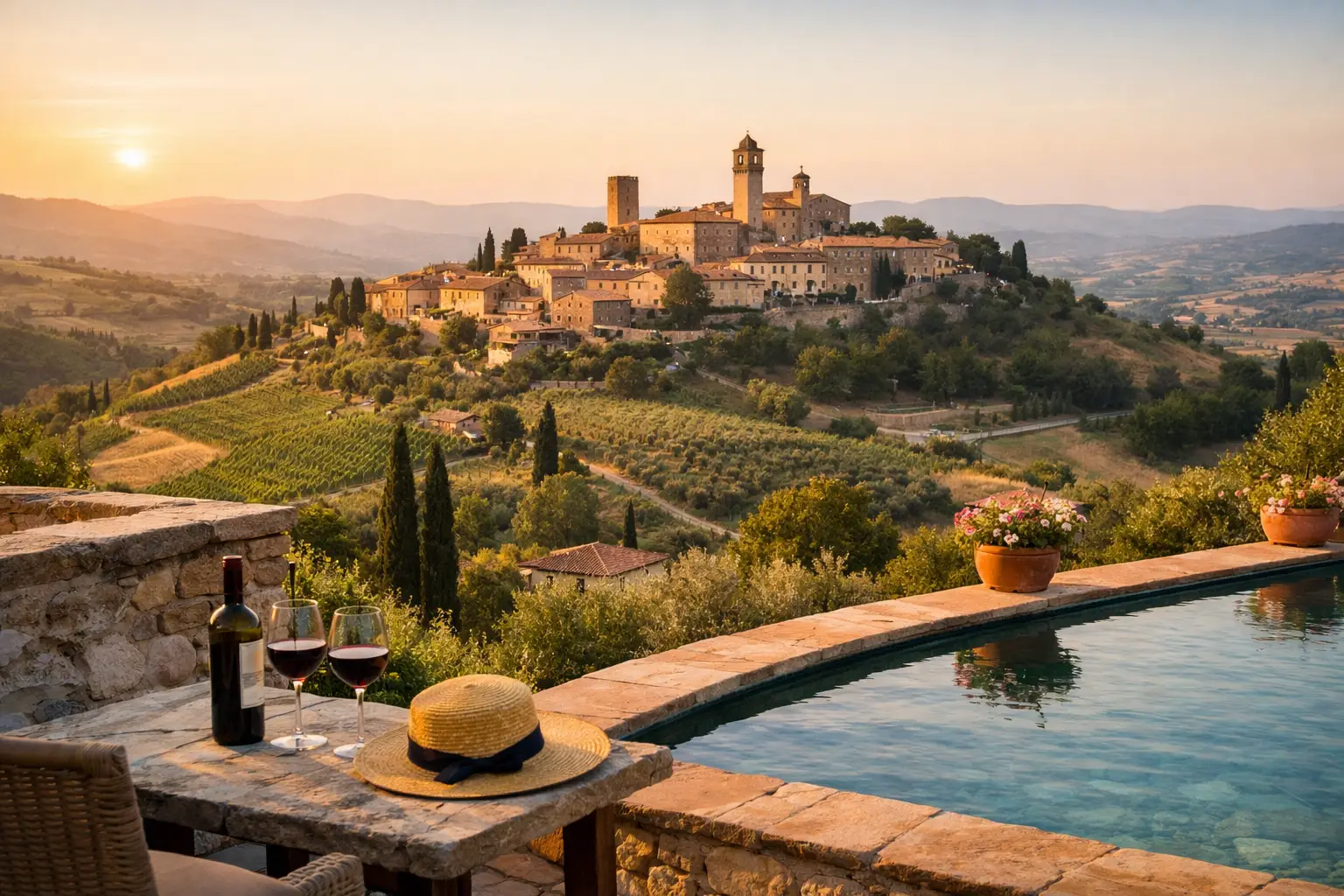
Tuscany looks wonderfully compact on a map. Then you arrive, collect the hire car and realise that a 45-minute drive can involve a string of bends, a hilltop town, a tractor and an entirely reasonable stop for coffee. Knowing how to choose a Tuscany base is less about finding the region’s single ‘best’ town and more about matching your hotel to the holiday you actually want.
A city break with galleries and late dinners needs a different base from a week of vineyard visits, village markets and unhurried lunches. The pleasing part is that there is no wrong answer. Florence, Siena, Lucca, the Chianti hills and Val d’Orcia all offer a distinct version of Tuscany – but choosing carefully can save a surprising amount of time behind the wheel.
How to choose a Tuscany base: decide what you want to do most
Before comparing hotels, choose the rhythm of your trip. Tuscany rewards a little focus. Trying to cover Florence, Pisa, Siena, San Gimignano, the Chianti Classico vineyards, the coast and Val d’Orcia from one address can turn a beautiful holiday into a small logistical project.
For a first visit without a car, Florence is the obvious and often excellent answer. You can walk between major museums, churches, markets and restaurants, use frequent trains for day trips to Pisa, Lucca, Arezzo and Bologna, and return to a hotel without thinking about parking. It is also the right choice if Renaissance art is the main event. The trade-off is that Florence feels like a city, not a pastoral escape, particularly around the historic centre in high season.
If your vision of Tuscany involves cypress-lined roads, wineries and stone farmhouses, look further south. A countryside stay gives you the classic landscape, bigger rooms and slower mornings, but it generally requires a car. Build in time for the journeys. On a map, a visit from Val d’Orcia to Florence may appear manageable; in practice, it can consume most of a day once you include parking, traffic and the temptation to stop in every handsome village.
The most useful question is simple: would you rather step outside for an aperitivo, or wake to vineyard views? Your answer will narrow the map quickly.
Florence for culture, rail travel and short breaks
Florence works best for travellers who want their hotel to be part of the action. Stay in or near the centro storico if you want to walk to the Uffizi, the Duomo and the Ponte Vecchio, with an easy choice of wine bars after dark. Neighbourhoods just beyond the busiest streets, such as Santa Croce, San Frediano and Oltrarno, can offer more character and a gentler evening pace while keeping central sights within reach.
A Florence base is particularly practical for a long weekend or a first Tuscany trip where museums, food and architecture outrank rural wandering. It is also a good option for couples who would rather spend on a beautifully located hotel than a hire car and parking fees.
Do not book centrally and then plan to drive every day. Historic-centre traffic restrictions, known as ZTLs, are serious business and fines can arrive long after the holiday glow has faded. If you need a car for part of the trip, consider collecting it only when you leave Florence, or choose accommodation with clearly arranged parking outside the restricted zone.
Siena for medieval atmosphere and central Tuscany
Siena is arguably the smartest all-round choice for a first road-trip holiday. Smaller and calmer than Florence, it has enough restaurants, evening life and architectural drama to make staying put enjoyable, while its position puts Chianti, San Gimignano, Montepulciano and much of southern Tuscany within reasonable reach.
Choose Siena if you want a proper town rather than an isolated resort, but do not need a major city on the doorstep. The historic centre is gloriously atmospheric, especially after day visitors have gone home, although steep lanes and luggage do not always make the most harmonious pairing. A hotel just outside the walls with parking can be a sensible compromise, particularly if you are travelling by car.
Siena also suits travellers visiting around the Palio, its famous summer horse race. Book well ahead for those dates and expect a more intense, celebratory city. For some, that is the point. For others, a quieter nearby agriturismo will be preferable.
Chianti for wine country without going too remote
The Chianti Classico area, between Florence and Siena, is an excellent base for people whose ideal itinerary includes tastings, long lunches and scenic drives with no need to rush. Towns such as Greve, Panzano, Castellina and Radda offer different versions of the wine-country stay: some are more practical, some quieter, some more polished.
A countryside hotel or agriturismo can be very good value here, especially if a pool matters. It is worth being precise about location before booking. ‘Chianti’ can cover a broad area, and a property described as near a village may still be a 15-minute drive down a narrow road. That can be delightful in daylight and less appealing after dinner if you are relying on one person to stay sober.
For a wine-focused holiday, book winery visits in advance rather than assuming you can simply turn up. The better estates often run timed tours, and a guided tasting can spare everyone the driving calculation. Chianti is a strong choice for three to five nights, but it is less convenient if Florence’s museums or the coast are priorities every day.
Val d’Orcia for the Tuscany you have pictured
South of Siena, Val d’Orcia is the landscape of travel photographs: rolling wheat fields, cypresses, thermal towns and villages arranged with almost suspicious good looks. Base yourself near Pienza, Montalcino, Montepulciano or San Quirico d’Orcia for Brunello, Vino Nobile, pecorino cheese, spa time and some of the region’s most memorable drives.
This is the place for a villa, farmhouse hotel or agriturismo where the accommodation itself is part of the holiday. It rewards travellers who are happy to linger rather than tick off landmarks. Montalcino is a compelling choice for serious wine drinkers, Pienza for village charm and a central position, while Montepulciano has more life and a larger choice of restaurants.
The compromise is distance. Val d’Orcia is not the ideal base for regular day trips to Florence, Lucca or Pisa. It makes far more sense to pair it with a few city nights elsewhere, or to accept that this part of the trip is about southern Tuscany. That is hardly a hardship.
Lucca for a quieter city and northern day trips
Lucca is frequently the answer for travellers who like Florence’s cultural appeal but not its crowds. Its Renaissance walls, elegant streets and excellent food scene make it an easy city to enjoy at walking pace. Hire bicycles to circle the walls, linger in the piazzas and use the station for straightforward trips to Pisa and Florence.
It is a particularly good base for families, slower-paced travellers and anyone combining Tuscany with the Ligurian coast. The countryside around Lucca also has handsome villas and rural hotels, so you can choose between a town stay and a more secluded escape without moving far.
What Lucca does not provide is central access to the southern wine regions. If Val d’Orcia and Montepulciano are non-negotiable, save them for another leg of the holiday rather than treating them as a casual day trip.
Pick the hotel type as carefully as the town
Once you have settled on an area, the hotel style shapes the experience. A central boutique hotel is best when you want to walk to dinner and make spontaneous plans. An agriturismo offers space, rural views and often an excellent breakfast or on-site restaurant, but may leave you dependent on the car. A villa rental is ideal for families or friends, especially for a week, though check whether the final approach is suitable for all vehicles and whether air conditioning is available in summer.
Read the location details with a practical eye. Look for parking arrangements, pool opening dates, restaurant hours and whether the property is actually walkable to a town. In July and August, air conditioning can matter more than a romantic-looking four-poster bed. In spring and autumn, a heated pool, fireplace or on-site dining may make a countryside stay more comfortable.
If you are still comparing places, listen to the Destination Unlocked podcast before you book. It is as useful as a guidebook and as personal as a chat with your most well-travelled friend, with each 40-minute episode designed to give you the information you need for a great trip.
A well-chosen Tuscany base should make the days you most want easy, not make every corner of the region theoretically possible. Book the town, farmhouse or city hotel that suits your preferred pace, then leave a little room in the itinerary for the unplanned lunch, the empty road and the village that was never on the list.