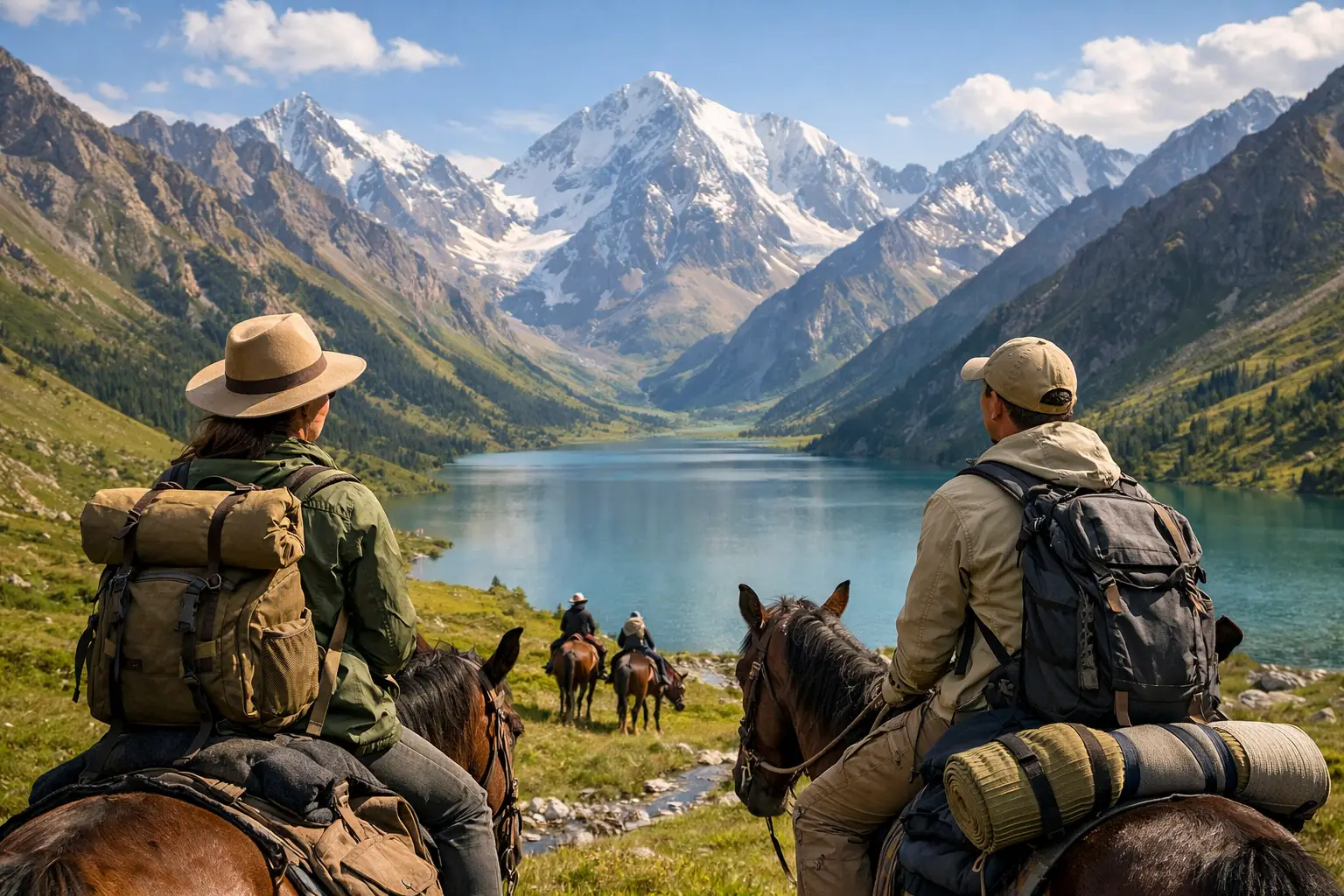
A horseman appears on a ridge above Song-Kul, the blue lake catching the afternoon light behind him, and the scale of Kyrgyzstan suddenly makes sense. This is a country where horses are not a novelty wheeled out for visitors. They remain part of daily rural life, sport and long-distance travel. A Kyrgyzstan horse trekking guide is therefore less about finding a picturesque ride and more about choosing the right way to enter a living mountain culture.
For travellers ready to book, the appeal is clear: a few days in the saddle can take you beyond roads, into high summer pastures, yurt camps and valleys that would otherwise require serious hiking effort. It is exhilarating, but it is not a soft-focus trail ride. Altitude, weather and the quality of the local operator all matter.
Why horse trekking works so well in Kyrgyzstan
Kyrgyzstan’s summer jailoos – high grazing pastures – are made for travelling at a horse’s pace. You cover real ground without the rush of a vehicle, while still having time to notice shepherds moving livestock, eagles circling above a pass and the changing colours of the mountains. On a well-run trek, the practicalities are refreshingly simple: ride, stop for tea, arrive at camp, eat communally and watch the light leave the valley.
It is also one of the most rewarding ways to experience the country beyond Bishkek. A private driver can reach handsome viewpoints, but a horse trek gives you a reason to stay. You sleep in a yurt or a modest guesthouse, meet families who spend the warmer months in the mountains, and get a more convincing sense of how remote these landscapes really are.
That said, this is not necessarily the best activity for everyone. Nervous first-time riders may prefer a half-day outing near a village before committing to several nights. Experienced riders, meanwhile, should not assume that local horses or saddles will feel familiar. Kyrgyz horses are famously sure-footed and resilient, but they are often ridden with a different style and rhythm from the horses found at a British trekking centre.
The best horse trekking routes in Kyrgyzstan
The right route depends on whether you want a gentle introduction, serious scenery or a proper expedition. Most travellers can find a strong option between two and five days; longer treks are possible but require more comfort with camping, changing weather and sustained time in the saddle.
Song-Kul: the classic first trek
Song-Kul is the most recognisable choice, and for good reason. This high-altitude lake sits in a broad, open basin where summer yurts dot the grassland and herds of horses, sheep and cattle move freely. Routes typically approach from Kochkor or Kyzart, with rides across rolling pastures rather than relentlessly steep mountain terrain.
It suits travellers looking for the iconic Kyrgyz yurt experience and a manageable introduction to riding at altitude. The trade-off is popularity. In peak summer, Song-Kul has more visitors and more established camps than wilder corners of the country. Choose a smaller, locally run camp if you want a quieter evening and ask whether your stay includes private or shared accommodation.
Kol-Ukok: close to Kochkor, big on atmosphere
The Kol-Ukok valley and lake make an excellent alternative for people short on time. Reached from the Kochkor area, it combines a rewarding mountain setting with a comparatively straightforward logistical plan. Two or three days is enough to ride into the valley, stay in a yurt camp and return without trying to cover too much ground.
It is a sensible choice for travellers who want to pair a trek with time in Bishkek, the Issyk-Kul region or a wider Central Asia itinerary. The ascent can still feel demanding if you are unaccustomed to altitude, but it offers a fine balance between effort and reward.
Jyrgalan and Altyn Arashan: for mountain drama
In eastern Kyrgyzstan, near Karakol and the shores of Issyk-Kul, the landscapes become sharper and more alpine. Jyrgalan has developed a reputation for community-based outdoor tourism, while routes around Altyn Arashan promise conifer forests, fast rivers and snowy peaks. These are strong options for confident riders who want scenery that feels less pastoral and more cinematic.
Conditions can be more variable here, particularly early and late in the season. A route involving high passes may be altered at short notice by snow, rain or unstable ground. That is not poor planning; it is mountain travel. Build flexibility into your itinerary, especially if you have a fixed onward flight.
When to go: season and weather matter
The main horse trekking season runs from roughly June to September. July and August bring the warmest weather and the fullest yurt camps, although nights at Song-Kul and other high-altitude areas can still be decidedly cold. June can be beautifully green but wetter, while September often offers clearer days, golden grass and fewer people.
The best month depends on the route. High passes may not be reliably open until late June or July, whereas lower valleys can be pleasant earlier. A good local guide will recommend an itinerary based on the actual season, not simply sell the same trek all summer.
Do not be misled by a sunny forecast in Bishkek. Mountain temperatures can fall sharply after sunset, and a warm afternoon in the saddle can turn into sleet within an hour. Layers are more useful than one heavy coat, and waterproofs are not optional.
How to choose a responsible horse trekking operator
This is where the booking decision has the greatest impact. Look for an operator that clearly explains group size, riding hours, accommodation, meals, transfers and what happens if the weather changes the route. Vague descriptions of an “authentic adventure” are not enough when you are committing several days and travelling far from the nearest town.
Ask direct questions before paying a deposit. How are the horses rested and fed? Is luggage carried separately, or will you ride with a heavy pack? Are helmets available, and are they compulsory? What riding experience does the guide expect? Is there a support vehicle on accessible sections, or an emergency plan where there is not?
Small groups are usually better for both safety and enjoyment. They allow the guide to match horses to riders and adjust the pace when someone is tiring. They also place less pressure on camps and trails. Do not choose solely on the lowest price: a cheaper trek may mean basic food, inadequate equipment or horses working longer days than they should.
A respectful trek should treat horses as working animals with limits, not as props for holiday photographs. Watch for signs of good care: horses that appear alert and well-fed, sensible daily distances, regular breaks, and guides who intervene calmly rather than aggressively. If something feels wrong at the start, speak up or reconsider continuing.
What to pack for a Kyrgyzstan horse trek
Your operator may provide sleeping bags or rain ponchos, but confirm this rather than assuming. Bring a properly fitting riding helmet if you own one; hired helmets are not always available in remote areas. Riding trousers or sturdy leggings without abrasive inner seams make long days more comfortable than jeans, and boots with a small heel are preferable to trainers.
You will also want warm layers, a waterproof jacket and trousers, gloves, sunglasses, sun cream and a refillable water bottle. A small daypack is useful for a camera, snacks and a warm layer, while larger luggage can often stay at your hotel in Kochkor or Karakol. Pack a basic personal first-aid kit, including blister plasters and any medication you need. Mobile signal is patchy or absent on many routes.
Comfort at camp is relative. Some yurt stays offer beds, electricity and excellent home cooking; others are simpler, with outside toilets and limited washing facilities. Neither is inherently better, but expectations matter. If you value a private room, hot shower or vegetarian meals, raise it when booking rather than hoping it will be available at 3,000 metres.
A realistic itinerary around your trek
Avoid arriving in Bishkek and heading straight to a high-altitude saddle the next morning. Spend at least one night in the city, then consider another at a lower elevation near Kochkor, Karakol or Issyk-Kul before your trek. It makes the journey more enjoyable and gives your body time to adjust.
For a first visit, a week in Kyrgyzstan can work well: Bishkek at either end, a two- or three-night horse trek, and time around Issyk-Kul or Karakol. With 10 days or more, you can slow down, add a canyon or hot-spring stop, and leave room for weather changes. Pre-book accommodation around key arrival and departure points, but avoid overpacking every mountain day into a rigid schedule.
For the sort of destination knowledge that makes planning feel less like research and more like advice from a well-travelled friend, the Destination Unlocked podcast is as useful as a guidebook and as personal as a chat with your most well-travelled friend. Each 40-minute episode is designed to give you the information you need for a great trip.
Kyrgyzstan horse trekking guide: quick questions
Do you need riding experience?
Not always. Many routes accept beginners, provided you are honest about your ability and prepared for several hours in the saddle. A first-time rider should choose a shorter, lower-intensity route and expect some soreness. Confident riders can ask for longer days, faster paces or more technical terrain, but should still follow the guide’s judgement.
How much does a trek cost?
Prices vary widely with route, group size, transfers and accommodation. A multi-day guided trek generally costs more than a simple day ride because it includes horses, guides, meals, yurt stays and logistical support. Compare what is included rather than comparing headline prices alone, and keep cash for tips and small purchases in rural areas.
Is it safe?
With a reputable guide, sensible route choice and appropriate insurance, horse trekking is a reasonable adventure activity for fit travellers. The greater risks tend to be falls, cold weather and altitude rather than dramatic wilderness hazards. Tell your guide about injuries, medical conditions or concerns before setting off, and do not be embarrassed to ask for a slower pace.
Kyrgyzstan rewards travellers who leave a little space in the plan. Choose a route that suits your confidence, book people who care for their horses, and let a few days in the mountains be the part of the holiday that refuses to be hurried.