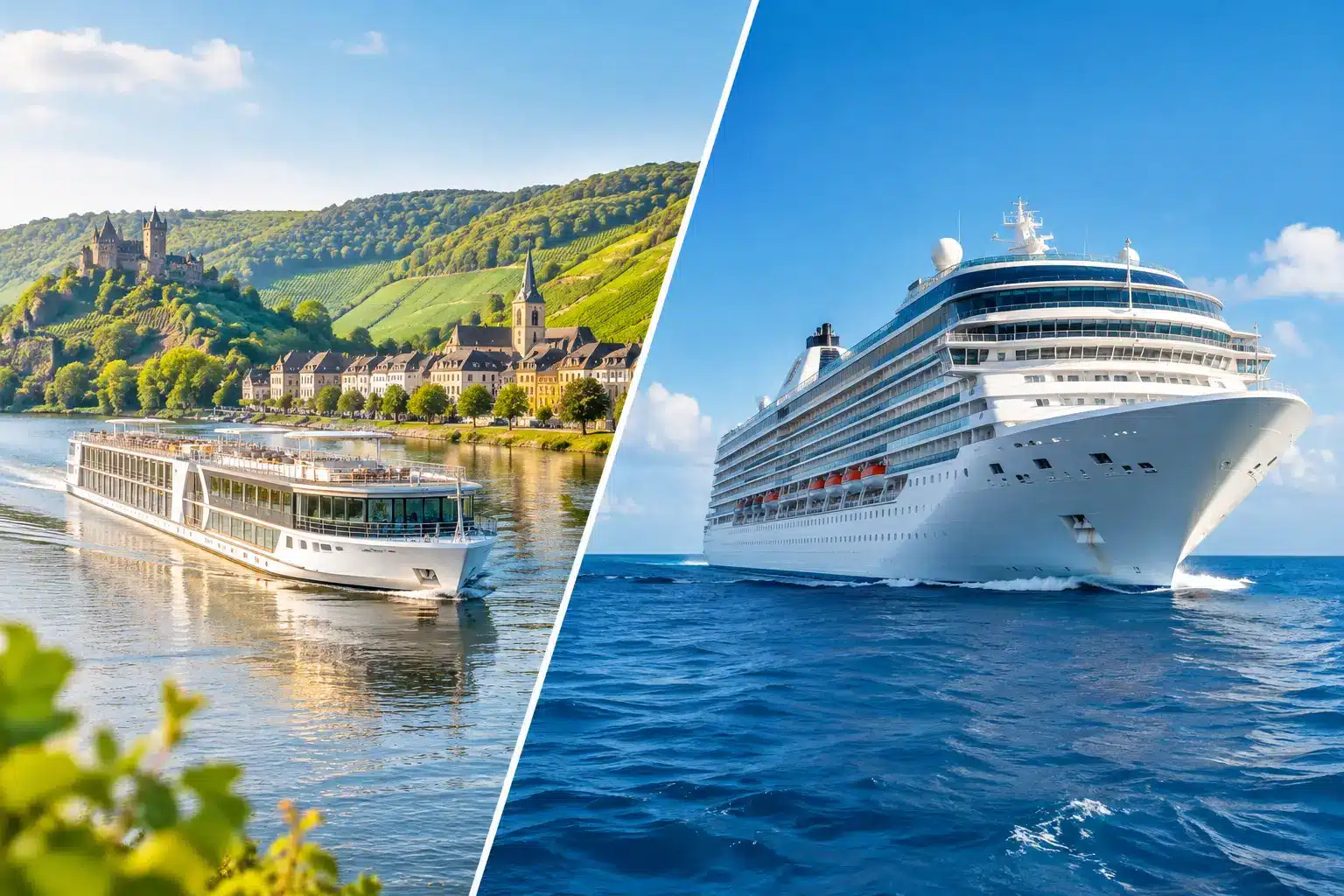
A ship may be your hotel for the week, but the holiday can feel entirely different depending on where it sails. The decision between a river cruise versus ocean cruise is less about choosing the prettier vessel and more about deciding how you want to experience a destination: from the centre of a city, or from a floating resort with the world beyond its decks.
For travellers who want to make the most of their annual leave, both have a strong case. River cruising puts culture, walkable towns and changing landscapes at the heart of the itinerary. Ocean cruising offers greater scale, more entertainment and access to islands, coastlines and far-flung regions that would take serious effort to stitch together independently.
River Cruise Versus Ocean Cruise: The Core Difference
A river cruise is usually destination-led. Ships are small enough to travel through city centres and along waterways that have shaped Europe, Egypt, India and parts of Asia for centuries. You might wake beside Budapest’s Parliament, step ashore in the old quarter of Strasbourg, or watch vineyards pass your cabin window on the Douro. There is little need for a tender boat, a long transfer or a day spent navigating a vast port complex.
An ocean cruise is often as much about the ship as the route. Modern vessels can carry thousands of guests and offer theatres, pools, spas, multiple restaurants, children’s clubs and a formidable amount of choice. That makes them particularly appealing for multigenerational holidays, first-time cruisers who want familiar comforts, and travellers who like sea days as much as sightseeing days.
Neither style is inherently better. A couple planning a food-and-wine break through Portugal may find a Douro river sailing wonderfully focused. A family looking at the Caribbean, with several beach days and activities for different ages, will likely get more from an ocean ship.
Where You Actually Spend Your Time
The biggest practical advantage of a river cruise is proximity. River ports tend to be part of the destination, not an industrial edge-of-town arrival point. On a Danube itinerary, you can often leave the ship after breakfast and be in a market, museum or café within minutes. Because the distances between stops can be modest, many sailings include evenings in port too. That means dinner ashore, a concert, or a relaxed drink in a city that does not need to be rushed.
Ocean cruise ports are more variable. Some are wonderfully convenient – Venice’s wider lagoon area, Valletta and smaller Greek islands can feel immediately rewarding – while others involve a coach journey before the day properly begins. Shore excursions are therefore especially valuable on an ocean cruise when the highlight lies beyond the harbour: Pompeii from Naples, the Norwegian fjords from a coastal port, or rainforest and waterfalls in the Caribbean.
Sea days are part of the bargain. On a Mediterranean route, there may be one or two; on a transatlantic crossing, there are many more. For some, they are a chance to slow down with a book, a long lunch and a good view. For others, they can feel like time that could have been spent in a place. Be honest about which camp you are in.
The rhythm on board
River ships rarely have the facilities of an ocean liner, but that is intentional. Days are more likely to begin with a guided walk, continue with an optional bike ride or tasting, then end over dinner as the scenery slips by. Cabins are generally quieter in mood than flashy in design, and the social atmosphere is intimate because guest numbers are often below 200.
Ocean ships offer more independence. You can take an organised tour, explore alone, stay aboard at a port you have visited before, or spend an afternoon by the pool while everyone else rushes towards a cathedral. There are more restaurants and bars, more cabin grades and more ways to shape your day. The trade-off is that boarding, disembarking and getting around the ship can take longer, particularly on the largest vessels.
Which Cruise Suits Your Travel Style?
Choose a river cruise if the pleasure of travel lies in wandering historic streets before the crowds arrive, learning why a local dish matters, and unpacking once while moving through a region. It works beautifully for travellers who would otherwise plan a rail-and-hotel journey through several European cities but would prefer the logistics handled for them.
It is also a fine choice for a first visit to destinations such as the Rhine, Danube, Seine or Rhône. These routes offer a coherent story rather than a tick-list: castles and wine villages on the Rhine, imperial cities on the Danube, or Normandy’s landscapes and history from the Seine. The ship becomes a comfortable base, not the main event.
Choose an ocean cruise if range matters. The Mediterranean can take in Spain, France and Italy on one sailing; Alaska can combine glaciers, wildlife and coastal towns; the Caribbean can offer a different island almost every morning. You will generally find more departure dates, cabin choices and price points too.
Ocean cruises are often better for travellers with mixed priorities. One person may want a guided archaeological tour, another a beach club, and another a slow afternoon at the spa. A larger ship gives each of them room to have a good holiday without turning every choice into a committee meeting.
Consider mobility, crowds and pace
River cruising is not automatically the gentler option. The ships are compact, lifts may not reach every deck, and old towns often bring cobbles, slopes and steps. Included walking tours can be brisk. If mobility is a concern, ask specifically about accessible cabins, lift access, excursion pace and whether coaches can get close to the major sights.
Ocean ships have more lifts, more accessible cabins and greater onboard space, though ports can involve considerable walking and occasionally tender boats. Crowds are more noticeable at buffet breakfast, theatre entrances and popular shore excursions. Booking speciality dining and key activities early can make a large-ship holiday feel much less hectic.
Costs: Look Beyond the Headline Fare
River cruise fares can initially appear higher, especially in Europe. They frequently include meals, selected drinks, Wi-Fi, gratuities and guided excursions, although inclusions vary markedly by line and itinerary. Once those elements are added to an independent city break, the value can look more persuasive.
Ocean cruising has a lower entry price in many markets, particularly for a short Mediterranean sailing outside school holidays. However, drinks packages, speciality restaurants, gratuities, internet, excursions and service charges can add up. The most useful comparison is the final holiday cost: flights or rail connections, a pre-cruise hotel, transfers, onboard spending and the activities you genuinely want to do.
A night or two in the departure city is usually money well spent. For a river cruise from Amsterdam, Budapest or Porto, it gives you time to settle in and see a little beyond the embarkation day. For an ocean cruise, arriving early protects you from flight delays and turns the port city into part of the holiday. Barcelona, Athens, Rome and Miami all reward a proper stay rather than a hurried taxi ride to the terminal.
The Best Questions to Ask Before Booking
Start with the itinerary, not the ship brochure. How long are you in each port? Are there overnight stays? Do excursions match your interests, or will you need to arrange private guides and activities? On a river itinerary, check whether water levels or locks can occasionally affect the planned route. On an ocean itinerary, look at how many sea days there are and whether the ports require long transfers.
Then look closely at the cabin. On river ships, the difference between a fixed window, French balcony and proper balcony can shape the whole experience because you are often close to the scenery. On ocean ships, location matters: mid-ship cabins on lower decks can be more comfortable for anyone concerned about motion, while cabins near lifts, theatres or pool decks may bring more noise.
Finally, think about the company you want to keep. River cruise lines often attract adults seeking cultural immersion, with a sociable but calm atmosphere. Ocean ships can be adults-only, family-friendly, premium or decidedly party-minded depending on the line and sailing date. The same route can feel remarkably different in July school holidays and late October.
For destination ideas that go beyond the obvious, the Destination Unlocked podcast is as useful as a guidebook and as personal as a chat with your most well-travelled friend. Each 40-minute episode brings together the practical details and local perspective needed to make a great trip.
The best cruise is the one that leaves you with time to notice where you are. If your perfect morning begins beside a medieval quay with a bakery around the corner, book the river. If it starts with an open horizon, a choice of breakfast venues and a new coastline waiting tomorrow, head for the ocean.