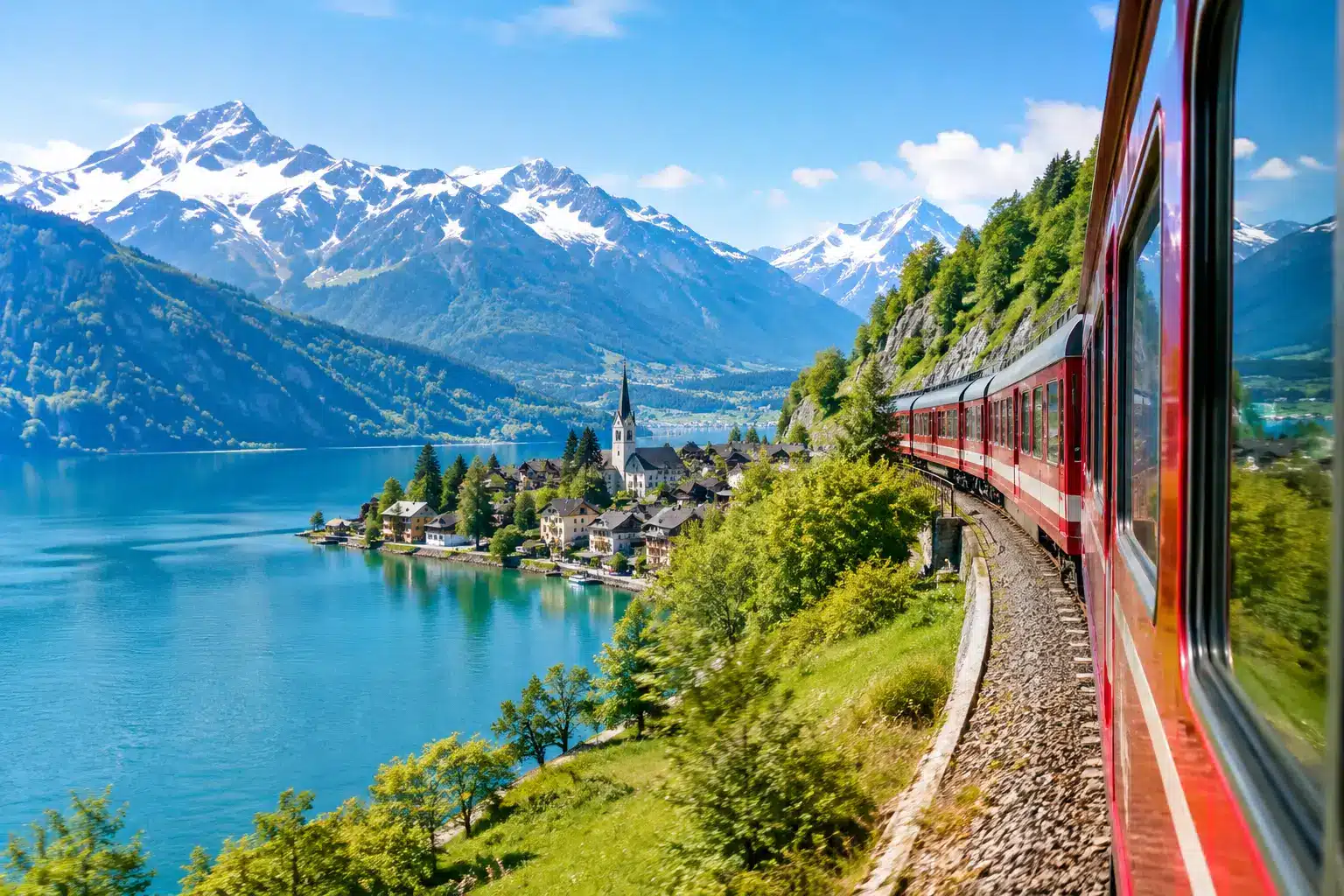
A great European rail journey changes the shape of a holiday. Instead of treating the space between airport and hotel as a necessary inconvenience, you watch vineyards, glaciers, lochs and limestone valleys arrive at window height. The finest scenic train routes in Europe are not simply about beautiful views, either. They make a persuasive case for slowing down, choosing a base with character and allowing a journey to become one of the main events.
For UK travellers, the practical appeal is considerable. Several of these routes can be woven into a longer rail holiday from London, while others make a compelling addition to a city break or cruise itinerary. The key is not attempting to collect them all. Pick one that suits the season, the landscape you want to see and the sort of stay you fancy at either end.
The Alpine scenic train routes in Europe
Bernina Express, Switzerland and Italy
The Bernina Express is rail travel at its most theatrical. Running between Chur or St Moritz in Switzerland and Tirano in northern Italy, it climbs over the Bernina Pass without a rack railway, crossing the Landwasser Viaduct and curling around the extraordinary Brusio spiral viaduct before descending towards Italian palms and pizza.
The contrast is what makes it memorable. One moment you are looking across high Alpine lakes and glacial terrain; a few hours later, the light has softened and the landscape has turned distinctly Mediterranean. Panoramic carriages are popular for good reason, although regular regional trains follow much of the same line and can be better for travellers who want the freedom to stop overnight in places such as Poschiavo.
Stay in St Moritz for lakeside walks, grand hotels and easy access to the Engadin valley, or make Tirano a brief but pleasing Italian pause before continuing to Lake Como. Seats on the named Bernina Express need reservations, particularly in summer and around the ski season.
Glacier Express, Switzerland
If the Bernina is dramatic, the Glacier Express is expansive. This full-day journey links Zermatt and St Moritz, travelling through eight hours of Swiss mountain scenery: deep gorges, wooden chalets, broad valleys and the Oberalp Pass. It is often called the slowest express train in the world, which sounds less like a criticism when the view keeps asking you to look up from your lunch.
This is a fine choice for a first Swiss rail holiday, especially if you stay two or three nights at each end. Zermatt gives you car-free village streets and the Matterhorn, while St Moritz offers an altogether different kind of mountain glamour. The trade-off is cost. Reservations are compulsory, and the complete journey can feel like a long day if you are travelling with young children or prefer more time outdoors than behind glass. Splitting the route with a night in Andermatt makes the experience feel less like a marathon.
GoldenPass, Switzerland
For a gentler Swiss itinerary, take the GoldenPass route between Lucerne and Montreux. The train threads together lakeside towns, green pastures and the stylish villages of the Bernese Oberland before reaching Lake Geneva and its vineyard-lined shores.
It lacks the high-altitude extremity of the Glacier Express, but that is precisely the attraction. This is a route built for a holiday with room for stops: Lucerne for its compact old town, Interlaken for mountain excursions, and Montreux for Belle Époque hotels, wine country and lake promenades. The journey is especially lovely in late spring and early autumn, when the hills are green and the crowds slightly thinner.
Fjords, forests and northern light
Flåm Railway, Norway
The Flåm Railway is short, steep and almost absurdly scenic. In roughly an hour, it drops from Myrdal on the Bergen Line to the tiny fjord village of Flåm, passing waterfalls, farmsteads clinging to hillsides and a valley so narrow it feels designed for a camera lens.
Book it as part of a wider Norway itinerary rather than a stand-alone tick. Bergen is a handsome base for a night or two, while Flåm works best if you stay overnight after the day visitors have gone, then take a fjord cruise through Aurlandsfjord or Nærøyfjord. Summer brings long days and busy platforms. Winter is quieter, moodier and potentially snow-covered, although weather may affect onward plans. Reserve ahead in either season.
Bergen Line, Norway
The main line between Oslo and Bergen deserves more attention than its famous branch to Flåm. It crosses the Hardangervidda plateau, one of Europe’s highest railway stretches, where the landscape becomes stark, treeless and wonderfully remote.
For travellers who dislike packaged sightseeing, this is the more satisfying Norwegian train journey. It connects two excellent city stays and gives you a serious sense of distance in between. Go westbound if you want to finish among Bergen’s painted wooden wharves and seafood restaurants. In colder months, build in a little flexibility: snow is part of the scenery, but it can also complicate timetables.
Belgrade to Bar Railway, Serbia and Montenegro
The Belgrade to Bar line is for travellers who like their scenery with a little Balkan unpredictability. It runs south through Serbia and Montenegro, crossing huge viaducts and cutting through mountains before reaching the Adriatic coast at Bar. The Mala Rijeka Viaduct, high above a green valley, is the headline act.
This is not the polished, panoramic-carriage version of scenic rail travel. Services can be slow and schedules should be checked carefully. Yet that is part of its appeal: the journey feels connected to the places it passes through rather than curated around a view. Consider stopping in Podgorica, then continue to the Bay of Kotor or Budva for a few nights by the coast.
Coastlines and classic landscapes
West Highland Line, Scotland
For British travellers, the West Highland Line offers one of Europe’s great rail journeys without the airport logistics. From Glasgow to Mallaig, the train travels through Argyll and the Highlands, crossing Rannoch Moor and the Glenfinnan Viaduct before reaching the coast opposite Skye.
It is particularly rewarding when paired with a few days in Fort William, a ferry to Skye or an island-hopping route through the Hebrides. Sit on the left-hand side when travelling north from Glasgow for the broadest views across Rannoch Moor, although the scenery is generous on both sides. Summer has the longest days, but May and September can bring quieter trains and softer light.
Cinque Terre train, Italy
Italy’s coastal rail journey through the Cinque Terre is a different proposition: short hops rather than one grand sweep. The line connects the five villages of Monterosso, Vernazza, Corniglia, Manarola and Riomaggiore, slipping in and out of tunnels with sudden flashes of terraced hillsides and the Ligurian Sea.
The train is the sensible way to see this coastline. Driving is restrictive, parking is scarce, and walking every section of trail is not always possible due to closures or heat. Stay in Levanto or La Spezia for better value and easier luggage logistics, then visit the villages early or late in the day. For a more romantic splurge, book a room in Vernazza or Manarola and accept that the setting, rather than square footage, is what you are paying for.
Semmering Railway, Austria
The Semmering Railway between Gloggnitz and Mürzzuschlag is less famous than Switzerland’s Alpine lines, but it is a brilliant addition to a Vienna itinerary. Built in the nineteenth century, it crosses viaducts and tunnels through wooded mountains with a confidence that still feels remarkable.
This is a route for those who prefer a cultured detour to an all-day spectacle. Take a morning train from Vienna, walk one of the marked trails around Semmering, and stay overnight in a traditional mountain hotel if you have time. In autumn, the forest colours make a convincing argument for lingering.
How to choose and book your rail journey
A scenic rail trip is at its best when it fits the wider holiday. If you want jaw-dropping engineering and glaciers, choose Switzerland. For fjords and dramatic weather, Norway is hard to beat. If food, villages and a slower Mediterranean rhythm matter more, northern Italy may be the smarter choice.
Book reserved scenic services as early as your dates allow, especially from June to September and over Christmas. Check whether a rail pass covers the fare but still requires a seat supplement, as this catches out plenty of otherwise organised travellers. Regular regional trains are often cheaper and more flexible, but they may involve changes and do not always have panoramic windows.
Leave space either side of a major train journey. An early departure after a late flight is a poor exchange for a beautiful view, and a two-night stay can turn a station town into a proper destination. The Destination Unlocked podcast is as useful as a guidebook and as personal as a chat with your most well-travelled friend: each 40-minute episode has the information you need to plan a great trip.
Choose the route that gives you an excuse to stop somewhere you might otherwise have rushed past. The train will handle the grand entrance; your holiday gets more interesting when you step off before the final station.