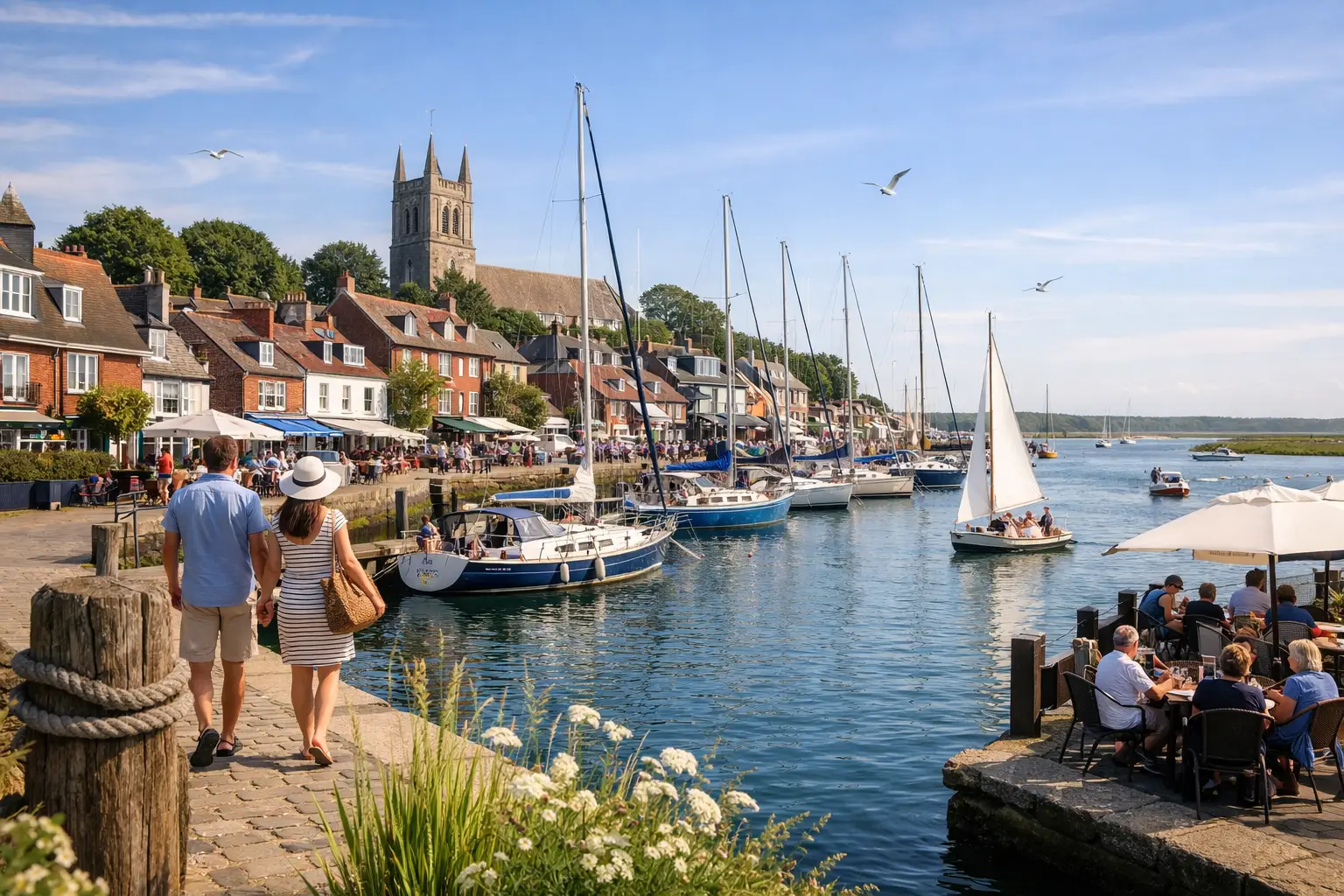
Lymington has the kind of arrival that quietly resets your pace. One minute you are thinking in terms of train times, car parks and weekend plans, and the next you are looking down a Georgian high street that rolls towards the sea. If you are searching for things to do in Lymington, the real appeal is not just ticking off sights. It is the way this corner of the New Forest blends sailing culture, market-town character and easy access to salt marsh, woodland and coast.
Why the best things to do in Lymington work so well together
Some places are either a seaside town or a national park base. Lymington manages to be both, which is why it suits different kinds of break. You can spend a morning with coffee and independent shops, be on the water by lunch, and finish the day with a forest walk or a pub meal. That variety makes it especially good for a long weekend, when you want options without needing to drive all over the map.
It also helps that Lymington still feels lived in. There is polish here, certainly, but not in a way that flattens the town into a backdrop. The marina, the old quay, the High Street and the nearby marshes all have their own rhythm, and that gives the place more depth than a simple postcard stop.
Start on the High Street and the Saturday market
The High Street is the obvious place to begin, but in Lymington obvious is not a bad thing. The long, sloping street is lined with Georgian and Victorian buildings, and it remains the town’s social spine. Good places reveal themselves slowly here – a smart deli, a bookshop, a traditional butcher, somewhere for coffee that feels local rather than generic.
If you can time your visit for Saturday, the market is one of the most enjoyable things to do in Lymington. It has been part of the town for centuries and still gives the centre extra energy. This is less about spectacle and more about atmosphere. You wander, browse, pick up something edible or useful, and get a better sense of the town than you would from a landmark alone.
The trade-off is that market day is busier, so if you prefer a quieter feel, a weekday morning may suit you better. Lymington wears both well.
Walk down to the harbour and old quay
From the High Street, the natural pull is downhill towards the water. The old quay is where Lymington’s maritime character becomes unmistakable. Fishing boats, yachts and working harbour details sit together in a way that feels authentic rather than staged.
This is one of those places where not doing much is, frankly, the point. Walk the quay, watch the comings and goings, and let the town’s sailing heritage come into focus. Lymington has long been associated with yachting, but the harbour scene is broader than polished leisure craft. There is still enough texture here to remind you that coastal towns are shaped by trade, tides and routine as much as by leisure.
For first-time visitors, this area often provides the strongest sense of place. It is compact, photogenic and easy to absorb without needing a plan.
Take the seawall path to Lymington-Keyhaven Nature Reserve
If there is one experience that captures Lymington beyond the town centre, it is the walk out towards Keyhaven along the seawall. The reserve stretches across salt marsh, mudflats and lagoons, with big skies and a constantly changing light that makes even a short walk feel expansive.
This is where Lymington opens out. You trade shopfronts for reedbeds, sailing masts for birdlife, and the neatness of the town for a more elemental coastal landscape. Depending on the season, you may spot waders, ducks and other migratory birds, but even if you are not remotely a birder, the setting is absorbing.
It is worth knowing that this is a place for weather-ready footwear and a little flexibility. On a clear day it can feel glorious and open. In wind or rain, it becomes more rugged. That is part of the appeal, but it helps to arrive expecting a proper coastal walk rather than a manicured promenade.
Go crabbing with children – or with your own sense of nostalgia
Lymington Quay is one of those places where crabbing still feels entirely at home. For families, it is an easy win. For adults, it can be oddly transportive. Buckets, lines and a bit of patience go a long way, and the whole thing suits the town’s old-fashioned coastal charm.
What makes this activity work is its simplicity. It does not ask for much planning or much money, and it gives children something tactile and memorable in a place that might otherwise be all about nice views and grown-up lunches. If you are travelling as a family and want one of the more low-key things to do in Lymington, this earns its place.
Spend time at St Barbe Museum and Art Gallery
For a town of this size, Lymington has a cultural stop that adds useful context. St Barbe Museum and Art Gallery covers local history, archaeology and changing exhibitions, helping connect the harbour, the salt-marsh landscape and the town’s development.
This is a good option when the weather turns or when you want a break from walking. More than that, it helps explain why Lymington feels the way it does. Coastal towns can be easy to enjoy superficially. A museum like this gives the place a timeline, not just a view.
If your ideal trip is entirely outdoors, you may only want a short visit. Even then, it can sharpen the rest of your stay.
Take to the water
Lymington’s relationship with the Solent is not decorative. Getting on the water is one of the best ways to understand the town. Depending on your confidence and the season, that might mean a sailing experience, a boat trip, paddleboarding or simply spending time around the marinas watching others do it.
This is where preference matters. If you are already drawn to sailing, Lymington is an obvious fit. If you are not, forcing a full-on nautical day may feel like hard work. The middle ground is often best – enough time on or near the water to appreciate the town’s identity, without pretending you need to become a sailor by teatime.
The Isle of Wight ferry also adds another dimension. Even if you are not crossing, seeing the movement between mainland and island reinforces Lymington’s role as a gateway as well as a destination.
Venture into the New Forest from town
One of the smartest things about staying in Lymington is how easily it pairs with the New Forest. Within a short drive or cycle, the atmosphere changes completely. Heathland, ancient woodland and open stretches where ponies and donkeys wander give you a second landscape without the hassle of changing base.
This makes Lymington particularly strong for travellers who dislike one-note destinations. You can have coast and forest in the same day. Walk in the morning, lunch in town, then head out to somewhere quieter like Beaulieu, Brockenhurst or one of the smaller forest villages.
There is a balance to strike, though. If your main aim is deep New Forest walking, you may prefer to spend part of your trip further inland. Lymington is best when you want the forest within reach, not when you want to disappear into it entirely.
Find a pub lunch or waterside dinner
Lymington is well suited to meals that feel like part of the day rather than an event that interrupts it. A long lunch after a quay walk, or supper after time on the seawall, makes sense here. You will find everything from classic pubs to more polished spots with a marina outlook.
The pleasure lies less in chasing the single best table and more in matching the mood. On bright days, somewhere near the water feels right. After a blustery walk, a cosy pub inland can be even better. Lymington rewards that kind of flexible planning.
Browse beyond the obvious
Independent shopping may not be the headline reason to visit, but it adds texture. Antiques, homewares, food shops and smaller boutiques give the town a browseable quality that works especially well on slower weekends. This is not high-octane retail therapy. It is the more satisfying kind, where you find something because you happened to look properly.
For listeners and readers who like travel with a strong sense of place, that matters. A destination becomes more memorable when it offers small discoveries between the bigger set pieces, which is very much Lymington’s style.
Make time for the in-between moments
The strongest case for Lymington is that it does not need to oversell itself. Yes, there are clear highlights – the quay, the market, the marshes, the easy access to the New Forest. But some of the best moments here come in between: a bench with a harbour view, the turn of the High Street in late afternoon light, the shift from town to open coast in the space of half an hour.
That is what makes it a good fit for a travel brand like Destination Unlocked, and for travellers who want somewhere with more personality than noise. Lymington is not trying to compete with louder seaside towns or more famous forest villages. It simply offers a richer mix than many places its size.
If you are planning a visit, leave a little room in the schedule. The best things to do in Lymington are easy to name, but the real pleasure comes when the town has time to surprise you.

[yarpp]