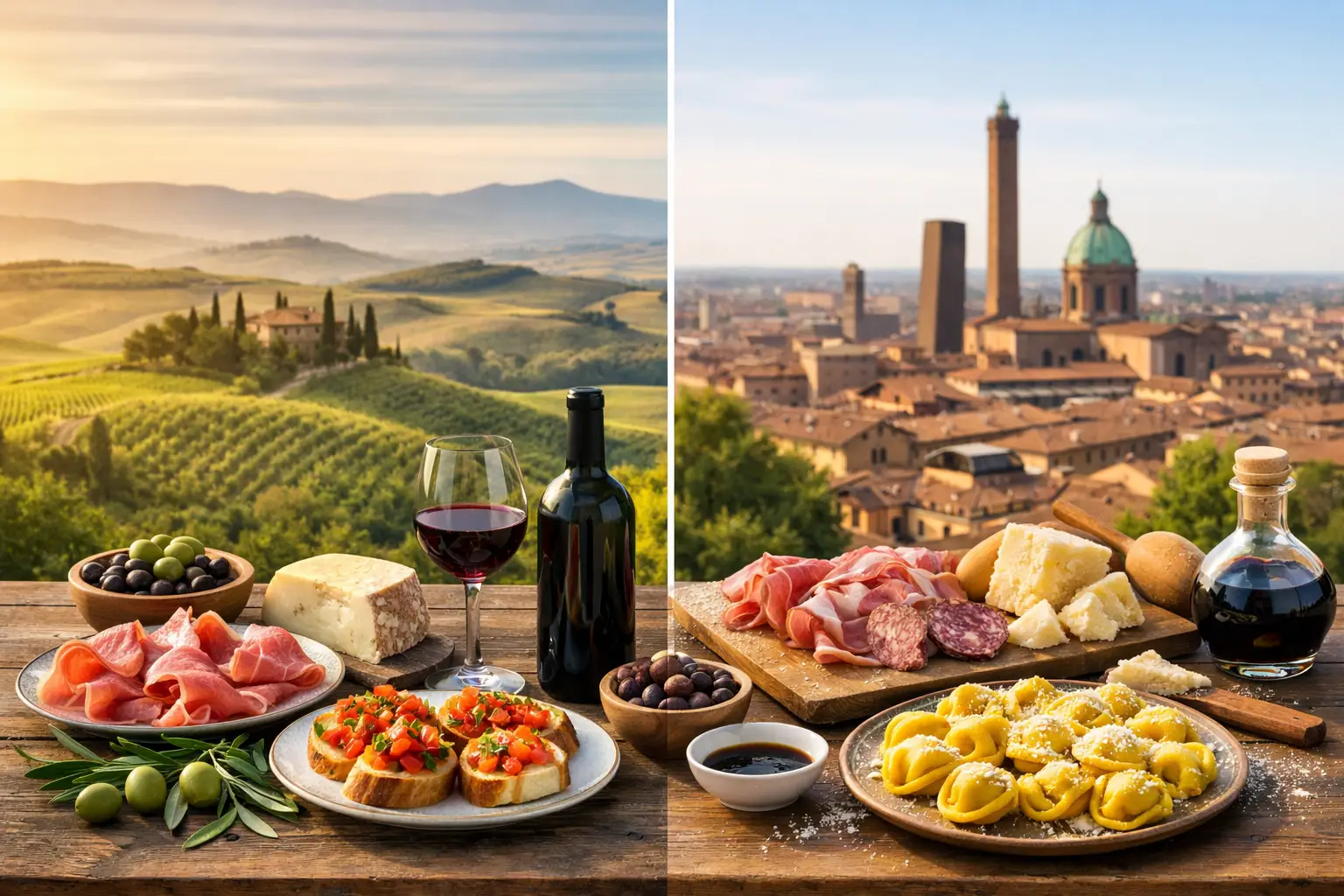
A plate of tortelli drenched in butter and sage in Bologna, or a long lunch above the vineyards of Chianti? The question at the heart of a Tuscany vs Emilia-Romagna food trip is not which region has better food. That is a pleasingly impossible argument. It is about deciding what sort of Italian appetite you want to travel with.
Tuscany delivers the romance many travellers picture before they book: rolling hills, medieval towns, handsome farmhouses and wines that deserve an unhurried afternoon. Emilia-Romagna is more urban, industrious and intensely food-minded, a place where extraordinary ingredients are part of daily life rather than a special-occasion performance. Both reward a well-planned holiday. Their differences, though, will shape where you stay, how you get around and how many meals you can reasonably face in a day.
Tuscany vs Emilia-Romagna food trip: the essential difference
Choose Tuscany if you want food folded into a broader countryside escape. The region is made for lingering between meals: browsing Siena’s lanes, taking in Florence’s galleries, driving through Val d’Orcia and settling into an agriturismo where dinner may be produced a few metres from your table. Its cooking has a confident simplicity – excellent olive oil, beans, grilled meat, pecorino, wild boar, hand-rolled pasta and bread used inventively, never wastefully.
Choose Emilia-Romagna if eating is the central reason for the trip. Its greatest hits are remarkably familiar in Britain – Parmigiano Reggiano, Prosciutto di Parma, traditional balsamic vinegar, ragù alla bolognese and mortadella – but tasting them near their source corrects plenty of assumptions. Here, food has precision and depth. A modest osteria may serve a regional pasta with the kind of care elsewhere reserved for a tasting menu.
There is also a useful practical distinction. Tuscany is spread out and usually best with a car, particularly once you leave Florence. Emilia-Romagna has an excellent rail spine running through Bologna, Modena, Reggio Emilia and Parma. You can build an absorbing long weekend with no driving at all, then use organised day trips for producers in the countryside.
Choose Tuscany for wine, scenery and slow lunches
Tuscany is the easier choice for a food trip that needs a generous helping of landscape. Start in Florence if you want museums, aperitivo bars and a lively dining scene, but do not give the whole holiday to the city. A few nights in the Chianti Classico area, around Panzano, Greve or Radda, puts vineyard visits and rustic restaurants within easy reach. For a more cinematic rural stay, look towards Val d’Orcia, with bases such as Pienza, Montalcino and Montepulciano.
The food is at its best when you follow the seasons and keep expectations grounded. This is not necessarily the region for elaborate multi-course menus every night. It is where a bowl of ribollita, pappa al pomodoro or pici with a slow-cooked sauce can feel completely right after a day outside. In autumn, mushrooms, game and new olive oil add particular appeal. In summer, seek shaded terraces, chilled white wine from the coast or a light Vermentino, and lunches that do not require a nap of geological proportions.
Wine is the major draw. Brunello di Montalcino, Vino Nobile di Montepulciano and Chianti Classico all offer distinctive routes into the region, and a visit is far more satisfying when it is booked in advance rather than attempted on a whim. Smaller estates can be wonderfully personal, but appointment-only is common. If you plan to drink seriously, choose accommodation within walking distance of a village restaurant or arrange a driver for tasting days. Tuscan roads are beautiful, not forgiving.
A farmhouse hotel or polished agriturismo suits the experience beautifully, especially for couples or friends planning a three- to five-night escape. The trade-off is that rural properties can feel isolated after dark, and taxis are scarce. Travellers who want to wander out for dinner, browse shops and avoid car logistics will be happier in Florence, Siena or Lucca.
Tuscan dishes worth planning around
Order bistecca alla fiorentina in Florence or the Chianti hills with enough people to share it. In Siena, look for pici pasta and panforte; around Pienza, taste sheep’s-milk pecorino; and in coastal Tuscany, let seafood take over for a meal or two. A cooking class can be a good investment here, particularly one held in a market or rural kitchen, because Tuscan cooking is often about technique, ingredients and restraint rather than a long list of complicated components.
Choose Emilia-Romagna for pasta, producers and city energy
Emilia-Romagna makes a persuasive case for travelling from one lunch to the next. Bologna is the natural starting point: elegant porticoes, a large historic centre and a dining culture that works from breakfast onwards. Stay near the centre for easy access to markets, wine bars and traditional trattorie, then reserve a table for tortellini in brodo, tagliatelle al ragù or lasagne made in the Bolognese style. The latter is generally green from spinach pasta, which tells you something about the region’s refusal to be simplified.
From Bologna, Modena is an easy rail addition. It is compact, handsome and the place to understand why properly aged traditional balsamic vinegar bears little resemblance to the glossy condiment often sold under the same name. A producer visit can be revelatory, especially when paired with a local lunch. Modena also offers fine dining at the highest level, though its simple restaurants are more than capable of stealing the show.
Continue west to Parma for Parmigiano Reggiano and Prosciutto di Parma. These are not merely labels but products shaped by places, methods and fiercely defended traditions. Early-morning dairy visits are popular because that is when the wheels are made. They require an early start, but watching milk become cheese before breakfast is one of those holiday experiences that makes a supermarket shelf look rather different afterwards.
Emilia-Romagna is ideal for a four-night city-to-city itinerary: two nights in Bologna, then one each in Modena and Parma, or Bologna as a single base with rail day trips. Book food tours and producer visits before arrival, particularly at weekends and during spring or autumn. The best experiences tend to be small, and the practical details matter: a parmesan dairy may begin before 8am, while balsamic producers and ham makers are often outside town.
The case for Bologna as a base
Bologna offers the widest choice of hotels, the simplest station connections and enough restaurants to keep repeat meals interesting. It is also a city in which you can eat extraordinarily well without treating every dinner as an event. That makes it a better fit than Tuscany for a quick Friday-to-Monday break from the UK.
The trade-off is scenery. Bologna has enormous character, but it does not offer the open, cypress-lined vistas that make Tuscany feel like a film location. If your ideal Italian holiday includes pool time, vineyard views and long drives through hill towns, Emilia-Romagna may feel more purposeful than picturesque.
Budget, booking and the best time to go
Neither region is a bargain if you are booking sought-after hotels and restaurant tables in peak season. Tuscany can become particularly expensive from late spring through early autumn, when countryside properties, hire cars and wine-focused stays command a premium. Emilia-Romagna is often better value for central hotels and transport, although Bologna gets busy around major events and university dates.
For comfortable weather and strong seasonal menus, aim for April to June or September to October. Tuscany is especially attractive in October, when harvest energy reaches the wineries and richer dishes return to menus. Emilia-Romagna is arguably at its most delicious in the cooler months, when broths, stuffed pasta and long lunches feel less like an athletic challenge. August can be hot in both regions, and smaller independent businesses may close for holidays.
Book your standout meals first, then choose your hotel around them. In rural Tuscany, that may mean securing a restaurant or winery lunch and staying nearby. In Emilia-Romagna, it may mean a central Bologna hotel within a pleasant walk of your dinner reservation and the station. This small reversal of the usual planning order can make a food trip far less fiddly.
So, which Italian food trip should you book?
Book Tuscany when your table is one part of a wider holiday built around wine country, Renaissance cities and an occasional very good view. It is the choice for travellers who enjoy a meal more when it has been earned by a morning in a hill town or an afternoon among vines.
Book Emilia-Romagna when you want to understand Italian food at source, eat pasta with serious intent and travel efficiently between exceptional cities. It is the choice for friends, solo travellers and couples who would happily trade a poolside sunset for an 8am cheese-making visit followed by an exemplary lunch.
If you are still torn, listen to the Destination Unlocked podcast before booking. It is as useful as a guidebook and as personal as a chat with your most well-travelled friend, with each 40-minute episode designed to give you what you need for a great trip. Then make the decision in the most sensible Italian way possible: choose the region whose next meal you can already taste.