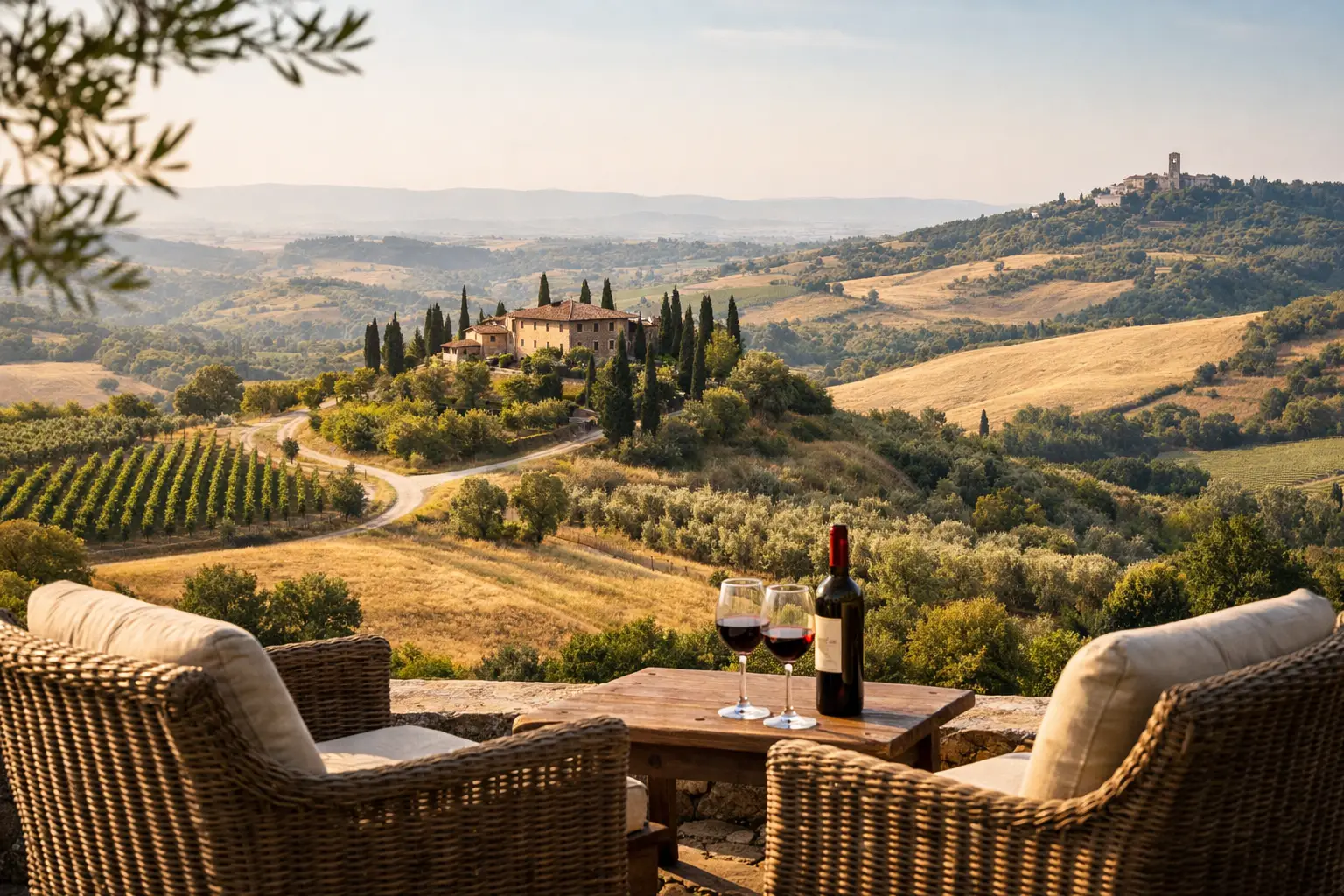
The right Tuscan address can turn a beautiful holiday into an effortless one. When deciding where to stay in Tuscany countryside, the key question is not simply which view you want outside the window. It is whether you want vineyard lunches within walking distance, easy day trips to Florence and Siena, a peaceful pool day, or a hill town where dinner is a stroll rather than a drive.
Tuscany is large, rural and deceptively slow to cross. A handsome stone farmhouse may look central on a map, yet be 40 minutes from the nearest proper town and another hour from your planned morning activity. Choose your base around the kind of days you actually want to have, then book the most characterful stay within that area.
Chianti for vineyards, food and easy access to cities
For many first-time visitors, Chianti is the strongest answer to where to stay in Tuscany countryside. The landscape between Florence and Siena delivers the classic picture: cypress-lined lanes, vine-covered slopes, olive groves and compact villages built around ancient churches and lively piazzas.
Stay near Greve in Chianti if you want the most practical base. It has shops, restaurants and a useful sense of life beyond tourism, while Florence is reachable in around an hour by car. Panzano suits travellers drawn to food and wine, particularly those happy to build a day around a long lunch. Radda, Gaiole and Castellina in Chianti are quieter and more romantic, with a greater feeling of being tucked into the hills.
This is the area for a winery stay, especially if you would rather taste than drive. Many agriturismi and wine estates offer pools, cooking classes and tastings, making it very easy to settle in for two or three nights. The trade-off is that Chianti is popular and prices rise sharply in late spring and early autumn. Book early if you want a polished boutique hotel or a vineyard room with a view.
Val d’Orcia for Tuscany at its most cinematic
South of Siena, Val d’Orcia is the Tuscany of long, elegant horizons. The roads roll past wheat fields, lone farmhouses and cypress avenues, with Pienza, Montalcino, Montepulciano and Bagno Vignoni providing excellent reasons to leave your hotel.
Choose Pienza for a compact town stay with views, good restaurants and easy access to the valley. It is particularly appealing for couples who like to walk out for an aperitivo and not worry about driving home. Montalcino is the better fit for Brunello enthusiasts and anyone who enjoys a more dramatic hilltop setting. Montepulciano has plenty of character, atmospheric wine cellars and a livelier historic centre, though its steep streets can be a consideration if mobility is an issue.
For an unhurried countryside escape, look outside these towns for a farmhouse hotel or refined agriturismo. A pool matters here in summer, when afternoon heat encourages a slower rhythm. You will need a car, and restaurant choice may be limited close to your accommodation, but the reward is space, silence and those sunset views that rarely look overdone in real life.
Val d’Orcia is also a fine choice for a special occasion. A converted estate with an excellent restaurant can make a short break feel wonderfully complete, even if you only venture out for wine tasting, a spa afternoon or a visit to a neighbouring village.
Near Siena for history without giving up the rural setting
Siena is a superb base for travellers who want medieval grandeur alongside Tuscan countryside. Its shell-shaped Piazza del Campo, Gothic streets and exceptional food scene merit more than a rushed day trip. Yet a stay just beyond the city walls gives you access to rolling landscapes and handsome country hotels without the isolation of deeper rural areas.
Look south and east of Siena towards Asciano, the Crete Senesi and the road to Val d’Orcia. The scenery becomes more open and earthier, with sculpted clay hills that are especially striking in spring and autumn. West of the city, towards Monteriggioni and Colle di Val d’Elsa, is useful for combining Siena with San Gimignano and Chianti.
This is a sensible compromise for a first Tuscan road trip. You can spend one day in Siena, another tasting wine in Chianti, then head south towards Pienza or Montalcino without constantly changing hotels. If you are staying in the centre, check parking arrangements carefully. If you are outside it, confirm how far the property is from restaurants after dark.
Lucca and northern Tuscany for a gentler, greener stay
Northern Tuscany has a different character. Around Lucca, the countryside is greener and flatter, with villas, gardens and a more relaxed relationship with the coast. Lucca itself is an excellent base if you want a beautiful walled city where cycling the ramparts and lingering over dinner are part of the holiday.
Stay in or near Lucca if you prefer independent restaurants, a broad choice of accommodation and the option of day trips to Pisa, the Garfagnana mountains or the Versilia coast. Country houses in the hills north of the city offer privacy and swimming pools, while remaining close enough to return for dinner.
This region is particularly good for families and mixed-interest groups. One person can take a food tour or visit a villa garden, another can spend a day by the sea, and nobody has to undertake a three-hour drive to reunite for supper. It lacks the concentrated vineyard drama of Chianti and Val d’Orcia, but that may be precisely its advantage.
The Maremma for coast, wildness and lower-key Tuscany
If your ideal countryside holiday includes beaches, thermal springs and fewer coach parties, look to Maremma in southern Tuscany. This broad region runs towards the Tyrrhenian coast and has a wilder feel than the better-known central valleys. Expect pine forests, natural reserves, medieval villages and food with a more rustic edge.
Base yourself near Bolgheri for prestigious wine estates and an attractive village atmosphere, though it sits at the northern edge of the wider Maremma area. For beaches and nature, consider the countryside around Grosseto, Scansano or Capalbio. Saturnia is the choice for thermal bathing, with country hotels and farm stays offering a restorative alternative to a city-heavy itinerary.
Maremma rewards travellers who are happy to explore by car and do not need a famous sight every morning. It is also worth considering in August, when much of inland Tuscany is hot and busy. Coastal breezes and a swim can be very persuasive.
Choose the accommodation as carefully as the village
In Tuscany, the property type shapes the trip. An agriturismo is a working farm or rural estate offering accommodation, and it can range from simple self-catering flats to elegant rooms with a serious restaurant. It is often the best value choice for longer stays, families and travellers who want countryside character rather than formal hotel service.
A boutique country hotel is better for a celebratory break, particularly if you value an on-site restaurant, spa treatments and someone else arranging the details. A self-catering villa gives groups freedom and privacy, but think honestly about shopping, cooking and who will drive. The romance of a remote house can fade slightly when the nearest bakery is 25 minutes away.
Before booking, check whether air conditioning is available in bedrooms, whether the pool is open on your dates, and whether the access road is suitable for a standard hire car. Also look closely at the distance to the nearest town. ‘Five kilometres away’ in rural Tuscany may mean ten scenic but winding minutes, which is charming at lunchtime and less so after a late dinner.
A practical way to plan your Tuscan base
For a first trip of five to seven nights, choose one area rather than trying to cover the whole region. Chianti works best for Florence, Siena and wine; Val d’Orcia is ideal for a slower, more romantic escape; and Lucca is the practical pick for northern Tuscany and the coast. With ten nights or more, splitting time between Chianti or Siena and Val d’Orcia gives a pleasing change of pace without turning the holiday into a packing exercise.
Avoid trying to stay in Florence, Lucca, Siena, San Gimignano, Chianti and Val d’Orcia all in separate hotels over one week. Tuscany is best enjoyed with room for an unplanned stop, a second glass of local wine and the occasional afternoon when nothing more urgent is required than a shaded table and a good book.
For more destination planning in the company of well-travelled voices, the Destination Unlocked podcast is as useful as a guidebook and as personal as a chat with your most well-travelled friend. Each 40-minute episode brings together the details that make a trip work, from where to linger to what is worth booking ahead.
Book the base that fits your holiday rather than the postcard alone. In Tuscany, the best view is even better when it is close to the table, town or vineyard you came to enjoy.