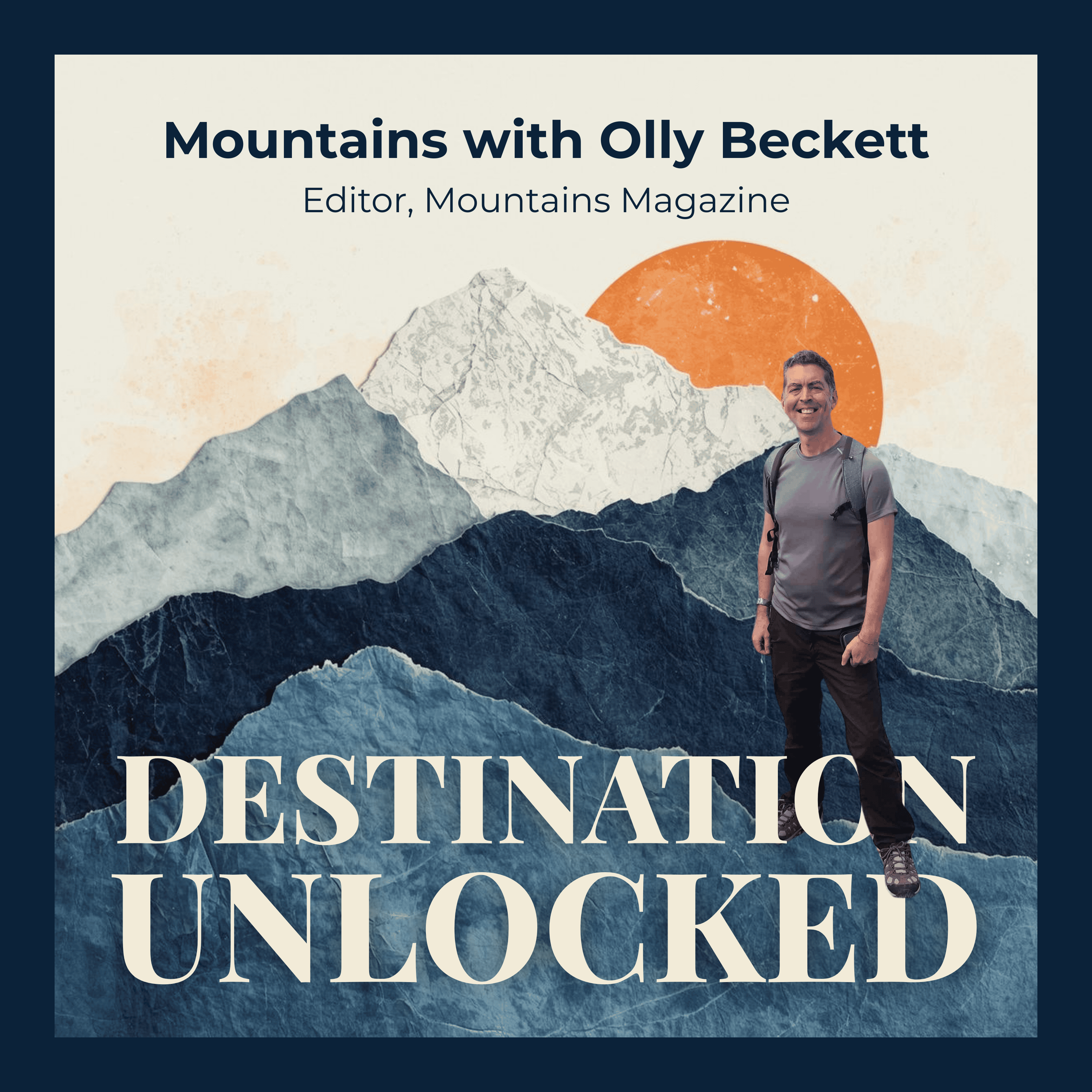
Editor of Mountains Magazine, Olly Beckett, joins Daniel to chat about the world’s greatest peaks, tips for enjoying the best mountain holidays, and insight into launching a new national magazine.
To read or order a print copy of Mountains Magazine, visit: www.mountains-magazine.com
Transcript
Welcome back to the Destination Unlocked
Daniel Edward:Podcast with me, Daniel Edward.
Daniel Edward:Today on the Destination Unlocked Podcast, in the words of Ike and Tina
Daniel Edward:Turner, we’re going Mountain High and in the words of The Carpenters,
Daniel Edward:we are gonna be On Top Of The World.
Daniel Edward:And that’s because we are unlocking mountains today with
Daniel Edward:none other than the editor of Mountains Magazine, Olly Beckett.
Daniel Edward:And in this conversation, not only are you gonna hear some great tips for how
Daniel Edward:to enjoy the world’s peaks, but also some really fascinating insight into what it
Daniel Edward:takes to launch a magazine that is now stocked in hundreds of shops up and down
Daniel Edward:the country, as well as being available online at www.mountains-magazine.com.
Daniel Edward:Enjoy.
Daniel Edward:So Olly, what are you unlocking for us today?
Olly Beckett:Today, Daniel, I’m gonna be unlocking the mountains of the world.
Daniel Edward:Ah, that’s a big claim.
Daniel Edward:There’s some big mountains out there.
Daniel Edward:People say, are you a mountain or a sea person?
Daniel Edward:And you find you are a mountain person, do you?
Olly Beckett:That’s the question that I kind of asked myself over the years
Olly Beckett:as someone that’s worked in travel for two and a half decades is yeah,
Olly Beckett:that question of beach, city, mountain and Forest, and after having a good,
Olly Beckett:long, hard think about it, mountains was definitely coming out on top.
Olly Beckett:I like the others, but yeah, mountains are where I belong.
Daniel Edward:Why?
Olly Beckett:Why?
Olly Beckett:Because mountains are surprisingly diverse.
Olly Beckett:You can have massive, snowy mountains.
Olly Beckett:You can have very dry, dusty mountains.
Olly Beckett:You can have mountains that are covered in forest.
Olly Beckett:You can have cities that are up in the mountains.
Olly Beckett:You can have deep human history in the mountains.
Olly Beckett:Geology is fascinating.
Olly Beckett:There’s a lot going on in the mountains.
Olly Beckett:And I just like the look of them when it comes down to it.
Olly Beckett:Like they are extremely dramatic things to look at and to be in; sitting there
Olly Beckett:and feeling very humble, staring up at this immense object that’s thousands
Olly Beckett:of meters tall and covered in snow.
Olly Beckett:It’s, extremely scenic in my eyes.
Daniel Edward:Do you remember your first ever mountain?
Olly Beckett:Not a specific mountain, but kind of vague hazy
Olly Beckett:memories of family holidays.
Olly Beckett:I grew up on the south coast of England and a cheap family holiday
Olly Beckett:involved getting on a cross channel ferry and in our cheap battered
Olly Beckett:Passat, driving across Europe.
Olly Beckett:And going to destinations such as Brione song and Grenoble.
Olly Beckett:And having grown up in the New Forest, which is notoriously flat,
Olly Beckett:being confronted with these immense things that are impossibly huge.
Olly Beckett:How is it possible that people can go up, go up these, but sure enough,
Olly Beckett:in France, in Italy and Switzerland, not only do they stand there and
Olly Beckett:stare at them, they build roads and railways up these things as well.
Olly Beckett:So yeah, I’ve got hazy memories of standing there feeling
Olly Beckett:very small in the Alps.
Olly Beckett:That’s where we went primarily.
Daniel Edward:So it was the Alps that started it.
Daniel Edward:Probably one of the most famous mountain ranges.
Olly Beckett:It’s a great place to start, right?
Olly Beckett:They are very nice and pointy and snowy and have all that
Olly Beckett:fascinating culture within them.
Daniel Edward:I haven’t spent so much time in mountains.
Daniel Edward:As much as I like looking at them, I find them very cold in the winter
Daniel Edward:and very hilly In the summer,
Olly Beckett:Yeah.
Daniel Edward:you must be quite fit and active.
Olly Beckett:Um, not as fit and active as you might think.
Olly Beckett:That is kind of one of the perceptions that I’m hoping to change is
Olly Beckett:that you don’t need to be fit and active to enjoy the mountains.
Olly Beckett:All around the world, not just in the Alps, there’s impressive
Olly Beckett:infrastructure that can help you get to the top of a mountain.
Olly Beckett:You don’t have to be an athlete to do that.
Olly Beckett:You can hop on a cable car, you can hop on a train, you can drive up one.
Olly Beckett:And even if you are, you know, wanting to be a bit more active, there’s some
Olly Beckett:really good equipment, there’s some really good tour operators out there that can
Olly Beckett:help anyone of any ability to get out onto a mountain trail, down a slope.
Olly Beckett:They are very accessible in winter, in summer.
Daniel Edward:Why don’t we do a beginner’s guide to mountains.
Daniel Edward:If somebody’s surprised by the fact that you’ve said, actually you don’t need to be
Daniel Edward:that fit, you can get out there, you can use a cable car, you can use the train.
Daniel Edward:There’s some amazing mountain trains, you could even drive to the top of a mountain.
Daniel Edward:Where is a comfortable place to start?
Olly Beckett:The most comfortable would be Switzerland.
Olly Beckett:The Swiss are remarkable engineers.
Olly Beckett:They don’t just look at a mountain and walk away.
Olly Beckett:They look at a mountain and decide to build a rotating
Olly Beckett:restaurant on the top of one.
Olly Beckett:That is where you will find the highest train station in Europe, they
Olly Beckett:blasted tunnels through the mountain to reach the top of this mountain.
Olly Beckett:It’s easy.
Olly Beckett:There’s, there’s railways everywhere in Switzerland.
Olly Beckett:They are reliable.
Olly Beckett:They connect very well with the cable car systems as well.
Olly Beckett:That is by far the easiest, most accessible mountains you can find.
Olly Beckett:But then, there’s countries around Switzerland also do a very good job.
Olly Beckett:Austria, very, very similar.
Olly Beckett:Good railway system, great cable cars.
Olly Beckett:France, also very, very good.
Olly Beckett:Compared to Switzerland, I’d say those countries are more affordable.
Olly Beckett:So if it talking about accessibility in terms of budget, then France and Austria
Olly Beckett:would be a good starting place as well.
Daniel Edward:And what do you need to bring with you on mountain holiday?
Olly Beckett:It depends on what season you’re going in.
Olly Beckett:In any season, sunscreen’s usually a good idea because even in
Olly Beckett:winter, if it’s a sunny day, the UV levels up there are much harsher.
Olly Beckett:Mountain weather can be unpredictable.
Olly Beckett:So again, any season come prepared for rain or for snow, it could get
Olly Beckett:cold even in the height of summer.
Olly Beckett:So be prepared for that.
Olly Beckett:Apart from that, it really depends on the season that you’re going in.
Olly Beckett:Winter, obviously you’re gonna want to bring thermals and stuff
Olly Beckett:in summer far less equipment.
Olly Beckett:Any time of year sunglasses, sunscreen, and the expectation that
Olly Beckett:the weather could change very quickly.
Olly Beckett:I fully appreciate mountain climbers and people that.
Olly Beckett:Literally run up the top of mountains and do various other
Olly Beckett:extreme things in the mountains.
Olly Beckett:That is something that I am more than happy to be a spectator
Olly Beckett:of rather than a participant.
Olly Beckett:My magazine, it’s for people that just want to go up, enjoy the mountains
Olly Beckett:without necessarily having to do anything or at least do anything extreme.
Daniel Edward:Yeah.
Daniel Edward:Just to enjoy being there in this gorgeous environment.
Olly Beckett:exactly.
Daniel Edward:Talking of extreme things on mountains, this is something that
Daniel Edward:I saw and I thought, wow, there is something for everyone: extreme ironing.
Daniel Edward:Have you heard of it?
Olly Beckett:I’ve heard of it and I’ve seen the pictures.
Olly Beckett:Yeah.
Olly Beckett:This is where people unfold an ironing board on the top of a
Olly Beckett:mountain, literally on the peak, with all their climbing equipment.
Olly Beckett:yeah.
Olly Beckett:Good for them.
Daniel Edward:I just have no idea what brings somebody to think
Daniel Edward:that that’s a worthwhile pursuit.
Daniel Edward:They bring a deliberately unironed shirt to iron it at the
Daniel Edward:top of climbing up a mountain.
Olly Beckett:I mean, I struggle to do ironing at the best of
Olly Beckett:times that let alone at the top
Olly Beckett:of the mountain, so, yeah.
Daniel Edward:And all of that extra weight to carry.
Olly Beckett:Yeah.
Olly Beckett:And how do they plug the iron in?
Olly Beckett:They bring like batteries up there as well?
Daniel Edward:Yeah.
Daniel Edward:A lot of thought went into it.
Daniel Edward:An unnecessary amount of thought.
Daniel Edward:What sort of food can you find up in the mountains?
Daniel Edward:Are there resorts where essentially you’re staying in a village, or
Daniel Edward:is it quite a remote holiday?
Olly Beckett:There can be a remote holiday if you want it to be.
Olly Beckett:You can go up and either camp or stay in a remote mountain hut, in which case the
Olly Beckett:food is gonna be more basic, although there are now more luxurious mountain
Olly Beckett:huts way up in the middle of nowhere where you can get good gourmet cuisine.
Olly Beckett:But like I said, there’s cities up in the mountains.
Olly Beckett:There are mountain cities which have Michelin star restaurants.
Olly Beckett:I think Saint Moritz is one of those.
Olly Beckett:I know Ischgl’s got a couple that has some good quality.
Olly Beckett:I think they’ve got a few Michelin starred restaurants there.
Olly Beckett:You certainly don’t have to sacrifice things like that.
Olly Beckett:If you want to go off a mountain, of course, depends
Olly Beckett:where you are in the world.
Olly Beckett:Europe is very good for that.
Olly Beckett:North America also, South America, you can certainly go to some good
Olly Beckett:mountain towns and eat very well too.
Olly Beckett:But you’re less likely to find like the gourmet cuisine
Olly Beckett:in those kind of locations.
Daniel Edward:I feel like as travel writers, we are sort of spoiled when it
Daniel Edward:comes to gourmet food though, because I feel like gourmet food seems to be thrown
Daniel Edward:at almost any trip that we do, whereas when I’m doing my own holidays, I don’t
Daniel Edward:actually need it to be Michelin starred.
Daniel Edward:I like local.
Olly Beckett:I like local.
Olly Beckett:I totally agree.
Olly Beckett:Yeah.
Olly Beckett:And, and luckily for me, I like cheese and chocolate, which are things
Olly Beckett:that are extremely prevalent in the mountains no matter where you are.
Olly Beckett:I was talking about South America; there’s a beautiful town called
Olly Beckett:Barce in Argentina, that is famous for its chocolate shops.
Olly Beckett:I know it’s got very good restaurants as well, but I’m quite a basic
Olly Beckett:person, so just give me some chocolate and I’ll be very happy.
Olly Beckett:In the Alps, give me a good fondue any day.
Olly Beckett:Doesn’t have to be that complicated.
Olly Beckett:Bit of melted cheese, I’m happy.
Daniel Edward:Find me anybody who would turn well apart from somebody
Daniel Edward:who’s lactose intolerant, I suppose, in which case they ought to turn it down.
Daniel Edward:But the rest of us, there’s something about a cheese fondue.
Olly Beckett:Och.
Olly Beckett:I mean, especially after you’ve spent a day doing something mildly active
Olly Beckett:in the mountains, like a nice, easy hike, you feel like you’ve earned
Olly Beckett:that fondue at the end of the day.
Daniel Edward:Did you ever expect that you would be spending your
Daniel Edward:career traveling and writing about it?
Olly Beckett:Certainly traveling.
Olly Beckett:Yeah.
Olly Beckett:As a teenager, I read the book, Seven Years in Tibet
Olly Beckett:and was immediately inspired.
Olly Beckett:And I guess that’s also where my love of the mountains stems from as well.
Olly Beckett:So from that kind of moment on, once I put the book down, I knew
Olly Beckett:that I wanted a life in travel.
Olly Beckett:I wanted to be a travel writer from the get go.
Olly Beckett:Heinrich Carrow was the author of that book, really good writer.
Olly Beckett:So wanted to kind of emulate his life, going up on the
Olly Beckett:mountains and writing about it.
Olly Beckett:The big disadvantage that I had was that, I was never particularly academic.
Olly Beckett:So much as I wanted to start off in journalism and travel writing,
Olly Beckett:did not get the grades to get onto a decent writing course, so decided
Olly Beckett:to go into travel marketing instead.
Olly Beckett:Did a degree in tourism studies, did a really, really good internship at
Olly Beckett:STA Travel, if you can remember them.
Olly Beckett:They were great.
Olly Beckett:Really, really good company.
Olly Beckett:And then once I graduated it was like, well, still can’t really get
Olly Beckett:into journalism, so we’ll continue down the travel marketing route
Olly Beckett:and then hopefully sometime soon explore the writing a bit more.
Olly Beckett:About 15 years later, finally had put together enough money to take
Olly Beckett:the risk of being a travel writer.
Olly Beckett:It’s, as I’m sure you’re aware of, it’s not an easy business to get into.
Olly Beckett:It helps if you either have the grades or if you have a bit of money
Olly Beckett:to take the risk at some point to kind of start all over again, and
Olly Beckett:build a reputation for yourself.
Daniel Edward:It is a risky business, in that sense.
Daniel Edward:And I think a lot of people look at it and think, oh, I’d love to be doing that.
Daniel Edward:Oh, you’re so lucky you’re going away to these places; all you
Daniel Edward:have to do is write about it.
Daniel Edward:And actually, there’s a lot of stuff in the industry which people don’t see.
Daniel Edward:If somebody was looking to follow in what you’ve done, what is the
Daniel Edward:most important thing that you think they ought to be aware of?
Olly Beckett:Oh, don’t expect to be able to support yourself
Olly Beckett:through travel writing overnight.
Olly Beckett:It takes a long time to build up a reputation.
Olly Beckett:Either do what I’ve done and have a bit of money behind you to start
Olly Beckett:off with, so you know, you don’t have to fully support yourself.
Olly Beckett:And have other income streams as well; I know the majority of travel
Olly Beckett:writers, the vast majority in fact, do have other income streams as well.
Olly Beckett:It’s very, very difficult to fully support yourself as just a travel writer.
Daniel Edward:Yeah.
Daniel Edward:It almost doesn’t make sense
Daniel Edward:economically.
Olly Beckett:Mm-hmm.
Olly Beckett:Yeah.
Olly Beckett:When you see what you get paid per commission and how difficult
Olly Beckett:it is to get a commission, yeah.
Olly Beckett:It’s next to impossible to kind of make that your sole job.
Daniel Edward:And that’s why a lot of people have second jobs as well.
Daniel Edward:But a lot of people in the industry are creative types who have stories
Daniel Edward:that they want to share and then want to create outlets for those stories.
Daniel Edward:Both our own stories and other people’s stories.
Daniel Edward:And I think that’s where the magazine comes in.
Olly Beckett:Yeah.
Olly Beckett:The reasons for the magazine are multiple.
Olly Beckett:Firstly there was a gap in the market.
Olly Beckett:But also it is a really good outlet for my writing and for the writing of other
Olly Beckett:travel writers that I really, really admire and think deserve a wider audience.
Olly Beckett:It’s something that has now pretty much taken over my life.
Olly Beckett:So in that sense, I’m busy.
Olly Beckett:Economically still a bit of a struggle.
Olly Beckett:It’s a new business.
Olly Beckett:All new businesses, it’s a struggle to start off with.
Olly Beckett:But yeah, in terms of the actual being able to write, I’ve got more
Olly Beckett:than enough on my plate right now.
Daniel Edward:So the magazine is called Mountains Magazine.
Daniel Edward:It’s very obvious what we could expect to find inside a Mountains Magazine.
Daniel Edward:But, why don’t we unpack it a little bit more.
Daniel Edward:It’s a quarterly magazine, so it sort of follows the seasons.
Olly Beckett:Exactly that.
Olly Beckett:Yeah.
Olly Beckett:It comes out in March and June and September and in December.
Olly Beckett:And each issue vaguely reflects the seasons.
Olly Beckett:This is why in:Olly Beckett:wasn’t really a winter person in the mountains, but couldn’t really
Olly Beckett:edit something called Mountains Magazine without knowing how to ski.
Olly Beckett:So did a beginner trip to Saint Gervais, which is a really
Olly Beckett:fun, nice place to learn.
Olly Beckett:And just about got the hang of it.
Olly Beckett:Oh, actually, no.
Olly Beckett:My first trip was to the, uh, snow dome in Milton Keynes.
Daniel Edward:fantastic place
Daniel Edward:to
Olly Beckett:Have you been?
Daniel Edward:That’s my entirety of skiing actually.
Olly Beckett:It’s not a bad place.
Olly Beckett:I was, I was genuinely impressed that they had actual snow
Olly Beckett:inside this building in the middle of Milton Keynes.
Daniel Edward:For people who don’t know Milton Keynes, it’s the greyest,
Daniel Edward:concrete jungle, you’ll find.
Daniel Edward:It’s roundabouts and concrete.
Olly Beckett:about as far away as a scenic mountain landscape
Olly Beckett:as you can possibly imagine.
Olly Beckett:And yet there’s this immense building with an actual snowy slope inside.
Olly Beckett:yeah, I decided to, um, for a group lesson there just so I didn’t look like
Olly Beckett:a complete idiot on an actual mountain.
Olly Beckett:even down to how do you put on a ski boot sort of lesson,
Daniel Edward:Yeah, I, I don’t think
Daniel Edward:I’d
Olly Beckett:right?
Olly Beckett:Yeah.
Olly Beckett:It, I
Olly Beckett:mean, it.
Daniel Edward:I don’t think I’d know which equipment I would
Daniel Edward:need to bring and what would be there waiting for me as well.
Olly Beckett:Exactly that and even do you point the skis down to that sort of thing.
Olly Beckett:even so, like going on an actual mountain, despite having that
Olly Beckett:behind me, it still intimidating.
Olly Beckett:was lucky I was on a press trip and therefore had a one-on-one tuition.
Olly Beckett:I highly recommend, if you do want to do a beginner kind of skiing
Olly Beckett:thing, just splash out on a tutor at least once or twice because they are
Olly Beckett:fantastic at not quite literally holding your hand, but very close to holding
Olly Beckett:your hand, and just kind of slowly helping you improve your technique.
Olly Beckett:And even to like, if you do fall over, which you know it’s gonna happen,
Olly Beckett:probably, they will help you put your skis back on, which is really important
Olly Beckett:when you dunno what you’re doing.
Daniel Edward:Oh, what?
Daniel Edward:When you fall over, the skis come off?
Olly Beckett:depends on how you fall.
Olly Beckett:but that is part of the safety mechanism.
Olly Beckett:They, should ping off.
Olly Beckett:and of course if they’re pinging off on quite a slope, they’re gonna ping
Olly Beckett:off and keep on sliding down the slope.
Olly Beckett:So you need someone that can chase after it and then find you again,
Olly Beckett:and then help you this thing back on despite being on an icy slope?
Daniel Edward:Would you recommend learning to ski as an adult?
Olly Beckett:Yes, absolutely.
Olly Beckett:It’s, it’s not as intimidating or scary as it sounds.
Olly Beckett:mean, I I certainly felt apprehensive, I was scared, but having now done it, there
Olly Beckett:was no reason to be scared, even though I fell few times on a more recent visit.
Olly Beckett:just falling onto snow, it’s not gonna hurt.
Olly Beckett:as an adult, of course, you’re not gonna be as bouncy as a toddler.
Olly Beckett:but it’s still, it’s an adventure.
Olly Beckett:something completely different to anything you would’ve tried before.
Olly Beckett:So I’d thoroughly recommend it.
Daniel Edward:And what about the apres ski side of things?
Daniel Edward:That’s the other thing I keep hearing about ski.
Daniel Edward:It’s, it’s all of the stuff around it.
Daniel Edward:And after you’ve been on the slopes all day.
Olly Beckett:Yes.
Olly Beckett:Yeah.
Olly Beckett:I will admit, one of the reasons I wanted to try skiing was to
Olly Beckett:justify the apres ski as well.
Olly Beckett:apres ski can be as hedonistic or as easygoing as you wish it
Olly Beckett:to be, and there are destinations that you can choose accordingly.
Olly Beckett:Ischgl’s a really good party town, you want that kind of Nightlife,
Olly Beckett:of bars, lots of drinking.
Olly Beckett:Ischgl’s really good for that, really good skiing as well during the day.
Olly Beckett:then plenty of family resorts as well.
Olly Beckett:Saint Gervais I found really good for restaurants.
Olly Beckett:wasn’t too crazy in terms of nightlife.
Olly Beckett:yeah, I, enjoy the apres ski, includes the restaurants and stuff as well.
Daniel Edward:And so for your first winter magazine, you shared your
Daniel Edward:initial experiences as part of that
Daniel Edward:issue.
Daniel Edward:Did
Olly Beckett:Yes, I did.
Olly Beckett:Yeah, think it the cover story was about that ski trip to Saint
Olly Beckett:Gervais, it was titled How a Hiker Fell in Love with Skiing, because
Olly Beckett:traditionally, I’m, I. I’m a hiker.
Olly Beckett:Like what I do in the mountains.
Olly Beckett:I’ve done mountain biking as well.
Olly Beckett:Love whitewater rafting.
Olly Beckett:I really wanted to fall in love with skiing as well.
Olly Beckett:I did, once I had figured out what I was doing and I could kind up and
Olly Beckett:appreciate the fact that I was on a mountain looking up at Mont Blanc covered
Olly Beckett:in snow, was a very special moment.
Daniel Edward:As a scene it doesn’t really get much better than that.
Daniel Edward:If skiing was the part of mountains that was new to you, I’m assuming you
Daniel Edward:didn’t launch the magazine in winter.
Olly Beckett:st issue was out in September:Olly Beckett:And in that issue there was quite a lot of hiking content.
Olly Beckett:mountain biking content, but there was a little bit of ski content as well.
Olly Beckett:and that’s of the purposes of Mountains Magazine, is to try and encourage
Olly Beckett:people that love the mountains to go back to the mountains at a time of year
Olly Beckett:that I might not otherwise have done.
Olly Beckett:trying to get hikers to give skiing go.
Olly Beckett:I’m trying to encourage skiers to try mountain biking, which
Olly Beckett:kind of ticks their boxes of fast downhills, lots of adrenaline.
Olly Beckett:You still have bike, if you will, these towns and cities at the end of the day.
Olly Beckett:The winter issue.
Olly Beckett:Yeah, there was a lot of skiing.
Olly Beckett:September issue, bit of skiing.
Olly Beckett:yeah, it, not, this is just a ski magazine or this is just a hiking magazine.
Olly Beckett:It’s a magazine just about the mountains.
Daniel Edward:And as you say, it’s even encouraged you to see more
Daniel Edward:of the mountains by launching it.
Daniel Edward:Did you launch it in September because that’s the time of year
Daniel Edward:that speaks to you the most on the mountains, or that’s the time of year
Daniel Edward:that suited launching a magazine.
Olly Beckett:September is definitely one of my favorite times to be in
Olly Beckett:the mountains, as a hiker; you’re outside of the school holidays,
Olly Beckett:the weather’s still decent.
Olly Beckett:prices are better.
Olly Beckett:can still go hiking or biking or rafting.
Olly Beckett:Without the crowds, basically, it’s a good time of year to be in the mountains.
Olly Beckett:that was certainly one of the reasons.
Olly Beckett:The other reason it was, is pure, kind of practical.
Olly Beckett:had started working on the magazine at the beginning of the year.
Olly Beckett:It took that much time for me to get everything commissioned, get
Olly Beckett:everything designed, work with a distributor and get it out to the shops.
Olly Beckett:Um, so yeah, it, it takes a long time to get a magazine out onto the shelves.
Olly Beckett:and
Daniel Edward:Let’s talk a bit about that bit, people, I think will be
Daniel Edward:fascinated to understand how much work really goes into a new magazine.
Daniel Edward:People walk into the news agents, whichever one it is used to be WH
Daniel Edward:Smiths, and now I think it’s TG Jones and whichever others and you see this
Daniel Edward:whole wall of magazines, you think that there’s a magazine on everything.
Daniel Edward:And then new magazines pop up because there wasn’t a magazine on everything.
Daniel Edward:And these magazines, they’re full on publications.
Daniel Edward:There’s, advertising in a lot of magazines, there’s artwork
Daniel Edward:in magazines, there’s writing, of course, there’s type setting.
Daniel Edward:There’s so many people coming together, distribution.
Daniel Edward:Where did you even start?
Olly Beckett:I began just by mocking up some designs.
Olly Beckett:guess I could I started by reading other travel magazines, but I’ve
Olly Beckett:been doing that for decades anyway.
Olly Beckett:there’s some great examples out there, like I’ve subscribed to
Olly Beckett:Wanderlust a lot in the past.
Olly Beckett:My wife subscribes to Journey.
Olly Beckett:which that’s a good kind of starting place for me anyway, to see how everyone
Olly Beckett:else does it, but not to necessarily copy them, but to see how I can do
Olly Beckett:something a little bit different and have a different place in the market as well.
Olly Beckett:so then I mocked up the designs, and started figuring out who I wanted
Olly Beckett:to write in this magazine as well.
Olly Beckett:So reached out to kind of acquaintances that I know write extremely well and
Olly Beckett:have some mountain experience and trying to broaden the content as well.
Olly Beckett:So I looked at where writers are based and where they’ve been writing about.
Olly Beckett:not just to be Magazine about the Alps and maybe North America as well, but to
Olly Beckett:make sure it includes South America and Oceania and Asia and Africa as well.
Olly Beckett:so once I kind this kind team of other writers together, as knew how long the
Olly Beckett:magazine needed to be, and then that kind of dictated the design accordingly.
Olly Beckett:at the moment, a one man band.
Olly Beckett:I’m doing the design, I’m doing the ad sales, the commissioning, a lot of
Olly Beckett:the writing and it’s a lot of work.
Olly Beckett:become almost a full-time job now to get this magazine out.
Daniel Edward:It’s a huge undertaking and a lot of people,
Daniel Edward:really trust you with that.
Daniel Edward:We’re now into:Daniel Edward:By the time this episode comes out, three issues will have been out.
Daniel Edward:And everybody who’s written something, or any advertiser that’s spoken
Daniel Edward:to you, they’re trusting you to do something with their work or their
Daniel Edward:brand and they have to believe in that
Daniel Edward:project to make it worth
Daniel Edward:their
Olly Beckett:Absolutely.
Olly Beckett:Yeah.
Olly Beckett:Very much aware that I have responsibility towards the writers
Olly Beckett:as well and their reputation, I, it, the magazine’s got to look good.
Olly Beckett:It’s got to look professional.
Olly Beckett:similarly with the advertisers, like they are trusting me, their budget basically.
Olly Beckett:I think it’s, looking pretty good.
Olly Beckett:there’s been design tweaks that’s true of any magazine.
Olly Beckett:Even Wanderlust goes through little design tweaks every now and then.
Olly Beckett:magazines have been disappearing off the shelves.
Olly Beckett:travel’s always been a tough industry to work in.
Olly Beckett:I kind of wanna Be part of the turning point, which I’m hoping is gonna
Olly Beckett:happen where decent magazines are, once again available to the general public.
Daniel Edward:I think people really are gravitating back
Daniel Edward:slowly but surely to analog media.
Daniel Edward:I think there’s something very comforting and familiar about
Daniel Edward:holding a magazine, sharing it with a friend, having something that you
Daniel Edward:can connect over, which I think people are lacking with some of the digital
Daniel Edward:offerings.
Olly Beckett:Yeah, I totally agree.
Olly Beckett:And someone has put as much effort as I have into creating a magazine, you
Olly Beckett:can trust that that magazine is a good magazine and the content is reliable.
Olly Beckett:have a very strict anti AI policy for the magazine.
Olly Beckett:anything in there has been extremely well researched.
Olly Beckett:And I know travel writers that I’m commissioning are very,
Olly Beckett:very good travel writers.
Olly Beckett:so you can totally trust what they’re writing as well.
Daniel Edward:Do you think it’s your marketing background from the
Daniel Edward:years that you were doing travel marketing, that’s really helped you
Daniel Edward:with this as well, because you’re tying together multiple parts of the
Daniel Edward:industry.
Olly Beckett:Absolutely.
Olly Beckett:Yeah.
Olly Beckett:think my email marketing, I’ve absolutely nailed because I, I worked in email
Olly Beckett:marketing for a very long time.
Olly Beckett:I was a senior manager in email marketing for Expedia.
Olly Beckett:That was my last kind of full-time employed job.
Olly Beckett:I am not traditionally a social media marketer.
Olly Beckett:I have developed a very, very deep appreciation for those who
Olly Beckett:are, it’s a whole other skillset.
Olly Beckett:but I think slowly I’m getting that right as well.
Olly Beckett:then kind of paid marketing as well.
Olly Beckett:my budget is minus whatever at the moment, I’m trying to
Olly Beckett:stretch it as much as possible.
Olly Beckett:so paid advertising I’ve got to be very careful with, so
Olly Beckett:I’m experimenting with that.
Olly Beckett:marketing’s a huge, huge industry.
Olly Beckett:It’s a challenge, but at least the email marketing I’m getting right.
Daniel Edward:Yeah, you’ve got confidence in that part.
Daniel Edward:It’s a huge amount of pressure for one person to be spearheading such a big
Daniel Edward:project, and I suppose that that’s one of the things that people don’t always
Daniel Edward:realize with this industry travel writing.
Daniel Edward:It’s a freelancers industry really, because how can you send people to
Daniel Edward:all of these trips and expect them to be at the desk Monday morning?
Daniel Edward:got staff writers who are at the desk Monday morning, and you’ve
Daniel Edward:got the freelancers generally who are going out over the world
Daniel Edward:to cover the travel stories.
Daniel Edward:And so we are a lot of independent people, a lot of people who are used
Daniel Edward:to having to run things on our own.
Daniel Edward:And there’s a certain pleasure in that as well, even though it
Daniel Edward:can be a, a bit lonely sometimes.
Olly Beckett:Yeah.
Olly Beckett:Yeah.
Olly Beckett:I mean, I, each individual freelancer, you don’t need to have a magazine
Olly Beckett:to think of yourself as a business.
Olly Beckett:You are, you’re a one man, one person business.
Olly Beckett:I have always had a deep respect for writers because they have to battle
Olly Beckett:against all these different things and run themselves as a business.
Olly Beckett:They’re doing marketing as well, right.
Olly Beckett:It’s not easy.
Olly Beckett:But it’s hugely rewarding.
Olly Beckett:There’s a reason why people do it and also, I can certainly speak myself, I
Olly Beckett:don’t feel like I’m doing this alone.
Olly Beckett:I’ve got the support of my wife and friends and family, but also
Olly Beckett:there’s a little band of travel writers that I belong to as well.
Olly Beckett:Like I’ve got this little cheerleading, very supportive group behind me as well.
Olly Beckett:Even speaking with you, this is all part of that support network
Olly Beckett:that I think is very, very strong within the travel writing community.
Olly Beckett:I belong to the British Guild Travel Writers.
Olly Beckett:Within that, there’s deep support for what I’m doing as well.
Olly Beckett:So even though you are working solo, you are not alone doing this.
Daniel Edward:And I, I think it’s so important, whatever people do, whether
Daniel Edward:it’s travel writing or, accountancy, to surround yourself with people
Daniel Edward:who understand what you do, value what you do, can support it, where
Daniel Edward:they’ve got a skill which will help and can learn from you because that
Daniel Edward:gives everybody value and meaning.
Daniel Edward:If people want to find the magazine, where can they find it?
Olly Beckett:There is a website, actually that was the first thing I
Olly Beckett:built that was more than a year old now.
Olly Beckett:If you go to Mountains-Magazine, that’s the website, and then there’s
Olly Beckett:a shop link right at the top.
Olly Beckett:You can buy it direct from there, it’s priced extremely low.
Olly Beckett:You can get a digital copy for just £2.99.
Olly Beckett:You can get a physical copy delivered to your door for £7.99.
Olly Beckett:If you want to go out into the shops, it’s now in around 400 shops
Olly Beckett:across the UK and a few in Ireland.
Olly Beckett:You’ll be able to find it in at least 20 airports.
Olly Beckett:If you go to the website, there’s a map showing where your nearest branch
Olly Beckett:is to pick up a copy of the magazine.
Olly Beckett:It’s priced at just £4.99, so it’s priced deliberately low,
Olly Beckett:just so that people give it a try.
Olly Beckett:As travel magazines go, it’s probably one of, if not the cheapest one out there.
Olly Beckett:So pick up a copy, give it a go.
Olly Beckett:If you don’t like it, then you’ve only spent £4.99 or £2.99
Olly Beckett:if you’ve got the PDF version.
Daniel Edward:That’s so exciting to see your magazine in hundreds of
Daniel Edward:shops now up and down the country.
Daniel Edward:Something which a lot of people don’t realize, when they go into one of the
Daniel Edward:news agents and they’re flicking through the magazines, and I, I want to say
Daniel Edward:this explicitly to you, if you are one of these people: if you’re picking up a
Daniel Edward:magazine and you’re loving it… buy it, because what happens is magazines that
Daniel Edward:don’t get sold within their month or their quarter, their cover gets ripped
Daniel Edward:off and they get thrown away because they can’t get returned to anybody.
Daniel Edward:They get destroyed.
Daniel Edward:And I just think it’s so sad.
Daniel Edward:So if you are enjoying that magazine, and obviously we all do have a flick
Daniel Edward:through to work out, if we wanna pick something up, go to the till and get it.
Olly Beckett:Absolutely.
Olly Beckett:Yeah, please do, do that.
Olly Beckett:I think of all the magazines distributed in the uk, 50% go unsold.
Olly Beckett:That’s 50% of all UK magazines are being pulped.
Olly Beckett:So, yeah.
Olly Beckett:Just give it a go.
Olly Beckett:It’s more or less the price of a cup of coffee in Starbucks.
Daniel Edward:Something I’d love to see, and I don’t know if
Daniel Edward:we’re likely to see this or not.
Daniel Edward:I wanna see news agents change what they do.
Daniel Edward:I know at the moment they’ve ripped the cover off and they pulp them.
Daniel Edward:They should give them to local schools, if they are appropriate magazines,
Daniel Edward:because Mountains Magazine, sitting in a school library could inspire
Daniel Edward:somebody to change their life.
Olly Beckett:Absolutely.
Olly Beckett:I would be extremely happy for my magazine, once it’s reached its sell
Olly Beckett:by date to be given away for free.
Olly Beckett:It would give more value to me as a writer and my other writers that I use.
Olly Beckett:certainly to the advertisers as well.
Olly Beckett:Like they don’t care if I’m making money for it.
Olly Beckett:I’m sure they do, but they would appreciate it if that magazine
Olly Beckett:had a file, wider circulation.
Olly Beckett:So yeah, give it a, give it away for free, doctor’s surgeries, the amount of
Olly Beckett:outdated magazines you find in there.
Olly Beckett:Surely someone can find a way of getting these, not that
Olly Beckett:old magazines to them as well.
Daniel Edward:That’s a business idea.
Daniel Edward:Somebody goes into a news agent buys all of the out of date magazines
Daniel Edward:for a, an absolute minuscule fee and just distributes them
Daniel Edward:to places where they add value.
Daniel Edward:I dunno if it’s a business that makes any money, but it’s community minded.
Olly Beckett:Even if you’re selling that magazine for one pound, you’re
Olly Beckett:making one pound more than nothing.
Olly Beckett:I think that’s a golden opportunity for someone.
Olly Beckett:If I wasn’t doing this magazine and travel writing, having started this magazine,
Olly Beckett:I would absolutely be doing that.
Olly Beckett:’cause I know you can make a lot of money from that.
Olly Beckett:It’s a win-win.
Olly Beckett:You’re saving things from being pulped.
Olly Beckett:You’re helping out the news agents by taking these things off your hands.
Olly Beckett:You’re helping the publishers because they’re getting a wider audience.
Olly Beckett:Like it’s a win for everyone,
Daniel Edward:Everybody, the whole ecosystem.
Olly Beckett:ecosystem.
Daniel Edward:Yeah.
Daniel Edward:Back to mountains themselves, you mentioned that the book that really
Daniel Edward:got you thinking about mountains initially was set in Tibet.
Olly Beckett:Mm-hmm.
Daniel Edward:Did you then follow in the footsteps and
Daniel Edward:go there?
Olly Beckett:I have tried a couple of times.
Olly Beckett:the first time, my wife and I, she was then my girlfriend, we did an
Olly Beckett:epic overland trip, with the aim of getting to Tibet without flying.
Olly Beckett:So we took a coach through Europe to Latvia, another coach to Moscow,
Olly Beckett:trans Mongolian trains and buses down through China and Southeast Asia.
Olly Beckett:Took a cargo ship across to India.
Olly Beckett:Trains and buses up through India.
Olly Beckett:pal, and this was in the year:Olly Beckett:Beijing Olympics and Tibet got shut down.
Olly Beckett:, So we were on the, on the, almost at the border of Tibet, but couldn’t
Olly Beckett:get in on that particular occasion.
Olly Beckett:The next occasion I’d booked flights to Xian in China.
Olly Beckett:Really wanted to explore that city as well.
Olly Beckett:I love, like China’s a fantastic country, really love the people.
Olly Beckett:The cuisine’s amazing.
Olly Beckett:The mountains are spectacular.
Olly Beckett:Wanted to do that Xian to Lhasa Railway, the one that goes so high that
Olly Beckett:they pump oxygen into the carriages.
Olly Beckett:So booked the flights, booked, everything.
Olly Beckett:And this was in:Olly Beckett:So yeah, that’s two for two.
Olly Beckett:I’ve two opportunities, two missed opportunities.
Olly Beckett:Still wanna go to Tibet still very much top of the list, like
Olly Beckett:30 years later, pretty much.
Olly Beckett:So I’ll get there.
Olly Beckett:It’s just been a long time coming.
Daniel Edward:It’ll be even more meaningful when you finally do make it.
Daniel Edward:Where else is on the list then?
Olly Beckett:Oh, uh, I’ve ticked a lot of places off.
Olly Beckett:I’ve been very lucky, like I’ve now visited every continent.
Olly Beckett:I’ve been to the foot of mountains, even on Antarctica.
Olly Beckett:There’s regions I’d go back to.
Olly Beckett:There’s more of the Andes I’d like to explore.
Olly Beckett:I’ve, I’ve a really good travel writing acquaintance called Ian Packham.
Olly Beckett:He writes a lot about Africa.
Olly Beckett:He is currently, I think, in Cameroon and he has been up Mount Cameroon,
Olly Beckett:which looks incredible as well.
Olly Beckett:Would really love to go there.
Olly Beckett:The FCO, I think is currently a bit ambiguous, if not outright saying
Olly Beckett:don’t go to Mount Cameroon at the moment, but it’s on the list.
Olly Beckett:Similarly, the mountains of Congo would really like to go there.
Olly Beckett:There’s a lot of Africa I’d like to go to have not seen en lot enough of.
Olly Beckett:In the march issue of the magazine, there’s an interview with Hillary
Olly Beckett:t, the legend that is Hillary Bradt, and she’s got a love for Madagascar.
Olly Beckett:Would love to see some of the mountains and Highlands of Madagascar as well.
Olly Beckett:You’ve got me going there.
Olly Beckett:I, I’m just going spend hours listing places I want go to now, so I’ve
Olly Beckett:confined it to Africa, so there you go.
Olly Beckett:But yeah, plenty of places, not just the snowy ones.
Daniel Edward:Well, that’s true.
Daniel Edward:Yes.
Daniel Edward:Not all mountains have to be snowy.
Olly Beckett:Absolutely.
Olly Beckett:Yeah.
Olly Beckett:The Simeon Mountains in Ethiopia, sticking with Africa, they are huge.
Olly Beckett:They are huge and spectacular.
Olly Beckett:They have these things called gelada.
Olly Beckett:They call them baboons but they’re not actually baboons.
Olly Beckett:They’re running around.
Olly Beckett:You can just walk up to them or they’ll walk up to you pretty much.
Olly Beckett:There’s no one else there.
Olly Beckett:Like there’s very few tourists there.
Olly Beckett:But they are spectacular mountains.
Olly Beckett:You can easily walk and hike there.
Olly Beckett:very high, like they’re over:Olly Beckett:acclimatize for a couple of days.
Olly Beckett:but yeah, plenty of places.
Daniel Edward:And when you do go to a place where you’ve not been to before,
Daniel Edward:so one of these places on your list right now, do you go independently
Daniel Edward:or would you go with a group trip?
Olly Beckett:I have become enough in an experienced traveler that I am happy to
Olly Beckett:go independently now, and I kind of enjoy the deep level of planning that involves.
Olly Beckett:so yeah, I, I tend to go independently and plan accordingly.
Olly Beckett:That is not to say that I’ve not been on tours before, either on a press
Olly Beckett:ship or as a paying customer as well.
Olly Beckett:There’s some really good companies out there that I’ve
Olly Beckett:used to go to the mountains.
Olly Beckett:I did a really good Hill Tribe trek in northern Thailand
Olly Beckett:with Intrepid many years ago.
Olly Beckett:Sometimes it’s just easier to let someone else deal with their logistics, but yeah,
Olly Beckett:now very much an independent traveler.
Daniel Edward:If you’re doing an early trip, say for me, I’ve not
Daniel Edward:really done mountains much, so maybe I stick with a group so that
Daniel Edward:there’s a bit of comfort there.
Daniel Edward:I know somebody’s with more experience gonna guide me through it.
Daniel Edward:, Are there things which would make a trip, oh, that’s, that’s the one that’s
Daniel Edward:worth going to, but watch out for this one because even though you think it
Daniel Edward:sounds great, actually from experience, I can tell you that, that that’s not.
Olly Beckett:The good trips you can usually tell by how much detail they
Olly Beckett:give you pre-trip, down to which hotels or lodges or wherever you’ll be staying.
Olly Beckett:Just so that if you want to do a little bit of independent research, you can then
Olly Beckett:look up where you’ll be staying online and see, actually that’s an absolute dive.
Olly Beckett:It’s probably not safe to be staying there.
Olly Beckett:And also the destinations that some of these tour companies choose to go to.
Olly Beckett:You want to be able to trust that you’re going somewhere safe.
Olly Beckett:Some companies do go to places that might not be advisable, but they do
Olly Beckett:it with deep levels of Expertise.
Olly Beckett:Untamed Borders is a really good example.
Olly Beckett:They go to Afghanistan and Iraq.
Olly Beckett:But they know the people on the ground.
Olly Beckett:I’m not saying that these are safe places to go to.
Olly Beckett:But yeah, if you want to go to places like that, you want to use people
Olly Beckett:that can display that level of detail in the description that show you
Olly Beckett:actually, they know what they are talking about: they have clearly
Olly Beckett:been there before and multiple times.
Olly Beckett:Ideally there’ll be as well from customers.
Olly Beckett:That’s always a good sign.
Daniel Edward:And I think another thing, and this is why I love
Daniel Edward:the magazine so much, it’s about talking to expert travelers.
Daniel Edward:And the easiest way to talk with expert travelers is to go to magazines
Daniel Edward:like Mountains Magazine and hear what people are saying directly and travel
Daniel Edward:writers become an expert in their style of travel or location around the
Daniel Edward:world , and can share that guidance with people in an entertaining way.
Olly Beckett:Yeah, absolutely.
Olly Beckett:The writers that I commission, they have been to the places they are writing about.
Olly Beckett:I would only write about places I have been to.
Olly Beckett:So you can trust what I and what they are saying.
Olly Beckett:And yeah, I, and they are experts in their field.
Olly Beckett:So like I said, Ian Packham, he’s an expert in Africa.
Olly Beckett:I commissioned someone called Emily who wrote about Albania for the first issue.
Olly Beckett:She knows that country very well.
Olly Beckett:So these are people that you can totally trust what they’re saying.
Olly Beckett:Their recommendations are gonna be gold dust.
Olly Beckett:So yeah, read those magazines and get that advice from those sort of people.
Daniel Edward:To draw us to a close.
Daniel Edward:I’ve got some quick fire questions for you.
Daniel Edward:What would you say is the top thing to see or do in a mountain holiday?
Olly Beckett:The top thing to do is to have an unforgettable experience.
Olly Beckett:And that may well be climbing a mountain.
Olly Beckett:It may well just be sitting in a restaurant with a spectacular view.
Olly Beckett:That’s the number one thing to do.
Olly Beckett:Have that incredible experience that you’re never gonna forget.
Olly Beckett:It’s a tough one to answer.
Olly Beckett:’cause that could be hiking, that could be rafting.
Olly Beckett:It could be, yeah.
Olly Beckett:Just sitting there having a nice Aperol spritz in a really scenic bar.
Olly Beckett:And that changes depending on the destination.
Olly Beckett:So some places that, that experience is gonna be a hut
Olly Beckett:to hut hike somewhere remote.
Olly Beckett:Switzerland’s a place I love doing that, and Austria.
Olly Beckett:It could be going to see some impressive infrastructure.
Olly Beckett:And again, places like Switzerland, I’d mentioned this rotating
Olly Beckett:restaurant on a mountain called Schilthorn, which is where On Her
Olly Beckett:Majesty’s Secret Service was filmed.
Olly Beckett:For me that’s just so spectacular.
Olly Beckett:It’s equal to the experience I have hiking somewhere remote because you are
Olly Beckett:literally on the very top of a very high snowy mountain in a restaurant that’s
Olly Beckett:just revolving around the peak, which is just bonkers when you think about it.
Olly Beckett:But yeah, the Swiss, they can do that sort of thing.
Daniel Edward:It’s next stage.
Olly Beckett:Yeah.
Daniel Edward:What would you say is a tourist trap to avoid
Daniel Edward:if you’re looking at heading out onto a mountain for your holidays?
Olly Beckett:it depends on the season.
Olly Beckett:With ski season, you’ve gotta be really cautious about how crowded
Olly Beckett:some of these places can be.
Olly Beckett:You don’t wanna be waiting for a cable car to the top of the
Olly Beckett:mountain for what can be hours.
Olly Beckett:So be cautious about that.
Olly Beckett:How many people are going, when you’re going, and how busy it might be.
Olly Beckett:The other thing is like if you are doing a tour or something like that,
Olly Beckett:you don’t want it to be too intense.
Olly Beckett:You don’t wanna be moving all the time.
Olly Beckett:You want to have a bit of time to just sit or stand and appreciate the views as well.
Daniel Edward:When’s your favorite time of year to be out on the mountains?
Olly Beckett:Shoulder seasons.
Olly Beckett:So mentioned September.
Olly Beckett:October’s also good.
Olly Beckett:I’m talking about Northern Hemisphere here.
Olly Beckett:So the equivalent in the southern hemisphere as well.
Olly Beckett:It’s not gonna be too crowded, the weather’s still gonna be okay.
Olly Beckett:You can book into a remote mountain hut pretty easily.
Daniel Edward:That’s exciting.
Daniel Edward:What is a top book or film for somebody who’s interested in spending
Daniel Edward:a bit more time on the mountains?
Olly Beckett:Well, of course, I’m gonna say seven years in Tibet.
Olly Beckett:It’s a really good book.
Olly Beckett:The author probably a bit problematic, but if you can oversee that, this
Olly Beckett:was the:Olly Beckett:It’s a very good inspirational book.
Olly Beckett:In terms of actual films, there’s like disaster films, which I’d absolutely
Olly Beckett:recommend you do not watch, because they tend to be the more extreme
Olly Beckett:things like climbing, so don’t, don’t necessarily bother with those.
Olly Beckett:I’d say stick to books.
Olly Beckett:I’m a writer.
Olly Beckett:So yeah, good books, books by people like Hillary Bradt, who’s written about her
Olly Beckett:life in travel, and how she uncovered this very remote trail to Machu Picchu.
Olly Beckett:Find any of her books and be inspired.
Olly Beckett:Read Seven Years in Tibet and maybe you’ll be very much inspired, like I was.
Daniel Edward:Now typically for this next question, I ask for a top food or drink
Daniel Edward:to try in wherever we’re talking about.
Daniel Edward:Given that we’re talking about the entire world of mountains, what do you think?!
Olly Beckett:Like I said before, you can’t really go wrong with melted cheese.
Olly Beckett:That seems to be fairly ubiquitous.
Olly Beckett:Bit tougher in Asia, but yeah, melted cheese and chocolate.
Olly Beckett:In terms of drink, go for something local, there’s some
Olly Beckett:really good local mountain drinks.
Olly Beckett:If you go to Austria, you’re gonna find it hard to avoid the local schnapps.
Olly Beckett:Give it a try.
Olly Beckett:You might only try it once, but at least you’ve given a go.
Daniel Edward:Is there something that you always carry when
Daniel Edward:traveling in the mountains?
Olly Beckett:This seems like a really obvious answer,
Olly Beckett:but I always carry my phone.
Olly Beckett:And on my phone, I’ve got a really good app that has all the
Olly Beckett:trails I need to follow on it.
Olly Beckett:so I always carry a phone either to kind of find a way along a trail
Olly Beckett:to take some photos and if need be, let people know where I am.
Olly Beckett:A phone is extremely useful in the mountains whether
Olly Beckett:or not you’ve got signal.
Daniel Edward:What’s the app that you use?
Olly Beckett:I use one called Mapy, MAPY.
Olly Beckett:It’s one of these freemium ones, so you can download one country at a time;
Olly Beckett:anymore you have to pay a little extra.
Olly Beckett:But I’ve used it in the remotest parts of Chile, in the most popular parts of the
Olly Beckett:Alps, in Asia, every continent it seems to have good level of detail for trails.
Daniel Edward:A final question.
Daniel Edward:If you were looking to get a really good souvenir, maybe something that
Daniel Edward:you can build a little collection of as you go around and explore the world’s
Daniel Edward:mountains, what sort of thing would you recommend keeping an eye out for?
Olly Beckett:lot of mountain destinations I’ve been to have like
Olly Beckett:a little sew on patch, that reflects that place in quite an authentic way.
Olly Beckett:A little picture of the destination or the local mountain and the
Olly Beckett:elevation and that sort of thing.
Olly Beckett:So keep an out for them.
Olly Beckett:You’ll have to sew on yourself or just stash it, stash ’em somewhere.
Olly Beckett:But yeah, they are pretty ubiquitous.
Daniel Edward:Olly Beckett, editor of Mountains Magazine.
Daniel Edward:Thank you so much for unlocking mountains for us.
Olly Beckett:My absolute pleasure.
Olly Beckett:Thank you so much, Daniel.
Daniel Edward:Well, thank you very much indeed.
Daniel Edward:Again, to Olly Beckett, the editor of Mountains Magazine, and if you’re
Daniel Edward:listening to this in March of:Daniel Edward:you are just in time to grab the latest issue of Mountains Magazine.
Daniel Edward:Hot off the shelves.
Daniel Edward:That’s mountains-magazine.com
Daniel Edward:if you wanna get it online.
Daniel Edward:And if you are based in the UK, you can get it in any of those TG
Daniel Edward:Jones shops up and down the country.
Daniel Edward:Indeed, you can pick it up in the airport as well in WH Smiths when
Daniel Edward:you are heading on your next flight.
Daniel Edward:Who knows, to a mountain somewhere around the world.
Daniel Edward:Make sure you are subscribed and follow the podcast.
Daniel Edward:destinationunlocked.com if you wanna see more, and I’ll see you next time.
Leave a Reply
You must be logged in to post a comment.