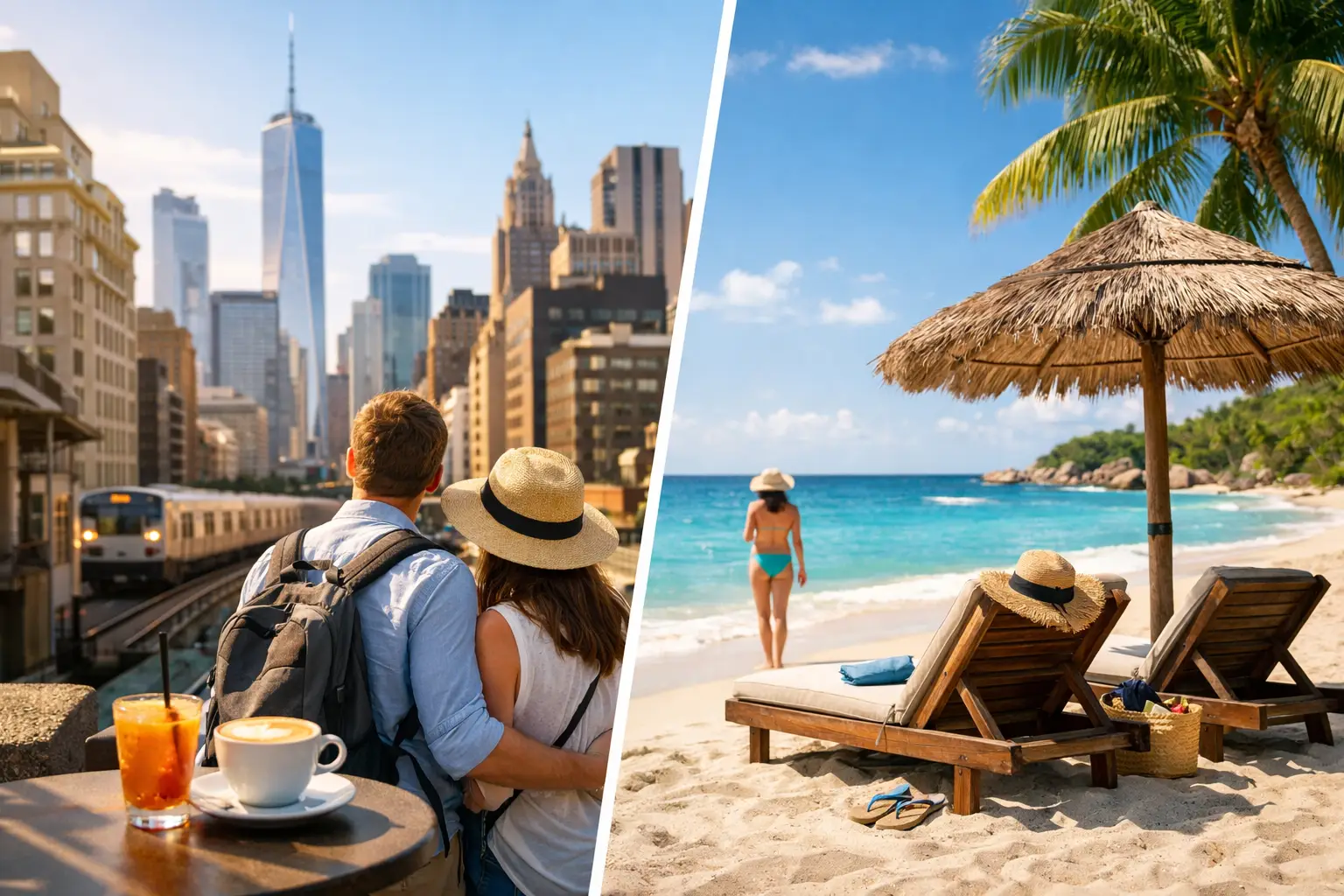
Some trips are decided in seconds. Others linger for weeks, usually somewhere between a grey Tuesday commute and an overly optimistic look at flight prices. If you’re stuck on the classic city break or beach holiday question, the answer is rarely about which one is better. It is about what kind of traveller you are right now, and what you want the next few days away to do for you.
A short trip can sharpen a mood or soften one. A city gives you pace, contrast, and that pleasing sense that something interesting is always happening just around the corner. A beach holiday does something else entirely. It slows the pulse, stretches the day, and gives you permission to stop performing productivity for a while. Both can be brilliant. Both can also disappoint if they are chosen for the wrong reasons.
City break or beach holiday: start with your energy
The simplest place to begin is not destination, weather or price. It is energy. Ask yourself whether you want stimulation or restoration.
A city break suits travellers who enjoy movement. You might spend the morning in a market, the afternoon in a gallery, and the evening in a neighbourhood wine bar you had not planned on finding. Cities reward curiosity and a certain tolerance for improvisation. Even when you have booked a smart hotel and pre-planned a few museum entries, there is often more walking, more decision-making and more sensory noise than you expected.
A beach holiday is usually better when your battery is low. That does not mean it has to be lazy or dull. The best beach destinations still offer boat trips, coastal walks, local restaurants and a few cultural diversions. But the centre of gravity is different. The days are built around rest rather than action. If your ideal holiday photo involves a paperback, a shaded terrace and no pressing schedule, that tells you quite a lot.
This is where many people misread themselves. They book a city because they think they should make the most of limited time, then come home needing another break. Or they choose the coast in search of collapse-level relaxation and realise by day two that they miss the hum of a place with galleries, cafés and late-night conversation. The better question is not what sounds more impressive. It is what will feel good once you are there.
What kind of memories do you actually want?
City memories tend to be layered. You remember the tiny bar with excellent anchovies, the side street church no one mentioned, the bookseller who sent you to lunch somewhere better than your saved list. Urban trips are often defined by accumulation. The pleasure comes from detail, from serendipity, and from feeling briefly plugged into the life of a place.
Beach memories are often more elemental. Light on the water. Salt on the skin. A long lunch that became dinner because no one saw a reason to move. The appeal is not that less happens, but that the right things happen more slowly. If your best travel moments come when time seems to loosen its grip, that matters.
This is also where travelling companions can settle the debate for you. If one of you likes structure and one prefers drift, a city with a nearby beach can be the diplomatic triumph. Lisbon, Barcelona, Nice and Palma all handle this balancing act well. You get museums, neighbourhoods and good meals, but the sea is not far away when urban enthusiasm starts to fade.
Budget changes the answer more than people admit
There is a romantic idea that beach holidays are indulgent and city breaks are efficient. Reality is messier.
A city break can be surprisingly expensive if you are heading somewhere popular for a weekend. Flights on Friday evenings and Sunday returns are not generally priced with compassion. Add central accommodation, museum tickets, taxis when your feet give up, and several meals out a day, and the bill rises quickly.
Beach holidays can offer better value if you stay longer, travel slightly off-peak, or choose a destination where the main entertainment is built into the landscape. Once you have paid for the room, a swim and a walk along the coast cost nothing. On the other hand, some classic beach resorts charge heavily for location, sea views and seasonal convenience.
If cost is the deciding factor, be honest about your habits. In cities, you are more likely to spend from morning to midnight because there is always one more thing to do. On the coast, your spending often clusters around accommodation and dining. Neither is automatically cheaper. The cheapest option is the one that matches how you naturally travel.
Season matters, especially from the UK
British travellers know this already, but it is worth saying plainly: weather can make fools of all of us.
A city break is often stronger in spring and autumn. Walking is pleasant, cultural programmes are in full swing, and you are less likely to spend the day searching for shade or shelter. Summer city trips can be glorious, but they can also mean queues, packed pavements and the sort of heat that makes even charming squares feel like a test of character.
A beach holiday has a narrower sweet spot if sun is the point. Travelling too early or too late in the season can mean a handsome coastal town with no real beach weather to speak of. That is not always a problem if you love sea views, seafood and long walks. It is a bigger issue if you were planning six straight hours on a sun lounger and a restorative swim before lunch.
One useful rule is this: if the weather forecast matters enough to affect your mood, lean beach only when conditions are reliably in your favour. Cities are more forgiving when the skies turn. You can always retreat into a museum, a market hall or a particularly well-timed lunch.
The best city break or beach holiday depends on trip length
For two or three nights, cities usually win. They are compact in experience even when they are physically spread out. You can arrive on Friday, have a full Saturday of culture and eating, squeeze in one more neighbourhood on Sunday, and return feeling you have genuinely gone somewhere.
A beach holiday often needs a little more runway. The first day is for arriving, exhaling and working out the rhythm. The second is when you begin to settle. By the third or fourth, you are finally operating at beach speed, which is rather the whole point.
That said, there are exceptions. If you live a frantic life and can reach a beach destination on a direct flight in a few hours, even a long weekend by the sea can feel medicinal. Likewise, some cities demand more time than a weekend can gracefully provide. If you are forever making lists of what you missed, that is usually a sign the trip was too short for the place.
Be honest about who you’re travelling with
Solo travellers often thrive on city breaks. There is built-in company in cafés, museums, walking tours and busy streets, and you can follow your own interests without negotiating every hour. Cities are generous to independence.
Beach holidays can be dreamy solo too, but they depend more on your comfort with stillness. If you enjoy your own company and can happily spend an afternoon reading by the water, perfect. If not, choose a beach destination with a proper town attached, so there is more to do than rotate on a towel.
Couples can go either way. If one of you hears holiday and thinks rooftop bar while the other hears it and thinks nap, compromise becomes strategic rather than sentimental. Families, meanwhile, often find beaches easier for younger children and cities better for older ones, though much depends on pace, weather and how enthusiastic everyone is about walking.
If you are still deciding, the Destination Unlocked podcast is genuinely useful. It is as handy as a guidebook and as personal as a chat with your most well-travelled friend, with each 40-minute episode packed with the details you need to shape a great trip.
The middle ground is often the smartest move
You do not always need to choose one camp and defend it to the death. Some of the best trips sit in the overlap. A stylish coastal city, a resort town with proper local life, or an island capital with beaches nearby can give you range without forcing a compromise that feels diluted.
This approach works particularly well for travellers who get restless after too much sun but tired after too much sightseeing. It is also excellent for first-time visits to destinations where culture and coastline are both part of the appeal. You can spend one day in museums and markets, the next on the water, and return without feeling that you sacrificed the good bits.
The best holiday choice is usually the one that matches the version of you getting on the plane. Not your aspirational self, not your social media self, and not the person who thinks they should be collecting landmarks at speed. If what you need is a reset, choose the sea. If what you need is spark, choose the city. And if you want a bit of both, there are plenty of places clever enough to offer exactly that.