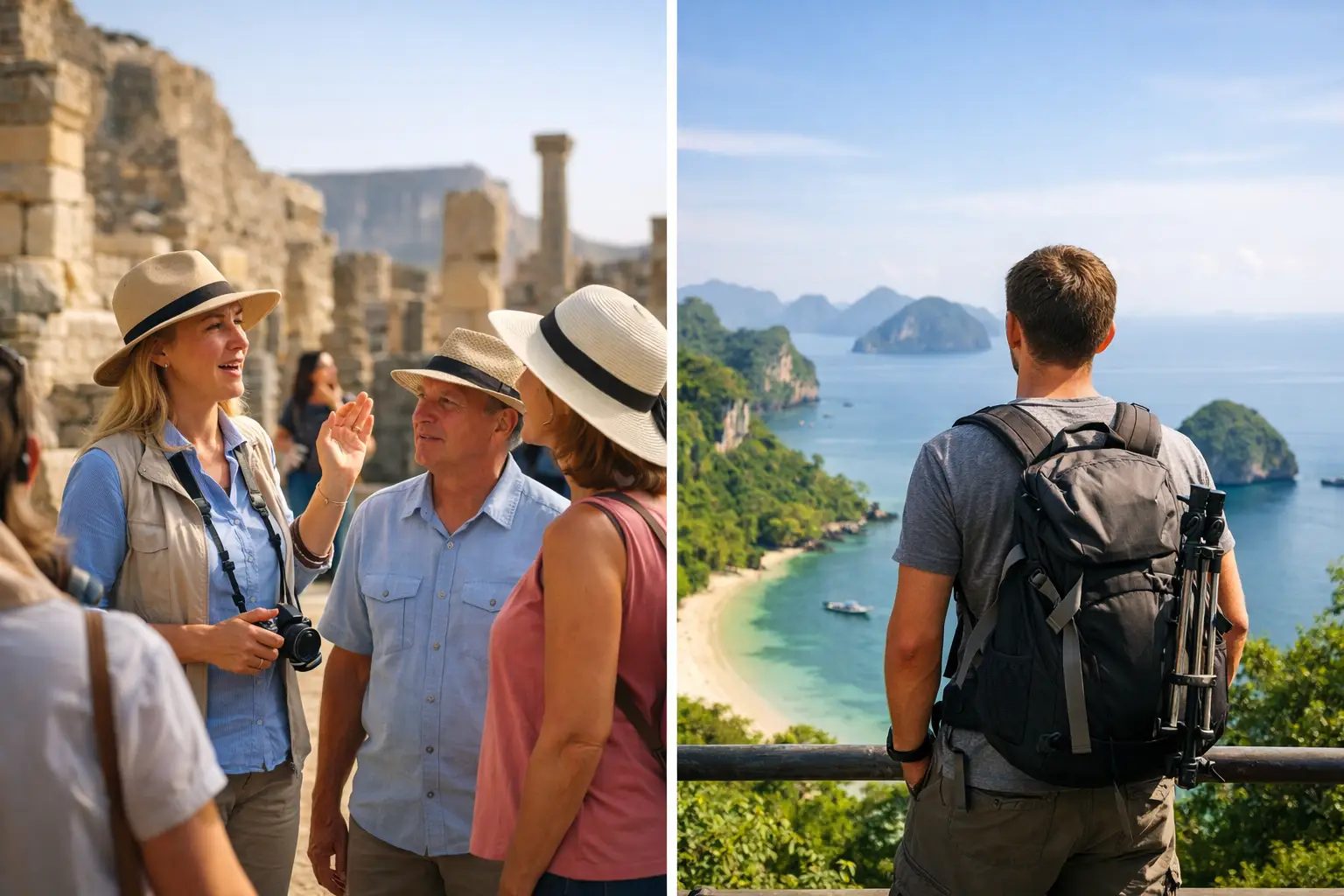
Some trips are crying out for a guide. Others are far better when you’re left alone with a decent map, a half-formed plan and the freedom to miss your train because a café looked too inviting to ignore. That is really the heart of guided tours vs independent travel: not which is better in the abstract, but which suits the place, the moment and the kind of traveller you are on this particular trip.
Plenty of experienced travellers switch between both. You might want expert structure in Jordan, complete freedom in Copenhagen, and a hybrid approach in Japan where a food tour on day one helps everything else make more sense. Treating the choice as a matter of ideology can lead to rather silly decisions. Treating it as a practical question usually leads to a better holiday.
Guided tours vs independent travel: what changes in practice?
The obvious difference is control. On a guided tour, someone else has done the planning, set the pace and usually solved the fiddly bits – transport timings, ticketing, logistics, local language hurdles. Independent travel hands all of that to you, which is either thrilling or faintly exhausting depending on your temperament and how much sleep you’ve had.
But the deeper difference is how each style shapes your experience of a place. Guided travel tends to create context quickly. A strong guide can explain why a city is laid out as it is, what you’re actually looking at in a market, or why one neighbourhood feels entirely different from the next. Independent travel creates room for accident and rhythm. You notice things because nobody is shepherding you onwards.
Neither is inherently more authentic. That word gets thrown about rather lazily in travel. A small-group walking tour led by a local historian can be far more meaningful than wandering around a city centre buying magnets and calling it spontaneity.
When guided tours are the smarter choice
Guided tours come into their own when a destination has layers that are hard to read without help. Archaeological sites, politically complex places, wildlife-rich landscapes and countries where transport is possible but awkward often become far richer with an expert in the picture.
Think about somewhere like Jerusalem, where history, religion and modern politics sit on top of one another in ways that can be difficult to grasp without informed explanation. Or somewhere vast such as Kazakhstan, where distances and local logistics can eat into your time if you try to work everything out from scratch. In those cases, a guide does more than save effort – they help you see what you might otherwise miss entirely.
There is also the question of access. Good tours can open doors. That might mean entry to a vineyard with the winemaker, a street food route you would never have found on your own, or the confidence to explore a medina without spending the afternoon mildly lost and pretending that was the plan.
For solo travellers, tours can also solve the social side of a trip. Not everyone wants to strike up conversation in hostels or bars, and not every destination makes that easy. A well-run tour gives you company without requiring the full extrovert performance.
The trade-off, of course, is pace. Even excellent tours involve compromise. If you love a museum, you may not get enough time. If you dislike shopping stops dressed up as cultural immersion, you may have to grin and get through them. Group travel can be energising, but it can also mean spending three hours with a man from Surrey who has very strong views on breakfast buffets.
Why independent travel still has a loyal following
Independent travel appeals for one reason above all: freedom. You can change your mind. You can stay longer. You can walk down the wrong street and find something far more memorable than the thing you meant to see.
That flexibility matters most in destinations that are easy to navigate or rewarding simply to inhabit. Cities such as Barcelona, Bristol or Seville offer plenty without needing constant interpretation. Part of their appeal lies in wandering, lingering and letting the day unfold. If you are comfortable researching as you go, independent travel lets you build a trip around your own interests rather than someone else’s itinerary.
It can also be better value, though not always. Booking trains, guesthouses and entrance tickets yourself can save money, particularly in Europe where infrastructure is straightforward and competition keeps prices relatively transparent. But independent travel can become expensive when mistakes creep in – last-minute bookings, poor route planning, expensive taxis because the bus system looked too confusing, or paying premium rates for experiences you could have found more cheaply with local knowledge.
There is also a particular pleasure in self-directed discovery. Many seasoned travellers are not trying to tick off maximum sights per day. They want enough structure to feel grounded and enough slack to follow instinct. That might mean an unscheduled detour into a bookshop in Reykjavik, an extra hour over lunch in Emilia-Romagna, or a long walk through a neighbourhood that never makes the guidebook cover.
Cost, confidence and the myth of the “better” traveller
One unhelpful idea persists in travel culture: that independent travel is somehow more impressive. It is not. It simply asks for a different skill set. You need planning ability, tolerance for uncertainty and enough confidence to recover when things go wrong.
Guided tours are sometimes dismissed as easy. That misses the point. The value of a guide is not that you couldn’t physically get somewhere on your own. It is that expertise can sharpen the experience. If a marine guide helps you understand a coastline, or a local food expert gives shape to a city’s culinary habits, that is not a lesser form of travel. It is often a smarter one.
Budget matters too, but it is not as simple as tour equals expensive and independent equals cheap. Group tours often bundle transport, accommodation and admission in ways that reduce surprise costs. Independent travel gives you more control, but also more chances to overspend. The right question is not “which is cheaper?” but “what am I paying for?” Convenience, insight, flexibility and comfort all carry a price.
Guided tours vs independent travel for different trip types
For short city breaks, independent travel often wins. If you have three days in Copenhagen or Lisbon, you may not want every hour spoken for. A single specialist tour – perhaps food, architecture or history – can provide useful orientation, while leaving the rest of the weekend open.
For ambitious multi-stop itineraries, tours can make far more sense. If your route involves internal flights, border crossings, remote regions or limited public transport, the admin load rises quickly. What looks romantic on paper can become a spreadsheet with luggage.
For adventure travel, the answer depends on risk and infrastructure. A well-marked Alpine region with reliable trains may reward independence. A mountain area with shifting conditions, language barriers and safety considerations may be far better with a local operator.
For culturally dense destinations, many travellers benefit from a blend. Independent travel gets you the freedom to absorb a place at your own pace; guided experiences add interpretation where it counts. That middle ground is often the sweet spot.
The best option is often both
The most interesting travellers rarely sit in one camp. They mix formats according to destination and purpose. You can travel independently and still book a guide for a day. You can join a longer tour and carve out time alone before or after. This is less a contest than a toolkit.
That approach also reduces the weaknesses of each style. A walking tour on your first morning can help decode a city, after which you explore alone with more confidence. A guided trek can handle safety and route finding, while independent days in town give you breathing room. Even travellers who strongly prefer autonomy often find that a good local guide changes the quality of what they notice.
If you enjoy travel media built around knowledgeable conversation – the sort that helps a place come into focus before you arrive – you’ll already understand the appeal of informed context. Sometimes that context is enough in advance. Sometimes it is best delivered on the ground by someone who knows the place intimately.
How to choose for your next holiday
Ask yourself three things. First, how much effort do you genuinely want to put into planning? Not how much effort you think a good traveller ought to put in. Second, how comfortable are you with uncertainty, missed connections and the occasional muddle? Third, is this a destination where expert interpretation will materially improve the trip?
Your answers may change from year to year. The holiday you want after a draining few months at work may be very different from the one you want when you are feeling energetic and curious. Age, budget, confidence and travel experience all matter, but so does mood.
A good trip is not the one that proves something. It is the one that gives you the richest experience of the place while still feeling like your holiday. Choose the format that leaves room for curiosity, and you are unlikely to go far wrong.