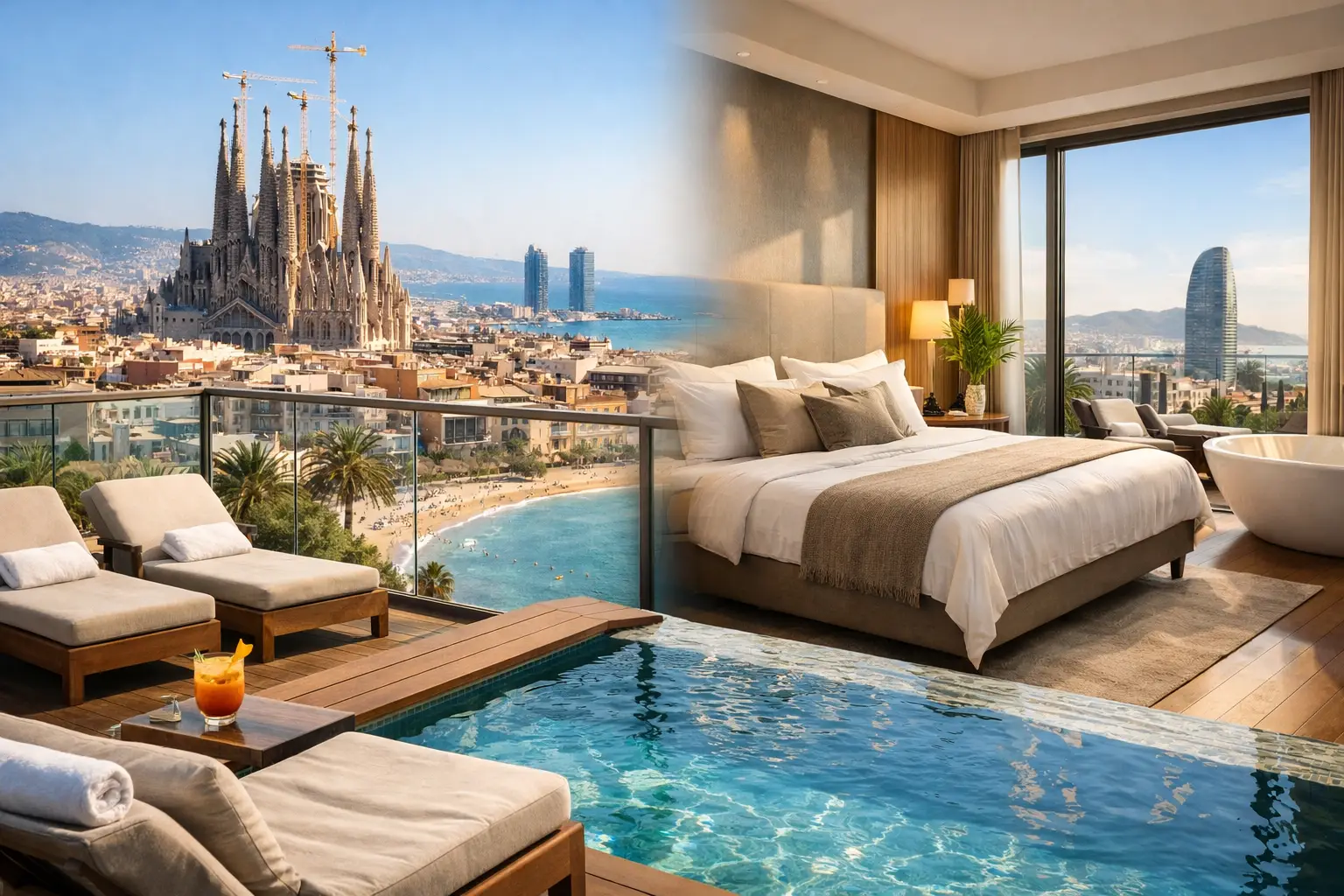
Barcelona asks a useful question before you book: what sort of city break are you actually planning? The best hotels in Barcelona are not necessarily the ones with the grandest lobby or the highest star rating. They are the ones that put you within easy reach of the version of the city you want to enjoy – early walks by the sea, vermouth in a handsome square, Modernista architecture before breakfast, or late dinners without a long trek back to bed.
The city is compact enough for a long weekend, but its neighbourhoods have strikingly different rhythms. Choose well and you can spend less time studying transport maps and more time lingering over a second coffee. Choose badly and a very good hotel can feel oddly removed from your plans.
Hotels in Barcelona: start with the neighbourhood
For a first visit, the Eixample is often the most straightforward answer. Its broad, gridded streets make navigation easy, and it places many of Barcelona’s great buildings within walking distance. This is where to stay if you want to see Casa Batlló, La Pedrera and the central stretch of Passeig de Gràcia without turning your holiday into a logistical exercise. Hotels range from polished five-star addresses to smart boutique options in restored townhouses, so it suits a generous range of budgets.
The trade-off is that Eixample can feel more composed than atmospheric, particularly at night. It is elegant, central and practical rather than intimate. Look a little west, around Enric Granados or the left side of Eixample, for a livelier local dining scene and streets that reward a post-dinner wander.
The Gothic Quarter appeals to travellers who want Barcelona at its most cinematic: narrow lanes, hidden courtyards and centuries of accumulated detail. It is superb for being close to the cathedral, El Born and the harbour, and there are memorable small hotels behind unassuming doorways. Yet this is an area to book with your eyes open. Some streets are noisy, rooms can be smaller than photographs suggest, and taxis cannot always pull up directly outside. If peace matters, request a room facing an inner courtyard or choose a property on the quieter fringes near Plaça de Catalunya or Via Laietana.
El Born offers much of the old-city atmosphere with a gentler, more creative mood. It is a strong choice for independent shops, wine bars, the Picasso Museum and the Parc de la Ciutadella. Couples and first-time visitors who want to walk almost everywhere tend to get on well here. The best hotels in the area feel integrated into the neighbourhood rather than set apart from it.
Pick a base for the way you travel
For architecture, shopping and a polished weekend
Stay around Passeig de Gràcia, Rambla de Catalunya or the central Eixample. You will be close to headline sights, excellent restaurants and major metro connections. This is also a sensible base if one person in your party wants galleries and Gaudí while another is quietly committed to designer shops. It happens.
Larger international hotels in this area often have the facilities that make a short break easier: dependable air conditioning, a proper concierge, generous breakfast hours and sometimes a rooftop pool. Boutique hotels can be more characterful, but check whether the room category you are considering has a lift, natural light and enough space for luggage. Barcelona’s beautiful historic buildings do not always translate into expansive bedrooms.
For food, bars and late evenings
El Born, the Gothic Quarter and Sant Antoni are better suited to travellers who want dinner to lead naturally into another drink. Sant Antoni, just south-west of Eixample, is particularly good value for a central stay. It has a confident restaurant scene, a magnificent market and fewer of the old-city crowds, while remaining walkable to many sights.
Poble-sec is another option for a more lived-in feeling, with tapas bars and access to Montjuïc. It is less conventionally pretty than El Born, but that is part of its appeal. Book here if you prefer neighbourhood energy to postcard perfection and do not mind a 20-minute walk, or a short metro ride, to some of the major attractions.
For beach time and contemporary Barcelona
Barceloneta sounds obvious for the beach, but it is not always the best place to sleep. The old fishing quarter is charming in parts, lively in summer and wonderfully close to the sand, though it can be noisy and heavily visited. For a calmer beach-adjacent stay, look towards Port Olímpic or Poblenou.
Poblenou has wide pavements, converted industrial buildings, good cafés and easy access to the waterfront. It suits families, runners, remote workers extending a break and anyone who likes to begin the day with a swim rather than a museum queue. The compromise is distance from the Gothic Quarter and Eixample, although the metro and taxis make the journey simple. If your Barcelona plan is equal parts city and seaside, this is one of the most persuasive choices.
For families and quieter nights
Gràcia feels like a small town folded into the city. Its leafy squares, independent bakeries and relaxed restaurant terraces are appealing after the intensity of central Barcelona. It is close to Park Güell and well served by public transport, but it is not the place to choose if you want every landmark on your doorstep.
Families should prioritise room layout over a fashionable postcode. Interconnecting rooms, suites with a separate sitting area, a pool and a quiet street can be worth more than a dramatic view. Barcelona is wonderfully walkable, but young children may reach a firm opinion about that by day two. A hotel near a metro stop gives everyone more options.
What to check before booking a Barcelona hotel
Barcelona’s hotel choices are plentiful, which makes the small print more useful than usual. First, establish whether breakfast is included and whether it genuinely suits your schedule. A brilliant bakery is rarely far away, but an included breakfast can be valuable when you have timed entry for the Sagrada Família or an early train.
Next, look at the room rather than just the property. In central districts, a lower-priced double may be compact, inward-facing or positioned above a busy street. Read recent guest comments for references to soundproofing, lifts and air conditioning, especially for summer travel. Rooftop terraces are a genuine pleasure in Barcelona, but they can also bring late-night noise to rooms directly below.
Location should be tested against your real itinerary. A hotel advertised as “central” may be central to the city on a map while still being a long walk from the places you have booked. If you have a morning flight, consider the ease of the airport bus, train or taxi rather than chasing the last available room in the historic centre. If you are joining a cruise from the port, a hotel near the waterfront or at the southern edge of the old town can make embarkation day less frantic.
Finally, do not assume a pool is essential. In high summer it can be a welcome reset between sightseeing and supper, particularly for families. In spring and autumn, a good terrace, a quiet room and a neighbourhood you enjoy may be the better investment.
When to book and what to spend
Barcelona is busy for much of the year. Spring and early autumn bring excellent weather alongside major demand, while summer adds beach travellers, festivals and school-holiday pressure. Prices can rise sharply around big events and weekends, so booking earlier gives you more than a lower rate: it gives you a better choice of room types and locations.
For value, consider travelling in November, January or February, avoiding major holiday dates where possible. The city remains compelling in cooler weather, with fewer queues and plenty of indoor culture. That said, some rooftop pools and terraces operate on reduced schedules, so check if those are central to your plans.
It is usually worth paying more for a location that saves regular taxi journeys and lets you return to the hotel between plans. For a two-night break, convenience has a higher value than it does on a week-long stay. On longer holidays, staying slightly beyond the tourist core can offer more space, better rates and a more local sense of daily life.
Build a hotel stay around Barcelona, not just a room
Once your base is chosen, reserve the experiences that shape your days. Timed visits to the Sagrada Família and Park Güell are best arranged before you arrive, while a guided walk through the Gothic Quarter or a food-focused evening in El Born can add the local context that guidebook checklists miss. Montjuïc deserves more than an hour between other sights, especially if you combine its galleries, gardens and city views.
For thoughtful planning before you book, the Destination Unlocked podcast is as useful as a guidebook and as personal as a chat with your most well-travelled friend. Each 40-minute episode is designed to give you the information you need for a great trip, with the sort of local perspective that helps a neighbourhood become more than a pin on a map.
Barcelona rewards a little precision. Book the hotel that supports your mornings and evenings, leave room for an unplanned vermouth stop, and the city will do the rest.