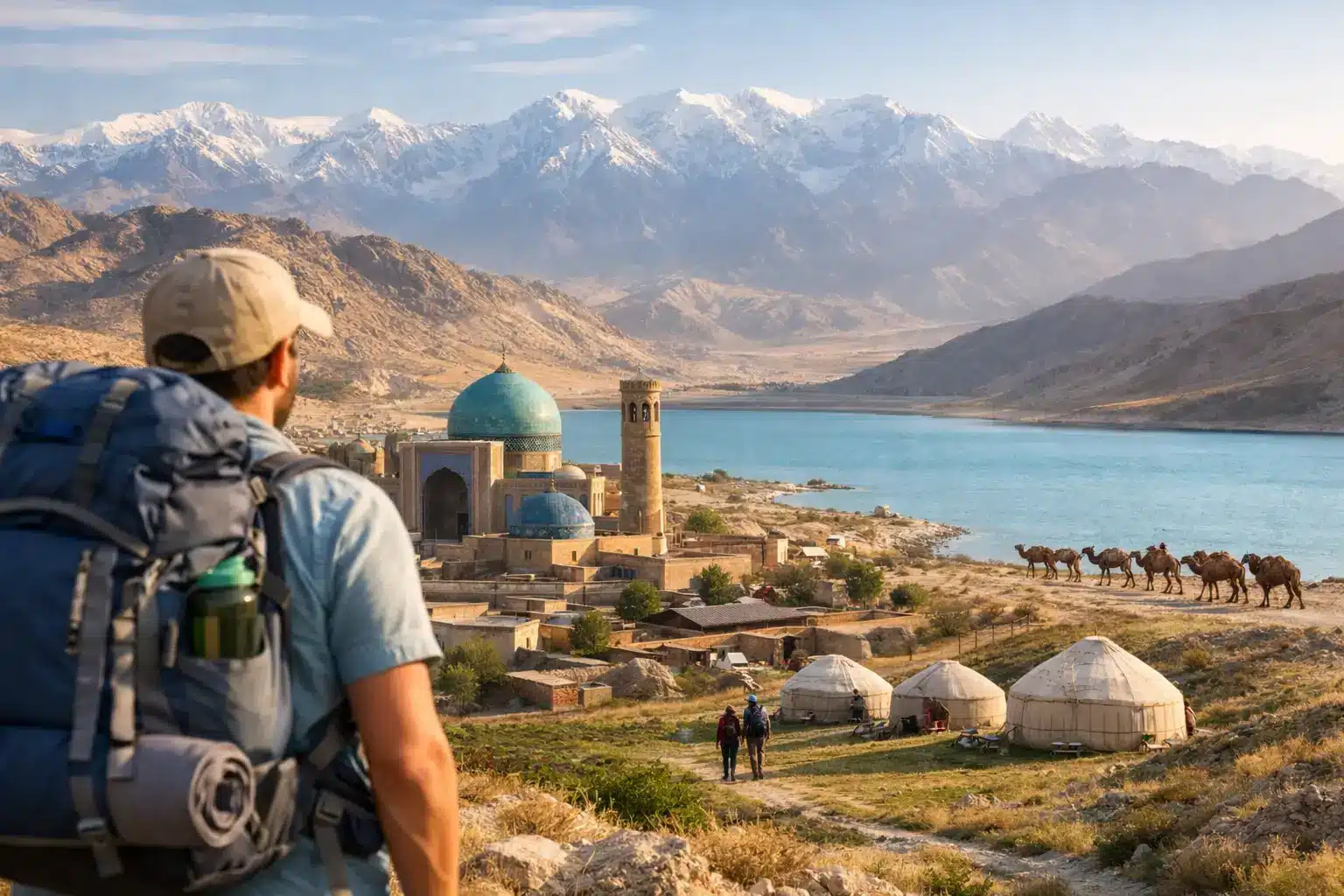
The first sight of the Tien Shan from Almaty can make the rest of your holiday plan feel rather small. Snowy ridges rise behind a city of leafy avenues, Soviet mosaics and excellent coffee, while a night train or shared taxi can take you towards red-rock canyons, yurt camps and Silk Road cities. This backpacking Central Asia route example is designed for travellers who want that contrast without trying to cross five borders in a fortnight.
The most rewarding first trip is a four-to-six-week overland journey through Kazakhstan, Kyrgyzstan and Uzbekistan. It has the right balance of straightforward logistics, genuinely varied landscapes and enough time to linger in places that deserve more than a hurried photo stop. Tajikistan can be added for the Pamir Highway, but it changes the pace, budget and planning considerably. Turkmenistan is fascinating but has more restrictive entry arrangements, so it is best treated as a separate project rather than a casual addition.
A four-to-six-week Central Asia backpacking route
Start in Almaty, travel south-east through Kyrgyzstan, cross into Uzbekistan via the Fergana Valley, then finish in Tashkent. The route works well in either direction, though beginning in Kazakhstan gives you a gentle introduction: comfortable city hotels, a major international airport and easy access to dramatic day trips.
Allow four weeks if you are happy with a quick rhythm and a few long travel days. Five or six weeks is better if you want to stay in family-run guesthouses, take a proper trek, and give Samarkand, Bukhara and Khiva the time their history commands.
Days 1-4: Almaty, Kazakhstan
Almaty is a civilised place to recover from a flight and sort out practicalities. Stay centrally, around Panfilov Park or the pedestrian-friendly streets near Abai Avenue, where you can walk to restaurants and use taxis easily. The city rewards an unhurried day: Zenkov Cathedral, the Green Bazaar, Soviet-era architecture and a proper Kazakh meal of beshbarmak are all within reach.
Reserve at least one day for Charyn Canyon and the surrounding national park. It is a long but memorable excursion through open steppe to sandstone formations that look as if they belong in the American West, only with fewer road signs and a great deal more sky. A guided small-group day trip is sensible if your time is limited; independent travellers can arrange transport, but the journey is less forgiving if plans slip.
Days 5-13: Bishkek, Issyk-Kul and Karakol, Kyrgyzstan
From Almaty, cross to Bishkek by shared taxi or pre-arranged transfer. Border procedures can be brisk or slow depending on the day, so avoid booking an onward connection that evening. Bishkek is compact and low-rise, with broad boulevards and an appealingly lived-in feel. One or two nights is usually enough before heading east.
The road to Issyk-Kul is where Kyrgyzstan begins to show its hand. This vast alpine lake is fringed by summer pastures, small settlements and mountains that change colour by the hour. Cholpon-Ata is convenient for beaches and petroglyphs, but Karakol, at the lake’s eastern end, is the stronger base for walkers and food-minded travellers.
Book a few nights in Karakol rather than treating it as a stopover. From here, a day walk in Altyn Arashan, a visit to the wooden Dungan Mosque and the Russian Orthodox church, or a hot spring excursion can all be arranged locally. In summer, consider an overnight yurt stay in Jeti-Oguz or a longer trek towards Ala-Kul Lake. These are the moments that tend to remain after the tiled domes have faded into photographs.
Days 14-19: Naryn and Tash Rabat
Travel south to Naryn for Kyrgyzstan at its most spacious. This is horse country: wide valleys, high roads, felt yurts and a sense that the map has been drawn with a very large pencil. Naryn town itself is functional rather than beautiful, but it is a useful base for organising transport and stocking up before heading to Tash Rabat.
Tash Rabat is a remarkably atmospheric stone caravanserai tucked into a mountain valley near the Chinese border. Staying in a nearby yurt camp is less about luxury than location. Nights can be cold even in summer, facilities are simple, and the weather has the final word. Yet waking to grazing horses and the sound of almost nothing is precisely why this detour belongs on the route.
If you have six weeks, add Song-Kul Lake between Naryn and Tash Rabat. It is one of Central Asia’s great yurt-camp experiences, especially from June to September. If you only have four weeks, choose either Song-Kul or Tash Rabat, rather than cramming both into an exhausting loop.
Crossing from Kyrgyzstan to Uzbekistan
Return via Naryn to Bishkek, then take an internal flight or long road journey to Osh. Osh is a useful staging point, but give it a night if you can. Its bustling bazaar and the view from Suleiman-Too offer a vivid introduction to the Fergana Valley’s trading culture.
The Osh-Andijan crossing is generally the most practical border into Uzbekistan for this itinerary. Keep printed or offline copies of hotel bookings, insurance and onward plans, and check current visa and border requirements well before departure. Rules, permitted crossings and registration expectations can change, and this is not a region where old forum posts deserve blind faith.
Once in Uzbekistan, trains become one of the pleasures of the trip. They are often more comfortable and predictable than long road transfers, particularly on the main route between Tashkent, Samarkand and Bukhara. Book popular departures in advance where possible, especially around Uzbek public holidays and the spring travel season.
Days 20-24: Samarkand
Samarkand has no need to compete for your attention, but it does benefit from good timing. See the Registan early or later in the day, when the crowds thin and the blue tilework takes on a softer light. The Shah-i-Zinda necropolis, Bibi-Khanym Mosque and Siyob Bazaar easily fill another day.
Choose a hotel in or near the old town if the budget allows. The convenience matters here: returning on foot after dinner, rather than negotiating taxis across town, makes the city feel more intimate. A local food tour or craft workshop is also worth booking, particularly for travellers who want more than a roll call of monuments.
Days 25-28: Bukhara and Khiva
Bukhara is the route’s most seductive city. Its old centre is compact enough to wander without a plan, moving from the Poi Kalyan complex to tea houses, caravanserais and quiet backstreets. Two nights is the minimum; three lets you enjoy it at the pace it deserves. Look for a characterful guesthouse in a converted merchant house, where the courtyard breakfast can become part of the experience rather than merely fuel for sightseeing.
From Bukhara, continue to Khiva if you have the time. The walled Ichon-Qala can feel theatrical at first, but stay overnight and it becomes far more compelling after day visitors leave. Climb a minaret or city wall close to sunset, then eat within walking distance of your hotel. The trade-off is travel time: reaching Khiva requires a long train or road day, so travellers on a tighter schedule may prefer an extra night in Bukhara instead.
Days 29-30: Tashkent
End in Tashkent, a capital that is more interesting than its reputation suggests. The metro stations are miniature galleries of Soviet design, Chorsu Bazaar is excellent for a final browse, and the city’s restaurants provide a fitting farewell to a route that has moved from mountain kitchens to Silk Road dining rooms.
Stay near the centre or close to a metro station for an easy airport departure. It is also the best place to build in a buffer night before flying home, especially after a multi-country journey where weather, shared taxis and border queues have all had a say in the schedule.
When to travel, and what to book ahead
Late May to June and September to early October are the sweet spots for most of this itinerary. Spring brings green valleys and comfortable city temperatures, though mountain routes can still be snowbound. Autumn is superb for Uzbekistan’s cities and harvest-season markets, while higher Kyrgyzstan can turn sharply cold by late September. July and August are ideal for high-altitude yurt stays but can be fiercely hot in Samarkand and Bukhara.
Book the anchors first: international flights, your first two nights in Almaty, any domestic flight to or from Osh, key train journeys in Uzbekistan, and yurt camps or guided treks in peak summer. Leave room around the edges. The best overland days often begin with a recommendation from a guesthouse owner, a driver heading in the right direction, or a lunch that takes longer than intended.
For useful pre-trip listening, the Destination Unlocked podcast is as useful as a guidebook and as personal as a chat with your most well-travelled friend. Each 40-minute episode brings together the practical detail and local perspective that help a promising route become a great trip.
Central Asia rewards travellers who plan the big moves, book the nights that matter, then allow the journey to remain a little unscripted. Leave one spare day if you can. You may spend it waiting for a mountain pass to clear, or you may spend it drinking tea in a courtyard you had never intended to find.