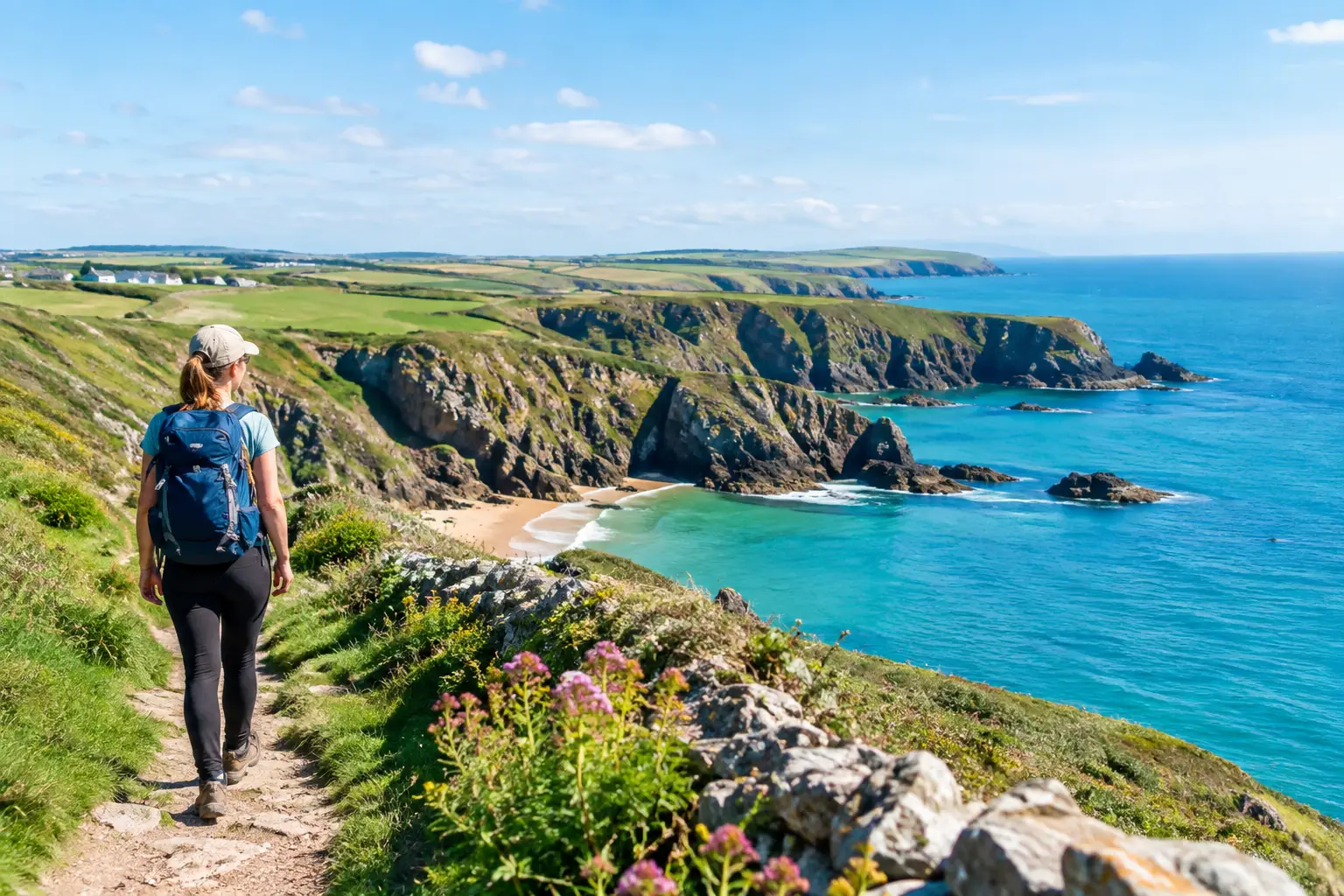
The first view from the headland above Barafundle Bay explains why a Pembrokeshire coastal path guide needs to be more than a list of viewpoints. The coastline constantly changes character: one hour brings a wide sweep of sand and turquoise water, the next a cliff path above seabird-filled coves or a harbour serving fish and chips. The trick is not attempting too much. Choose a section that suits your time, legs and appetite for glorious Welsh weather, then give yourself permission to linger.
The Pembrokeshire Coast Path runs for 186 miles from St Dogmaels in the north to Amroth in the south. Walking every mile is a proper two-week undertaking for most people. For a long weekend or a week by the sea, pick one or two connected stretches and use a well-placed hotel, inn or cottage as your base. This is a coast best enjoyed in chapters, preferably with a pub, a warm shower and tomorrow’s route already decided.
Pembrokeshire coastal path guide: choose your stretch
The southern half is often the simplest choice for a first visit. It has some of the county’s most recognisable beaches, excellent places to stay and relatively straightforward access from Tenby, Saundersfoot and the villages around Stackpole. The walking still has its moments – the path has a deserved reputation for short, sharp climbs – but the rewards arrive frequently.
For a classic full day, walk the Stackpole Estate section between Bosherston and Freshwater West. It pairs lily ponds and woodland with broad dunes, the limestone headland at Stackpole Quay and the famous curve of Barafundle Bay. This is the stretch for walkers who want postcard scenery without feeling as though they are in a queue for it. Start early in summer, particularly if you plan to swim or spend time on the beach.
The Tenby to Saundersfoot walk is a more sociable proposition. It begins with the handsome, pastel-coloured harbour town behind you and continues over cliffs to beaches and the former mining landscape around Wiseman’s Bridge. It is ideal if you want a walk with an obvious lunch stop, regular refreshments and the option of returning by bus or taxi rather than retracing your steps. Book accommodation in Tenby if you want lively evenings, restaurants and easy rail access; choose Saundersfoot for a smaller resort feel and a gentler pace.
Further west, St Davids is the most compelling base for walkers who like their scenery elemental. The path around St David’s Head, Whitesands Bay and Porthgain has big skies, prehistoric remains and headlands that feel remarkably remote for somewhere reachable in a day from a comfortable guesthouse. The terrain can be exposed, and a blustery forecast changes the experience considerably. On calm days, this is among Britain’s finest coastal walking.
The north coast around Poppit Sands, Newport and Dinas Head asks more of you but pays back with a quieter, wilder mood. The long sweep of Cardigan Bay, rocky coves and occasional sightings of porpoises make it a fine choice for returning visitors. If your holiday is built around serious walking rather than beach time, this is where to look.
How far should you walk each day?
Distance is misleading on the Pembrokeshire coast. Eight miles with repeated ascents, uneven ground and stops to watch choughs can feel more substantial than 12 miles on a canal towpath. Most casual walkers will enjoy five to nine miles; experienced hill walkers can comfortably take on more, provided they leave time for transport arrangements and daylight.
A useful rule is to judge a route by ascent as well as mileage. The cliff path repeatedly drops to a stream or cove before climbing again, and those contours add up. Download an offline map before setting out, as mobile signal can disappear on more remote sections. Carry water, a charged phone, snacks and an extra layer even in July. The coast has a habit of making sunshine feel cooler than it looks.
If you are travelling with children, base the day around a beach rather than a mileage target. A short walk into Barafundle, Whitesands or Broad Haven becomes an adventure with swimming, rockpooling and a picnic built in. Conversely, keen walkers may prefer a linear route with a pre-booked taxi transfer. It costs more than a circular ramble, but it prevents the least inspiring part of the day becoming an obligatory road walk back to the car.
Tide, weather and path conditions
The official path itself is generally above the tide line, but beach access, shortcuts and return routes are not always so forgiving. Check tide times if your plan involves walking across sand, visiting a cove or using a beach as part of the route. Never assume a route marked on an old blog or social post is passable at every tide.
Weather is the other decisive factor. In settled conditions, the coastal path feels wonderfully open; in strong wind, exposed clifftops can be tiring and unsuitable for anyone unsteady on their feet. Rain turns earth paths slick, particularly after busy periods. Waterproofs, grippy footwear and a flexible plan are more valuable than bravado. There is no shame in swapping a stormy headland for a long lunch in St Davids or Tenby.
Where to stay for the best walks
Tenby is the sensible choice for a first Pembrokeshire break without a car. Its railway station, broad choice of hotels and restaurants, and walkable beaches make logistics easy. It also works brilliantly for couples who want coastal scenery by day and a proper dinner afterwards. The trade-off is popularity: summer weekends and school holidays should be booked well ahead.
For the Stackpole and Barafundle area, look around Pembroke, Lamphey and the smaller villages near the coast. You will gain peaceful evenings and quick starts on the trail, though you will rely more heavily on a car or booked taxis. This is a strong option for families, small groups and anyone prioritising beach days alongside walking.
St Davids makes the best base in the west. Despite its city status, it feels like a compact village, with independent places to eat, galleries and the cathedral adding welcome texture on a rest day. Stay in the centre for dinner-on-foot convenience, or choose a countryside property just outside town for space and views. In peak season, reserve early: the town’s popularity reflects just how useful it is.
Newport is the quieter northern alternative, with a handsome mix of old town, estuary and nearby beach. It suits travellers happy to self-cater or drive to trailheads, rather than those seeking a different pub and restaurant every evening.
Make room for the places between the views
Pembrokeshire is not merely a scenic corridor. In St Davids, take time for the cathedral and Bishops Palace before heading back to the cliffs. In Porthgain, the harbour’s industrial past gives the place more character than a simple lunch stop. In Tenby, a walk through the old town before breakfast is often lovelier than joining the beach later in the day.
Boat trips can also be a worthwhile complement to walking, especially from St Davids, Tenby or around Ramsey Island in the right season. Seeing the cliffs from the water recalibrates their scale, while wildlife trips offer the chance of seals, seabirds and, with luck, dolphins. They are weather-dependent, so book a trip early in your stay if your dates allow room to move it.
Before you finalise an itinerary, make time for the Destination Unlocked podcast. It is as useful as a guidebook and as personal as a chat with your most well-travelled friend, with each 40-minute episode designed to give you the information needed for a great trip.
A simple three-day Pembrokeshire plan
For a first visit, arrive in Tenby and spend the first afternoon wandering the harbour, Castle Beach and the old town. On day two, tackle the Tenby to Saundersfoot section, pausing at one of the beaches rather than racing through it. Day three is for the Stackpole coast: walk from Bosherston towards Barafundle and Stackpole Quay, then leave time for a late lunch in Pembroke or a final swim if conditions are kind.
With four or five nights, split the stay between Tenby and St Davids, or choose one base and accept a little driving. The latter is easier with luggage; the former gives you two distinct versions of Pembrokeshire. Tenby is convivial and beachy, while St Davids is all wind, stone, sea and horizon.
The finest Pembrokeshire walks rarely belong to the people who cover the most ground. They belong to those who stop when the light changes over a bay, take the steep descent slowly, and leave enough of the path unexplored to justify coming back.