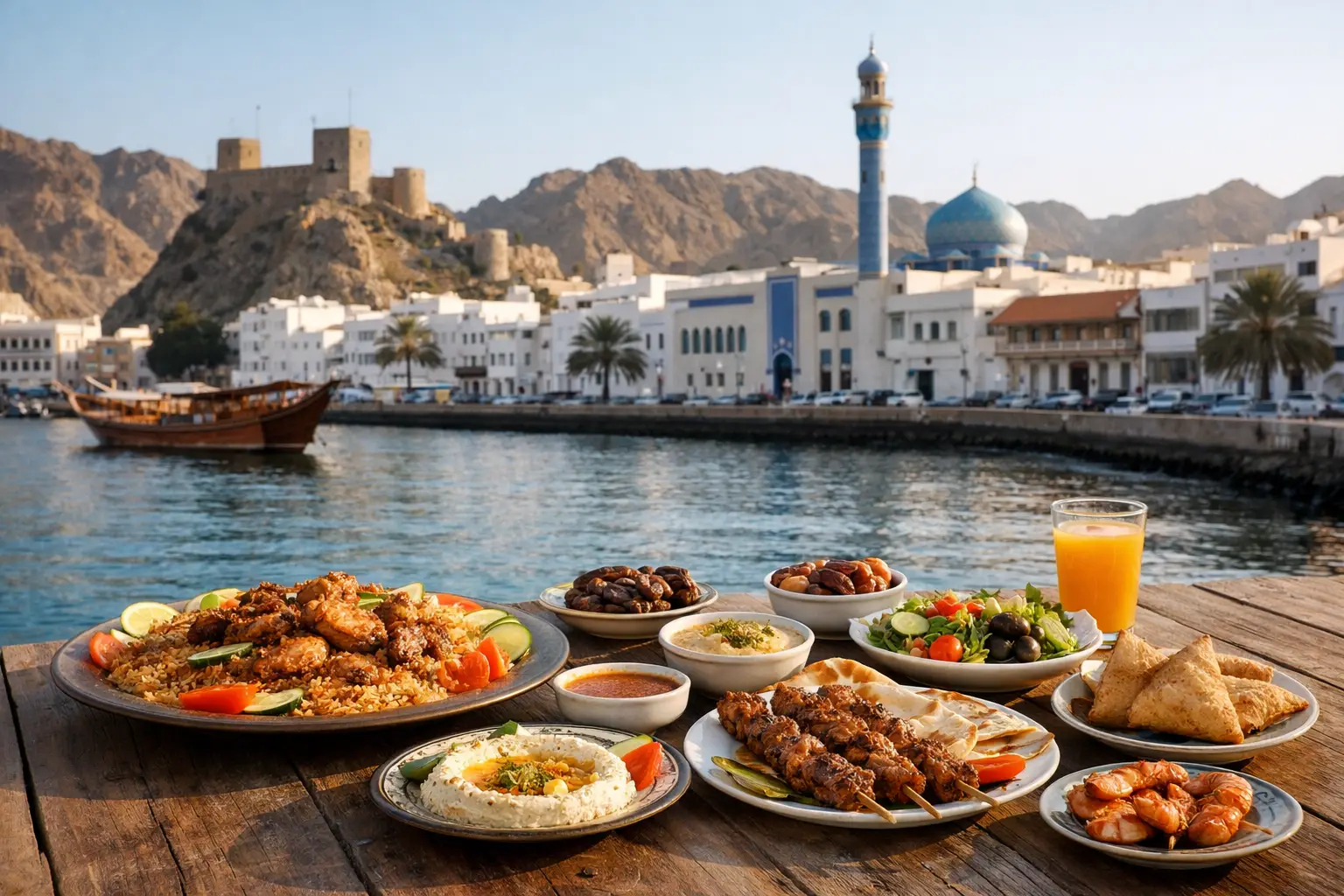
You can tell a lot about Muscat from its table. One minute you are eating smoky grilled meat with flatbread at a no-frills local spot, the next you are lingering over cardamom coffee and dates with the sea not far away. A good muscat food guide should help you do both, because this city’s food scene is not about a single headline dish. It is about Omani tradition, Indian Ocean influence, and the easy confidence of a capital that has never needed to shout.
For travellers planning a trip, that is good news. Muscat is a city where eating well is straightforward, often affordable, and far more varied than first-time visitors expect. If you are booking a few days in Oman’s capital, food deserves a proper place in the itinerary rather than being treated as an afterthought between the Grand Mosque and Mutrah Corniche.
Muscat food guide: what makes the city’s food scene distinctive
Muscat’s cooking reflects geography as much as history. Oman sits at the meeting point of Arabia, East Africa, Persia and the Indian subcontinent, and its capital absorbs all of that. The result is a food culture where rice, grilled meat, fish, spices, rosewater, dried lime and saffron all feel at home together.
That means you should not arrive expecting only heavy Gulf staples or luxury hotel dining. You will find excellent Omani dishes, but also strong South Asian cooking, seafood worth prioritising, and sweets and coffees that turn a short pause into a small ritual. In practical terms, Muscat suits travellers who like to alternate between proper sit-down meals and more casual, locally popular places.
There is also a useful trade-off to understand. Some of the smartest hotel restaurants offer polished versions of regional dishes in beautiful settings, ideal if you want an easy first evening. But the meals you are most likely to remember may come from simpler restaurants where the menu is short, the room is busy, and the food arrives without fanfare.
What to eat in Muscat first
If your time is limited, start with shuwa, mashuai, grilled meats and halwa. That will give you a quick sense of the city’s range.
Shuwa is one of Oman’s best-known dishes, traditionally lamb or goat marinated with spices and cooked slowly until tender. It is often associated with special occasions rather than everyday dining, so you may not find the most traditional version on every corner, but whenever it appears on a menu it is worth serious consideration. The appeal is not subtlety. It is depth, warmth and long cooking done properly.
Mashuai is another classic, usually kingfish served with rice and a sharp, tangy note from lemon or dried lime. In a coastal city like Muscat, this is exactly the kind of dish that makes sense early in your trip. It is Omani, local and rooted in the sea.
Then there are the grill houses. Across Muscat, you can eat well by ordering mixed grills, skewered chicken, lamb kebabs and generous baskets of bread. These places may not feel uniquely Omani in a narrow sense, but they are part of how the city eats now. If you want a reliable, satisfying dinner after sightseeing, they are often a better bet than overthinking it.
For dessert, halwa matters. Omani halwa is not the airy sweet you may know elsewhere. It is rich, glossy, spiced and often perfumed with rosewater or saffron, sometimes studded with nuts. It pairs naturally with kahwa, the lightly bitter Omani coffee flavoured with cardamom. Together they do more than round off a meal. They introduce you to Muscat’s sense of hospitality.
Where to eat in Muscat
The most useful way to approach Muscat is by area rather than by chasing a single famous address. The city stretches along the coast, and where you are staying will shape your eating pattern.
Mutrah and old Muscat make sense for atmosphere. After time in the souq or a walk along the corniche, you can find traditional dishes, seafood and casual cafés with a bit of character. This part of the city is especially good for travellers who want food folded into sightseeing rather than treated as a separate event.
Ruwi is more functional but often stronger for everyday eating. This is where you are likely to find busy, unfussy restaurants serving Indian, Omani and broader Middle Eastern food at sensible prices. It may not deliver the prettiest setting, but it often delivers flavour and value.
Qurum and Al Khuwair offer a broader middle ground, with cafés, contemporary restaurants and hotel dining that work well if you want comfort and choice. These districts are particularly useful if you are travelling as a couple or group with mixed appetites, because one person can chase local specialities while another quietly opts for grilled fish or biryani.
If you are staying at a beach resort or higher-end hotel, do not assume you should eat every meal there. Muscat is not a city where you need to stay inside the bubble. A smart approach is to use hotel dining selectively – perhaps breakfast and one polished dinner – and spend the rest of your meals out in neighbourhood restaurants.
A practical Muscat food guide for ordering well
The best meals in Muscat often come from a little confidence and a little flexibility. Menus can be broad, and the strongest dishes are not always the ones with the most explanation. If a restaurant looks locally popular and specialises in a few things, lean into that.
Ask for the house speciality if you are unsure. This is especially useful in Omani and seafood restaurants, where the freshest catch or the signature slow-cooked dish may be more interesting than the default mixed grill. In more casual places, ordering to share works well. Rice, breads, grilled meats, curries and salads tend to complement one another, and it gives you a better read on the table.
Breakfast is worth taking seriously too. Depending on where you go, you may find paratha, egg dishes, beans, honey, fresh bread and karak-style tea alongside Arabic coffee. If you have a day trip planned to Nizwa, the coast or the mountains, a substantial breakfast in Muscat is a wise move.
One thing to bear in mind is timing. Lunch can be hearty and satisfying, but dinner often feels more atmospheric, especially once the heat drops and people are out. If you want the city at its most sociable, eat later rather than earlier.
Street food, cafés and sweet stops
Muscat is not a street-food city in the same way as Bangkok or Istanbul, so adjust expectations. You are not here for endless pavement stalls. The appeal is more understated: juice shops, shawarma counters, small bakeries, sweet shops and cafés where a quick stop turns into an unexpectedly memorable half-hour.
Fresh juices are a pleasure in the climate, particularly mango, pomegranate and lemon-mint. Shawarma is widely available and makes a useful low-commitment meal between longer plans. Bakeries are worth a glance for flatbreads and simple savoury snacks, even if they are not what you flew to Oman for.
Coffee culture matters, but not always in the way visitors first imagine. There is the ceremonial appeal of kahwa and dates, and there is also a growing café scene where younger Muscat mixes global coffee habits with local pace. If you need a break from sightseeing, this is one of the easiest cities in the Gulf in which to sit, reset and watch the day move on.
How expensive is food in Muscat?
Muscat can be gentler on the wallet than many travellers expect, particularly compared with other Gulf capitals. Casual local and South Asian restaurants are often very reasonable, and portions tend to be generous. That makes the city well suited to travellers who want to spend more on a hotel room, a desert excursion or a boat trip without sacrificing food quality.
At the same time, upscale dining exists and can be excellent. The trade-off is simple: you are usually paying for setting, service and convenience rather than dramatically better cooking. For some meals that is absolutely worthwhile. For all of them, probably not.
If you want balance, make lunch your more economical meal in a local restaurant, then save one or two evenings for somewhere with a terrace, sea view or a polished interpretation of Omani cuisine. That rhythm tends to suit Muscat rather well.
The best food strategy for a short Muscat trip
For a two- or three-night stay, variety matters more than trying to tick off every famous dish. Aim for one traditional Omani meal, one seafood-focused meal, and one casual dinner in a busy neighbourhood restaurant. Add coffee and halwa at least once, and leave room for a shawarma or juice stop when you are out and about.
That approach gives you a truer picture of the city than a checklist ever could. Muscat is not trying to overwhelm you with novelty. Its charm is steadier than that. It feeds you through hospitality, coastal freshness, deep-rooted flavours and the kind of places locals actually use.
If you travel for food because it helps a place make sense, Muscat rewards that instinct. Order the fish. Say yes to the coffee. And give the city time to reveal itself one meal at a time.