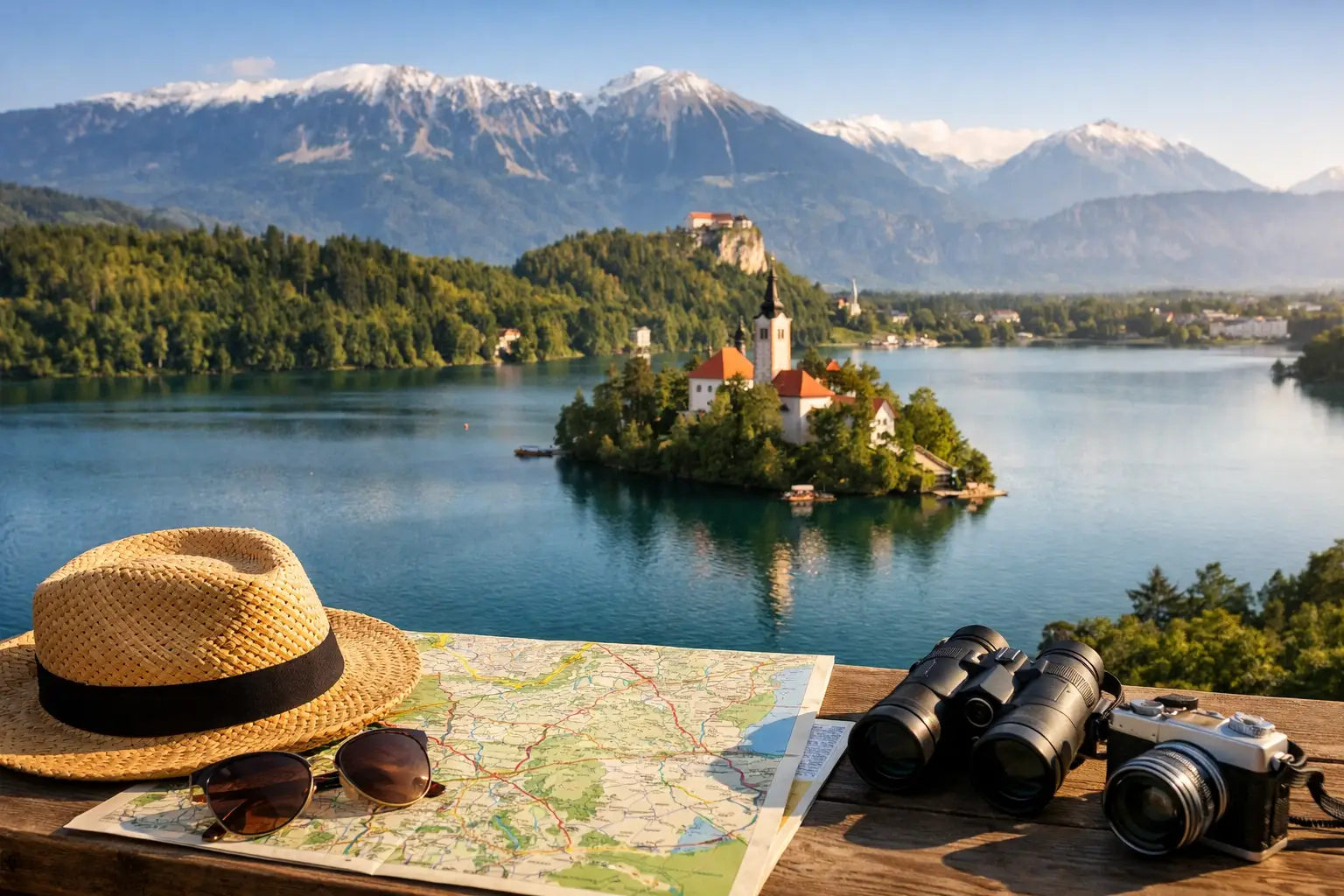
A good Slovenia travel guide should probably start with a small warning: this is the sort of country that ruins neat itineraries. You arrive thinking you will do Ljubljana, Lake Bled and perhaps a day trip or two, then suddenly you are plotting extra nights for wine country, Alpine valleys, river gorges and a stretch of Adriatic coast that feels more Venetian than Balkan. Slovenia is compact, yes. It is not simple.
That is also the pleasure of it. For British travellers who want a short-haul break with real variety, Slovenia offers the rare combination of ease and character. You can have city time, mountains, food, swimming, hiking and a very decent glass of local wine without spending half your holiday in transit. It suits long weekends if you stay focused, but it is even better over a week or ten days when the country has room to show its range.
Slovenia travel guide: where to base yourself
The first planning decision is not what to see, but how often you want to move. Slovenia is small enough that some visitors stay entirely in Ljubljana and day trip from there. That works if convenience matters most. The capital is easy-going, handsome and genuinely liveable, with a café culture that makes you want to linger rather than tick things off.
Still, there is a trade-off. Day-tripping everything means more time on roads and less time catching the atmosphere of places early in the morning or late in the evening, when they are at their best. Lake Bled after the coaches have gone is far more appealing than Lake Bled at midday in peak summer.
For most travellers, two or three bases make more sense. Ljubljana pairs well with either the Julian Alps or the coast. If you have eight nights or more, add a third stop in wine country or the Soča Valley. That gives you a trip that feels broad rather than rushed.
Ljubljana for culture, food and easy access
Ljubljana is often described as underrated, which undersells it slightly. It is not trying to overwhelm you with headline sights. Its appeal is subtler than that. The old town curves along the river with a confidence that feels distinctly Central European, while the markets, bridges and bar-lined embankments keep things relaxed rather than grand.
Two nights is the minimum. Three is better if you enjoy cities at a civilised pace. You can take in the castle, spend time in the market, browse galleries and settle into long dinners without feeling you are wasting precious sightseeing time. The city also works brilliantly as a springboard for organised excursions if you prefer not to hire a car.
Bled, Bohinj and the Julian Alps
If your mental picture of Slovenia is church spires on a lake backed by mountains, this is the region doing the heavy lifting. Bled is beautiful, photogenic and usually busy. Bohinj is quieter, broader and, for many travellers, more rewarding. The two are close enough to combine, but different enough that it is worth understanding the contrast.
Bled suits first-time visitors, short stays and people who want a polished resort atmosphere. Bohinj is better if you plan to hike, swim, kayak or simply want more landscape and fewer souvenir shops. Both open the door to Triglav National Park, where the scenery shifts from postcard-pretty to properly dramatic.
If you are choosing only one, it depends on your holiday style. Bled is easier and more iconic. Bohinj has more breathing room.
Piran and the Slovenian coast
Slovenia’s coastline is short, which is part of the charm. You are not coming here for a sprawling beach holiday. You are coming for pretty old towns, seafood, sunset walks and a neat Adriatic change of pace after the mountains.
Piran is the standout. Venetian architecture, narrow lanes and a lovely setting on the sea make it one of the country’s most atmospheric places to stay. Koper and Izola have their own appeal, but Piran is the place most visitors remember. In summer, book early. The coast is tiny, and the best rooms go quickly.
How long to spend in Slovenia
A long weekend is enough for Ljubljana and either Bled or Piran. A five-night trip allows a more rounded split between the capital and one second base. Seven to ten nights is where Slovenia becomes especially satisfying because you can combine city, mountains and either coast or wine country without turning the trip into a relay race.
If you are weighing Slovenia against somewhere larger, that compactness is a serious advantage. You get a sense of contrast quickly. What you lose, perhaps, is the scale and depth of a country where one region alone could absorb a fortnight. But for travellers who want variety without logistical grief, Slovenia is unusually efficient.
Getting around without making life difficult
This is the practical hinge of any Slovenia travel guide. Do you need a car? Not always. Should you consider one? Often, yes.
Ljubljana is easy on foot, and buses can cover a fair bit of the country. If you are sticking to classic stops and are happy to join tours for key day trips, public transport can work. But if you want to combine smaller Alpine areas, wine regions and the coast on your own timings, a hire car adds freedom and saves time.
The roads are generally straightforward, and distances are short by British standards. The catch is parking in popular areas and the fact that summer traffic around headline spots can be less idyllic than the views suggest. A mixed approach is often smart: city first without a car, then collect one for the rural part of the trip.
What to book before you go
Slovenia rewards spontaneity in some ways, but not with accommodation in the most desirable places. Ljubljana has a decent range, yet the best-located hotels and stylish guesthouses disappear early in peak periods. Bled and Piran are even tighter markets. If you are travelling in late spring, summer or around Christmas, book your hotel well ahead.
Activities depend on season. In Ljubljana, you can leave plenty flexible. In the Alps, guided outdoor trips are worth reserving in advance if they matter to you – white-water rafting on the Soča, canyoning, hiking guides or popular lake activities can fill up. If you have your heart set on a particular restaurant in Ljubljana or Bled, it is also sensible to reserve rather than rely on luck.
The experiences worth building a trip around
Slovenia is strongest when you treat it as more than a scenic backdrop. Yes, the views matter. But the trip gets better when you anchor it around a few well-chosen experiences.
One is river and mountain time in the Soča Valley. The colour of the water really is that startling, and the region offers a more adventurous version of Slovenia than the polished calm of Bled. Another is food and wine in the west, where Mediterranean and Central European influences mingle in a way that feels very distinctively Slovenian.
Then there is Ljubljana itself, which is not a box-ticking capital but a city to inhabit for a couple of days. Browse the market, take the funicular if you like, then allow time for the simple business of sitting by the river and watching the city work. That rhythm is part of the destination.
Don’t reduce Slovenia to Lake Bled
Lake Bled is worth seeing. It is not, however, the whole argument for visiting Slovenia. A trip built only around Bled can end up feeling narrower than it should. If you have time for just one extra layer, make it Bohinj, the Soča Valley, Piran or the Brda wine region. Any one of those will give the country more shape.
When to go
Late spring and early autumn are hard to beat. May, June and September offer good weather, long-ish days and a better balance between atmosphere and crowd levels. July and August bring the warmest conditions for lakes and the coast, but also the highest prices and busiest roads.
Winter is more conditional. Ljubljana can be festive and appealing, and alpine breaks work if snow conditions cooperate. But if your dream is a broad multi-region trip with outdoor activity, shoulder season tends to be the sweet spot.
Budget expectations for UK travellers
Slovenia is not the bargain it once was, especially in the best-known areas. It can still be better value than parts of Italy, Austria or Croatia in high season, but the difference is not always dramatic. Ljubljana remains fairly manageable for a city break, while Bled and the coast can feel noticeably pricier once you add prime accommodation and summer demand.
Where Slovenia does offer value is in the quality-to-hassle ratio. Journeys are short, standards are generally good, and you can pack a surprising amount into one trip. That matters when your annual leave is limited and you want a holiday that feels full without feeling exhausting.
A sample shape for a first trip
For seven nights, a very sensible first route is three nights in Ljubljana, two in the Bled or Bohinj area, and two in Piran. That gives you urban culture, Alpine scenery and a dose of Adriatic ease. If beaches matter less than hiking or rafting, swap the coast for the Soča Valley.
For four nights, keep it tighter: two in Ljubljana and two in either Bled or Piran. Trying to do all three in that timeframe is technically possible and spiritually unwise.
Slovenia is one of those rare destinations that feels both easy to recommend and slightly tricky to explain. It is not about one blockbuster city or one world-famous coastline. Its real strength is how elegantly it combines different moods within a manageable map. Plan with a bit of discipline, leave room for long lunches and late swims, and you will probably start wondering, halfway through the trip, how soon you can come back.