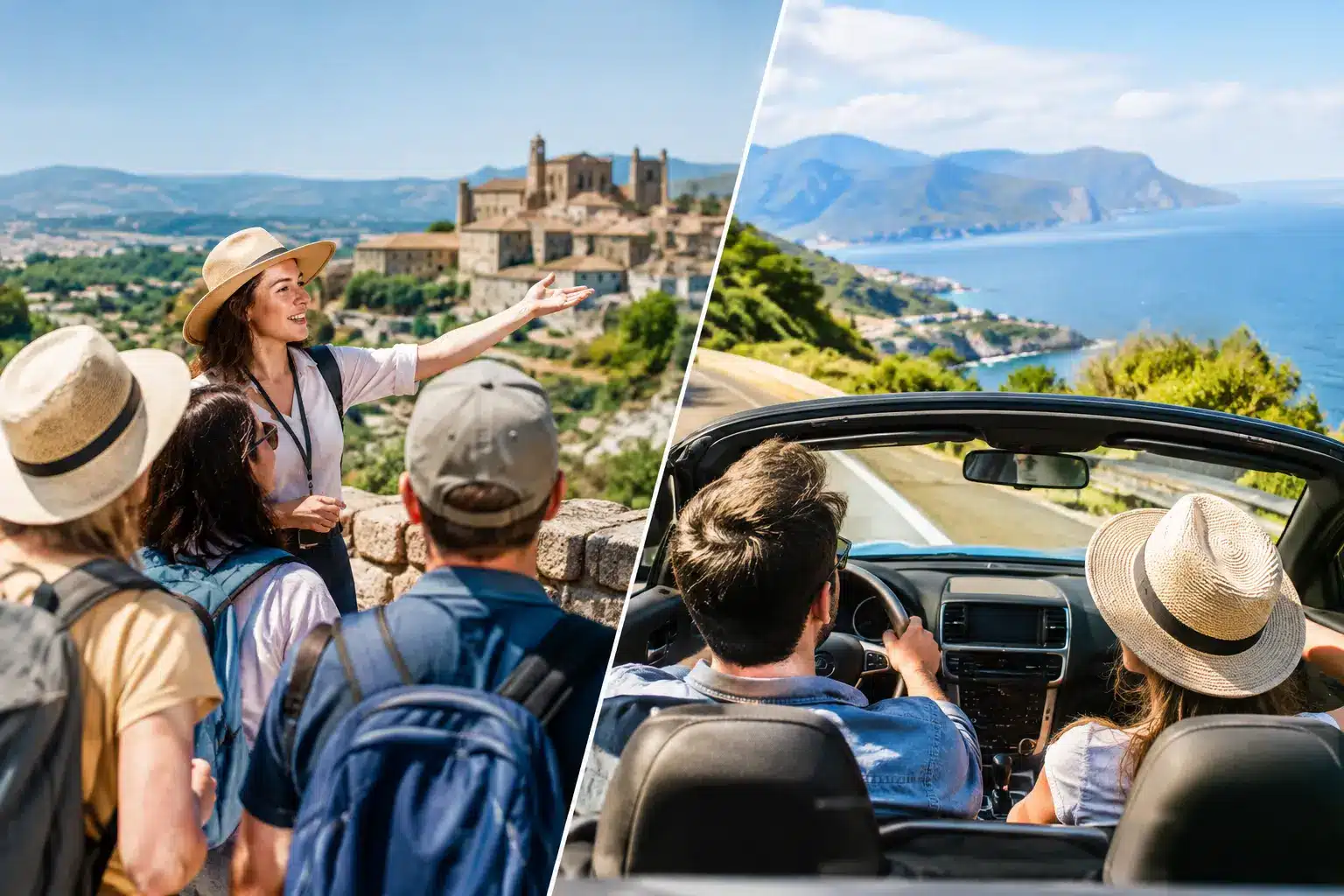
The choice between a guided tour versus self drive holiday is rarely about whether you like adventure. Both can deliver it. The real question is how much of your precious holiday time you want to spend making decisions: deciphering a mountain-road diversion, finding somewhere decent for lunch, choosing a wine bar, or simply wondering whether that unmarked track is actually the route.
For some travellers, those decisions are the point. For others, they are the bits best handed to someone who knows the place. A guided tour and a self-drive itinerary can take you through the same landscapes, villages and cities, yet create entirely different holidays. Here is how to choose the one that fits the trip you actually want.
Guided tour versus self drive: the essential difference
A guided tour gives you a framework. Transport, timings and key experiences are arranged, usually with a knowledgeable guide who can turn a ruin, market or quiet side street into a story worth remembering. Depending on the itinerary, you may join a small group, travel privately with a guide, or book individual guided excursions around a hotel stay.
Self drive gives you authorship. You choose the route, set the pace and can stay an extra hour in a coastal town because lunch has become unexpectedly excellent. It is particularly appealing in destinations where the journey is part of the pleasure: Scotland’s Highlands, the Algarve, Iceland, Tuscany, the American South West or South Africa’s Garden Route.
Neither option is automatically more authentic. A fine local guide can introduce you to a neighbourhood or family-run producer you would never have found alone. Equally, an unplanned stop at a village bakery can become the memory that defines a road trip. The distinction is between curated access and open-ended freedom.
When a guided tour is the better holiday
A guided tour earns its place when a destination has layers that are hard to interpret alone. Archaeological sites, great museums and historic city centres become far more rewarding with context. There is a difference between looking at a row of stones and understanding the political drama, religious belief or sheer engineering that put them there.
Guided travel is also a sensible choice where logistics are tiring or uncertain. Think of a first visit to Japan, a wildlife trip in Kenya, trekking in Patagonia, or a journey through several Balkan countries. You can spend less energy on train platforms, border crossings and restaurant research, and more on being present. A capable guide also knows when the headline attraction is at its quietest, which viewing point is genuinely worthwhile, and when a heavily promoted stop is best skipped.
For a short break, this efficiency matters even more. If you have three days in Rome, Edinburgh or Istanbul, a well-chosen walking tour on the first morning can quickly give you confidence with the city. You then have the rest of the trip to revisit the districts, galleries and food spots that appealed most.
There is a social consideration, too. Small-group tours suit solo travellers and couples who enjoy company at dinner or like sharing the moment when something remarkable appears around a bend. The quality of the group affects the experience, admittedly, but a good itinerary provides a ready-made circle without demanding constant sociability.
The trade-offs of travelling with a guide
The obvious compromise is spontaneity. Even excellent tours run to a schedule, and your preferred pace may not match the group’s. You may want longer in a gallery while someone else would rather be at the hotel bar. Private touring solves much of this, but raises the price.
It is also worth looking closely at what is included. A headline price can appear good value until optional excursions, tips, drinks and single supplements enter the picture. Check group size, accommodation standard, free time and whether meals are chosen for quality or simply convenience. A packed programme is not always generous. Sometimes it is just exhausting.
When self drive is the better holiday
Self drive is at its best when the places between the famous places matter. A car turns a hotel booking into a base for a wider landscape: hidden beaches, hilltop villages, trailheads, vineyards and restaurants that would be awkward or expensive to reach by taxi.
It is ideal for travellers who like to follow their instincts. Perhaps you spot a handwritten sign for a farm shop, hear about a beach from a waiter, or wake to sunshine and decide that today should be for the coast rather than the museum. Those choices are much easier when your luggage is in the boot and the next stop is yours to define.
Self drive can offer better value for couples, families and friends sharing costs, particularly outside major cities. A rental car, fuel, parking and insurance should all be budgeted properly, but the ability to stay in smaller towns rather than central tourist hubs can reduce accommodation costs. It also opens up distinctive stays: converted farmhouses, vineyard rooms, remote cottages and characterful country inns.
The best self-drive holidays still need shape. Booking every night somewhere different can make a scenic route feel like a luggage relay. Two or three-night stays usually create a better rhythm, especially if you want time for a boat trip, food tour, hiking day or lazy lunch without staring at tomorrow’s driving time.
The realities behind the freedom
A road trip asks more of the driver than glossy itineraries admit. Mountain passes, unfamiliar rules, city congestion, narrow lanes and long distances can turn an ambitious route into a test of goodwill. Check whether an automatic car costs more, whether you need an international driving permit, and whether your insurance covers the roads you plan to use.
Parking deserves special attention. Many historic European centres have restricted traffic zones, and some island destinations have limited parking at beaches and ports. It is often wiser to collect a car only when leaving the city, rather than paying to keep one stationary outside a hotel for three nights.
Then there is the question of local knowledge. You can research brilliantly and still miss the tiny details a resident would offer: the market stall with the best cheese, the cove that remains calm in a particular wind, or the restaurant where booking at 7pm means eating with visitors rather than locals. Self drive gives you room to discover, but not automatic access.
A hybrid holiday is often the clever answer
The most satisfying answer to guided tour versus self drive is often: both, in the right proportions. Book a car for the countryside, then add a small-group or private experience where expertise genuinely improves the day.
In wine country, drive between villages but join a tasting with a local host so nobody is calculating the return journey after the third pour. In a city, leave the car at the hotel and take a food tour or history walk early in the trip. On a coastal route, drive independently but book a guided kayak trip, wildlife cruise or hike in an area where local conditions matter.
This approach gives you independence without pretending that every part of travel needs to be self-directed. It can also make booking simpler. Choose accommodation with parking and a location that suits your route, then reserve the one or two excursions likely to sell out. Leave enough blank space for the discoveries that cannot be booked in advance.
How to decide before you book
Start with the destination rather than your usual travel style. A confident independent traveller may sensibly take a guide in Morocco or on a first safari, while a devoted group-tour traveller may find a self-drive break in rural France wonderfully uncomplicated.
Ask what you want to bring home from the trip. If it is understanding – history, food culture, wildlife or the stories behind a place – guided time is likely to be money well spent. If it is a feeling of movement, detours and finding your own favourite corner of a region, self drive has the advantage.
Be honest about energy, too. A demanding job, a long-haul flight or travelling with young children can make a guided itinerary feel delightfully restful. On the other hand, if the thought of a fixed breakfast time and a coach departure makes you wilt, build your own route and protect the freedom you are paying for.
Before committing, listen to the Destination Unlocked podcast. It is as useful as a guidebook and as personal as a chat with your most well-travelled friend, with each 40-minute episode giving you the practical detail and local perspective needed for a great trip.
The right choice is the one that leaves room for the kind of holiday you need now. Sometimes that means letting a brilliant guide take the wheel. Sometimes it means taking the keys yourself, turning off at the next interesting sign, and seeing where the afternoon goes.