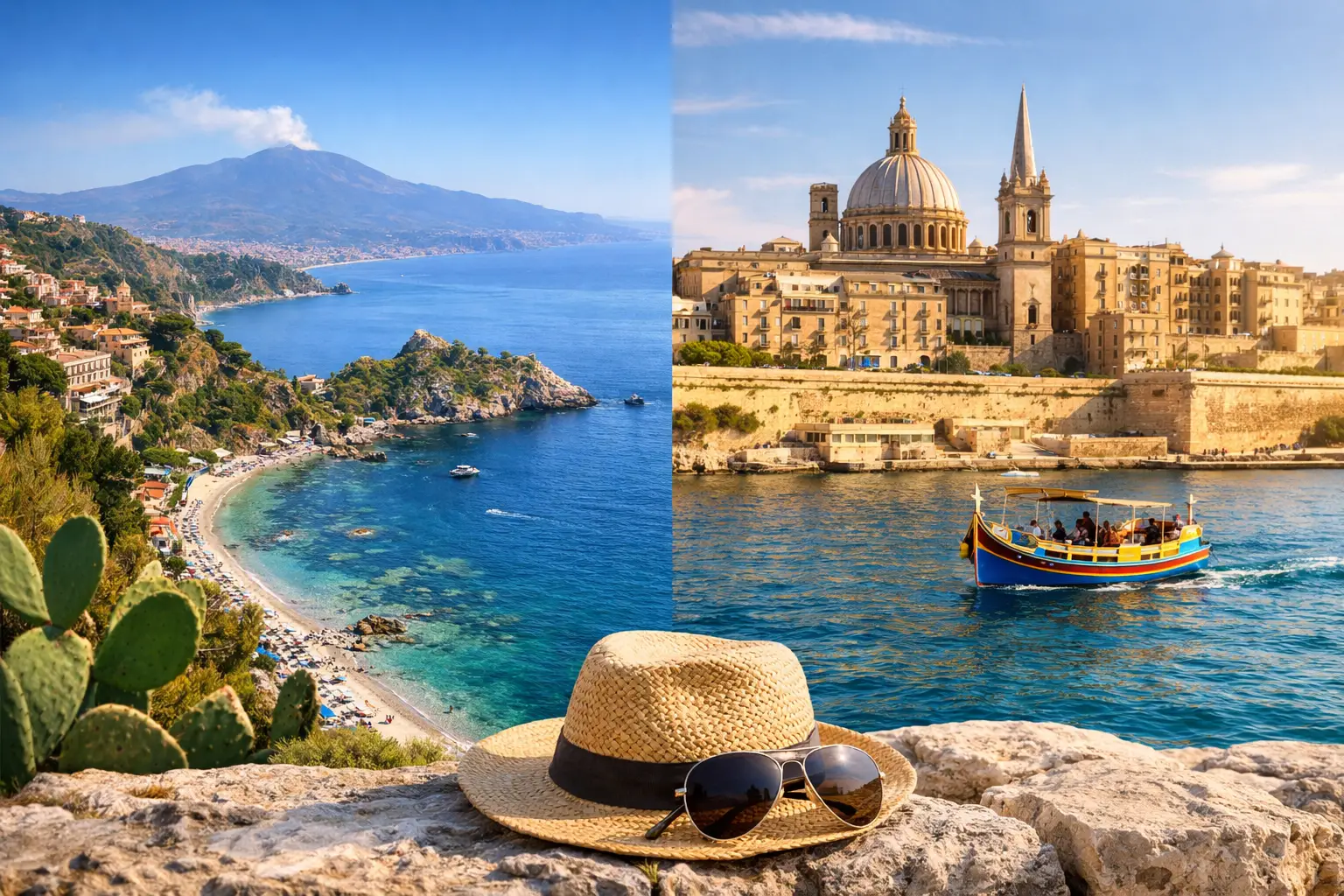
Some holiday decisions are really decisions about mood. Do you want baroque towns, smoking volcanoes and long lazy lunches that turn into dinner, or honey-coloured streets, clear coves and a compact island you can get your head around in a few days? If you are weighing up a Sicily or Malta holiday, that is the real question.
Both sit in the central Mediterranean, both have layers of history from one invading empire after another, and both work brilliantly for a warm-weather break from the UK. But they do not feel interchangeable once you are on the ground. Sicily is bigger, more varied and more dramatic. Malta is smaller, easier to navigate and often better suited to a shorter break. Which one wins depends less on abstract rankings and more on how you like to travel.
Sicily or Malta holiday: what kind of trip do you want?
Sicily suits travellers who want range. You can spend one day in Palermo among noisy markets and Norman churches, another by the sea in Cefalu, and another climbing or gazing at Mount Etna. The island has proper internal contrast. Its cities feel distinct, the food changes from place to place, and a week there can feel like three holidays stitched together.
Malta, by contrast, is about concentration. It delivers historic cities, swimming spots, boat trips, nightlife and excellent dining within a relatively small area. You do not need to commit to long travel days, and that changes the rhythm of the trip. If your idea of a good holiday is doing more and commuting less, Malta has an obvious advantage.
For a first-time visitor with only four or five nights, Malta is usually the easier choice. For a week or more, Sicily starts to justify the extra scale.
Culture and atmosphere
Sicily has a grand, untidy theatricality to it. Palermo can be scruffy and glorious in the same glance. Catania has black lava stone architecture and a fast, urban pulse. Syracuse, especially Ortigia, is more elegant and contemplative. You feel the Greek, Arab, Spanish and Norman influences, but not in a museum-piece way. Sicily is lived-in, exuberant and occasionally chaotic.
Malta feels more contained and more polished in its historic core. Valletta is one of Europe’s great small capitals, full of limestone facades, steep streets and military history. Mdina brings a quieter, older-world mood, while the Three Cities add depth without requiring much effort to reach. English is widely spoken, which makes Malta particularly easy for British travellers, though that convenience comes with a trade-off. Parts of the island can feel more overtly geared towards international tourism.
That is not necessarily a criticism. For many travellers, especially on a short break, ease is part of the appeal. But if you want a destination that keeps surprising you and occasionally asks a little more of you, Sicily tends to have the richer texture.
Beaches and swimming
If your Sicily or Malta holiday is really a beach decision in disguise, the answer gets more nuanced.
Malta is famous for clear water rather than long stretches of sand. You will find rocky coves, swimming platforms, turquoise bays and excellent conditions for snorkelling and boat trips. Comino and the Blue Lagoon are the postcard names, though they can be extremely busy in peak season. There are sandy beaches too, including Golden Bay and Mellieha Bay, but Malta’s great strength is access to the sea rather than classic beach sprawl.
Sicily offers more variety. There are sandy beaches near San Vito Lo Capo, Cefalu and Fontane Bianche, volcanic coastlines around the Aeolian Islands, and dramatic cliff-backed swimming spots in nature reserves. If you want a fly-and-flop holiday with a few cultural outings, Sicily gives you more room to shape that trip. The downside is that some of the best spots are spread out, so a car often improves matters.
For easy, beautiful swimming on a compact island, Malta is hard to beat. For broader beach choice and a more varied coastal trip, Sicily edges it.
Food and drink
This is where Sicily starts grinning.
Sicilian food is one of the island’s strongest arguments. Arancini, pasta alla Norma, cannoli, granita for breakfast, grilled seafood, caponata, pistachio everything if you are near Bronte – it is one of Italy’s most distinctive regional cuisines, and it has depth well beyond the greatest hits. Meals can become a proper part of the day rather than a pit stop between sights.
Malta eats well too, and its food scene has become more interesting and more confident in recent years. You will find strong Mediterranean cooking, good seafood, excellent pastries and local specialities such as rabbit stew, ftira and pastizzi. Valletta, in particular, has a dining scene that punches above the island’s size. Still, if food is central to how you choose destinations, Sicily is the stronger pull.
Wine follows a similar pattern. Sicily is a serious wine destination with compelling reds and whites, especially around Etna. Malta produces wine too, and some of it is very enjoyable, but it is less likely to shape the holiday in the same way.
Cost and value
Neither destination is a bargain-basement secret any more, especially in high season, but both can still offer decent value compared with parts of mainland Italy, France or the Balearics.
Malta can be surprisingly pricey in peak summer, especially in the most popular coastal areas and better-known hotels. Its compact nature keeps transport costs down, but accommodation can climb quickly when demand is high.
Sicily usually gives you more flexibility across budgets. There is a broader spread of hotels, guesthouses and self-catering options, and you can often eat very well without overspending. Car hire adds to the bill if you want to see a lot, but overall Sicily often offers better value for travellers who stay longer.
For a short city-and-sea break, the cost difference may be modest. For a longer trip with several stops, Sicily often works out better.
Getting around and practical ease
Malta is the simpler place to manage. You can base yourself in one hotel and cover a lot of ground. Buses are widespread, taxis and ride apps are straightforward, and airport transfers are short. There is very little friction, which matters if you are trying to make the most of a long weekend.
Sicily rewards planning. Public transport exists, but it is not always swift or intuitive for holidaymakers trying to combine coast, countryside and cities. Trains work well on some routes, especially between larger places, but a car opens up the island. That freedom is wonderful once you have it, but driving in Sicily is not for everyone, particularly in larger cities.
So ask yourself a slightly unromantic but useful question: do you want a holiday that unfolds neatly, or one that feels more exploratory? Malta is neat. Sicily is exploratory.
Sicily or Malta holiday for couples, families and friends
For couples, either can work beautifully, but in different ways. Malta is excellent for a stylish short break with boutique hotels, waterside dinners and enough culture to keep things interesting. Sicily is better if romance means a road trip, a vineyard lunch, a hill town at golden hour and a beach the next morning.
For families, Malta has a practical edge because distances are short and logistics are easier. Sicily can absolutely work for families, particularly in beach areas or agriturismos, but it asks more in terms of planning and moving around.
For groups of friends, the choice depends on the mood. Malta suits those wanting swimming, boat days, bars and low-effort fun. Sicily is better for a more layered trip where food, scenery and varied stops are part of the entertainment.
Best time to go
Both destinations are strong from late spring to early autumn. May, June, September and early October are often the sweet spots, with warm weather and fewer crowds than peak summer.
Malta gets very busy in midsummer, and the heat can feel intense in built-up areas. Sicily is also hot in July and August, but its larger size gives you more options to escape to the coast, hills or less crowded towns.
If you are travelling outside peak beach season, Malta still works well as a culture-led break. Sicily does too, of course, but because it is bigger, cooler-weather travel there tends to involve more deliberate route planning.
So which one should you book?
Choose Malta if you want a short, sun-soaked break that is easy to organise, easy to navigate and rich in swimming, history and restaurant time. It is particularly good for four nights, shoulder-season escapes and travellers who like a destination to feel manageable from the moment they land.
Choose Sicily if you want a bigger, more varied Mediterranean trip with stronger food, more dramatic landscapes and greater regional character. It makes more sense for a week or longer, and for travellers who do not mind a little logistical effort in exchange for more depth.
There is no wrong answer here, which is both helpful and mildly irritating. But if you are still stuck, use this simple test. Book Malta for convenience. Book Sicily for variety. And if what you really want is one memorable meal after another with a volcano in the background, Sicily is already halfway out the door.