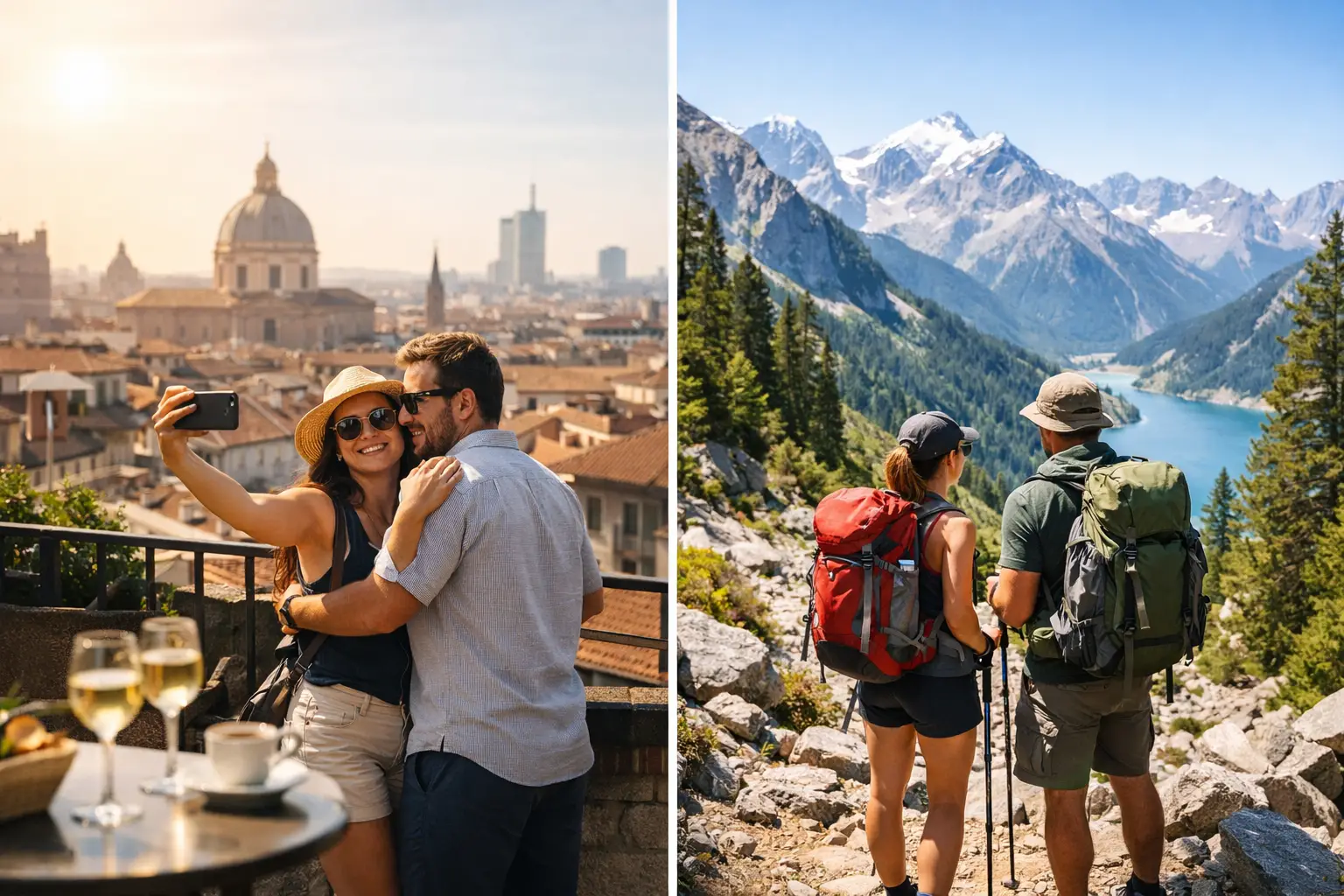
A Friday flight to Barcelona and a long weekend of galleries, vermouth and late dinners can feel like exactly the right answer – until you find yourself eyeing up mountain trails in Slovenia instead. The city break versus adventure holiday question is rarely about which style is better. It is about what kind of experience you want to remember when you are back at your desk on Tuesday morning.
Some travellers are instinctively urban. They like a place best when it reveals itself through neighbourhoods, food, architecture and the rhythm of local life. Others want movement, weather, a little uncertainty and the sort of days that leave your legs tired and your mobile phone largely ignored. Most of us, if we are honest, swing between the two.
City break versus adventure holiday: what are you really choosing?
At first glance, this sounds like a simple contrast. A city break is compact, cultural and easy to slot into a busy calendar. An adventure holiday usually asks more of you – more time, more planning, and often more willingness to be uncomfortable. But the deeper difference is not logistical. It is emotional.
A city break tends to offer stimulation without too much friction. You can land, check in, and be having a very good coffee within an hour. Even in an unfamiliar place, there is a reassuring structure. Museums have opening times, restaurants have tables, public transport has maps. The pleasure often lies in browsing rather than conquering.
An adventure holiday is built around effort and immersion. That might mean hiking in Kyrgyzstan, climbing in the Dolomites or spending several days on the move in a landscape where your plans are shaped by light, terrain or weather. The reward is different. You do not just see a place – you work your way into it.
Neither is inherently more meaningful. A brilliantly chosen 48 hours in Seville can stay with you for years. So can a windswept week in Iceland that involved wet boots and very little sleep.
The strongest case for a city break
City breaks suit modern life partly because they are realistic. You do not need two spare weeks, a specialist kit list or an appetite for logistical drama. If your annual leave is rationed with military precision, a city can give you a proper change of scene in a short window.
They also reward curiosity at different energy levels. You can spend a morning in a market, an afternoon in a museum and an evening in a neighbourhood wine bar without feeling as if you are following a punishing itinerary. That flexibility matters if you are travelling with a partner, a group of friends or children with varying tolerance for the phrase “one more viewpoint”.
For culturally minded travellers, cities compress a remarkable amount into a small area. History, design, food and politics all sit close together. A good city break has layers. You arrive for the headline attractions, but the real pleasure often comes from smaller details – the bakery queue in the morning, the side street bookshop, the local guide who reframes the whole place in half an hour.
There is also a practical truth here. City breaks can be easier to budget for than people assume. Yes, major capitals can be expensive, but they also allow a great deal of control. You can choose where to splurge and where to keep things simple. Adventure trips, by contrast, often involve transport, equipment, guiding or remote accommodation that can push costs up quickly.
Why adventure holidays have such a pull
Adventure holidays appeal because they change your pace of life, not just your postcode. They strip out a lot of the low-level noise that follows us around at home. You are less likely to spend an afternoon absent-mindedly scrolling if you are navigating a trail, watching the weather roll in or trying to identify the mountain pass someone at breakfast told you not to miss.
They also tend to sharpen memory. Ask someone about a city weekend and they may recall a few standout meals or a favourite district. Ask them about a multi-day trek, a diving trip or a road journey through a dramatic landscape and the answer is often more vivid. Challenge fixes moments in place.
That does not mean adventure travel has to be extreme. The word can be slightly misleading, conjuring images of ice axes and improbable levels of cardio. In reality, adventure can mean a gentle hut-to-hut walk, a train journey into a lesser-known region, a wildlife-focused trip or a cycling holiday with excellent lunches. It is less about danger than engagement.
There is another advantage that seasoned travellers often mention. Adventure holidays can make you feel farther from home than the flight time suggests. A two-hour hop to a European city may be delightful, but a few days in a mountain valley or coastal wilderness can create a stronger sense of escape.
Where the trade-offs become clear
The city break versus adventure holiday decision gets more interesting when you stop comparing fantasy versions. Not every city break is elegant and enriching. Some become a race between overbooked attractions, overpriced cocktails and a queue for brunch that lasts longer than your attention span. Equally, not every adventure holiday is transformative. Poor planning can leave you exhausted, underprepared and wondering why you paid to be cold.
Time is usually the biggest deciding factor. Cities are forgiving of short trips. Adventure often benefits from space. If two of your four days are swallowed by travel, transfers and sorting equipment, the trip may feel more admin-heavy than liberating.
Companions matter too. A city break is easier to tailor across mixed interests. One person can browse galleries while another seeks out vintage shops or football grounds, then everyone reconvenes for dinner. Adventure holidays ask for more alignment. Fitness, confidence and appetite for rough edges all need to be reasonably compatible.
Then there is weather. In a city, rain is inconvenient. In an outdoor trip, it can reshape the entire experience. Some travellers relish that unpredictability. Others prefer their holiday to involve fewer waterproof layers and more reliable lunch reservations.
How to choose the right trip for this moment
A better question than “Which type of holiday suits me?” is “What do I need from this particular trip?” Your answer may change from one season to the next.
If you are mentally tired, a city break can be more restorative than an ambitious expedition. Ease has value. Good meals, walkable streets and a hotel with a view may be exactly the medicine. If, on the other hand, you are physically restless and craving perspective, a few days in the mountains or by the sea might do more for you than another itinerary built around museum tickets.
Think about the memory you want to carry home. Do you want stories about conversations, neighbourhoods and discoveries around each corner? Or do you want that satisfying sense of having stretched yourself a little and seen a landscape the slow way?
It is worth considering your travel style at its least glamorous, not its most aspirational. Are you actually happy with early starts, variable weather and limited creature comforts? Or do you merely enjoy the idea of yourself in that scenario? There is no shame in preferring a good hotel bar to a sleeping bag. Wisdom in travel often begins with accuracy.
Can you combine a city break and adventure holiday?
Often, yes – and some of the best trips do exactly that. A few days in Muscat can lead naturally into desert or mountain landscapes. A stay in Reykjavik can be the cultural overture to waterfalls, geothermal valleys and long drives through otherworldly scenery. Even places better known for urban pleasures can have an adventurous edge just beyond the centre.
This hybrid approach works particularly well for travellers who want both texture and momentum. A city gives context. You understand the food, history and everyday life before heading outward. Then the landscape changes the scale of the story.
It is also a useful compromise for couples or friends with slightly different instincts. One person gets the gallery and restaurant moments, the other gets the trail, the coast or the road trip. Everyone gets a trip with range.
For a brand like Destination Unlocked, that mix often feels closest to how people actually travel. Very few places fit neatly into one category. The most memorable trips tend to involve both conversation and movement, local detail and wider horizon.
City break versus adventure holiday: the honest answer
If you are looking for a universal rule, there is not one. Some years call for urban ease and a tightly packed long weekend. Others call for muddy boots, patchy signal and the sort of day that makes dinner taste better because you earned it.
The best choice is usually the one that matches your current appetite, not your idealised travel identity. Pick the trip that feels alive to you now. The city will still be there when you want its energy. The mountains, coastlines and back roads will wait for when you are ready to step a little further out.