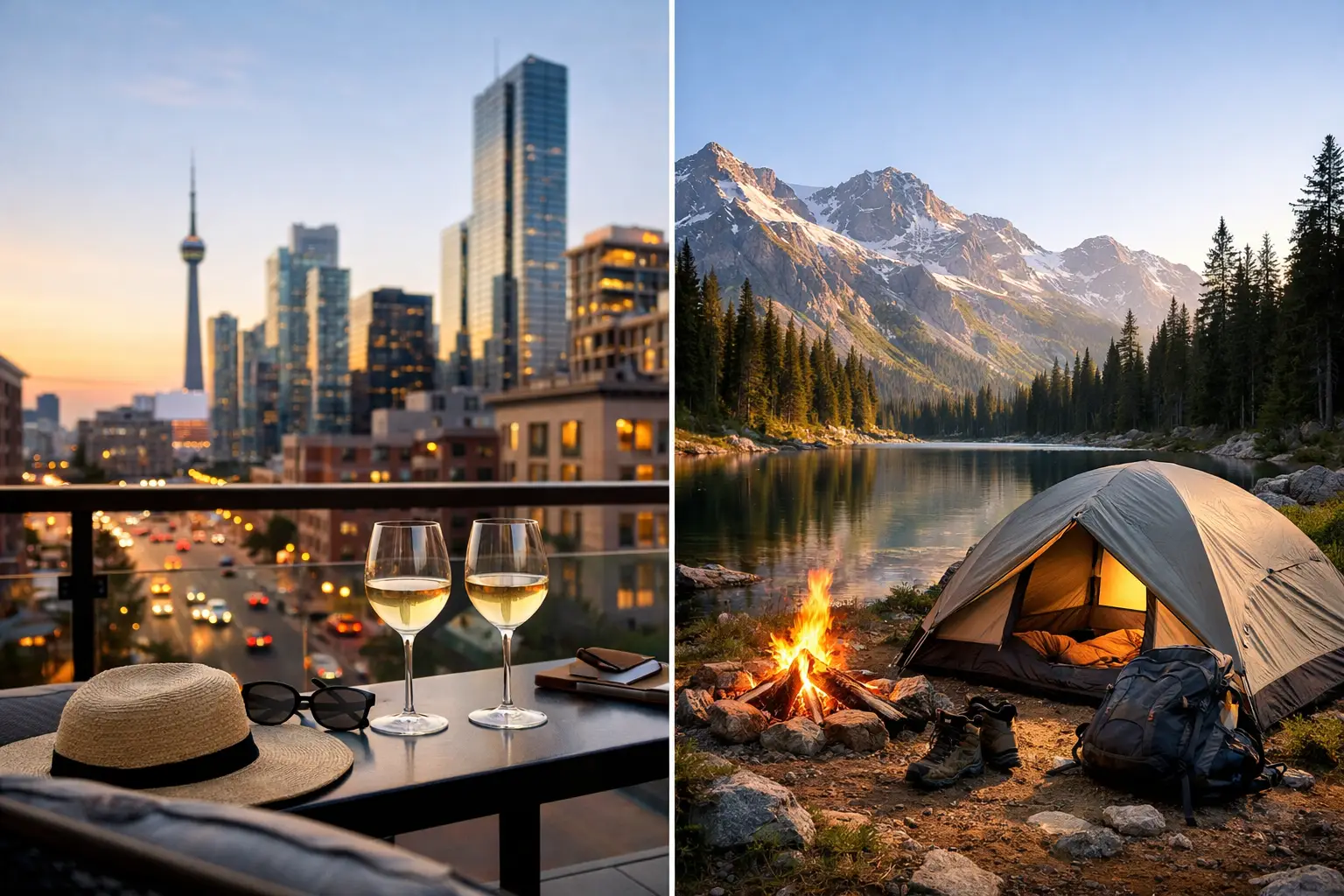
Friday afternoon, inbox still humming, weather undecided – and you are trying to answer one deceptively simple question: city breaks or wilderness escapes? It sounds like a matter of taste, but it is often really about timing, energy and what you need from a few days away. The best trips are not always the grandest ones. They are the ones that meet you where you are.
That is why this choice is more interesting than it first appears. A long weekend in Seville, Bristol or Chicago offers one kind of release. A few days in the Highlands, the Slovenian mountains or a remote coastal corner offers another altogether. Neither is inherently better. The trick is understanding what each does well, where each can disappoint, and why your ideal answer may change from one month to the next.
City breaks or wilderness escapes: what are you really craving?
People often frame travel choices as personality types. You are either a museum-and-wine-bar person or a boots-and-big-sky person. Real life is less tidy. The same traveller can want late-night conversation and gallery-hopping in March, then silence, sea air and patchy mobile phone signal in July.
A city break tends to suit moments when you want stimulation. You can land or arrive by train, drop your bag and feel that the trip has begun within minutes. There is momentum built in. Streets have rhythm, cafés stay open, and if one plan falls through there is usually another around the corner. Cities are forgiving in that sense. They allow a certain spontaneity.
Wilderness escapes tend to suit moments when stimulation is precisely the problem. If your brain feels cluttered, a remote setting can be more restorative than any smart hotel or tasting menu. Space changes your pace. You notice weather again. You walk further than intended because there is nowhere obvious to rush to. For some travellers, that is the whole point.
The question, then, is not simply whether you prefer buildings or hills. It is whether you want your next trip to energise you or quieten you down.
The case for a city break
A good city break can make three days feel improbably full. You might spend the morning in a market, the afternoon in a small museum you had never heard of, then finish with a meal that becomes the anecdote you are still telling six months later. Cities reward curiosity quickly. You do not need much time to get something from them.
They also work brilliantly for travellers who like a bit of structure without excessive planning. Even in less obvious urban picks, there is usually a clear framework for a short stay: neighbourhoods to explore, food to seek out, perhaps one or two major sights and a few local recommendations that give the trip shape. This is especially appealing if you are travelling with a partner or friends and need options that suit different interests.
Then there is practicality. From the UK, city breaks are often the easier lift. Rail connections, short flights and compact centres can make a two or three-night trip perfectly viable. You lose less time to logistics, which matters if your annual leave is precious.
But city travel has its trade-offs. The very atmosphere that makes a place exciting can also make it tiring. Crowds, queues, transport delays and rising costs all nibble away at the romance. Some cities are now so well-covered online that people arrive with a script instead of curiosity. If every restaurant is booked weeks ahead and every viewpoint has become a queue system, the trip can start to feel oddly transactional.
The best antidote is to treat a city less like a checklist and more like a conversation. Leave room for the side street, the ordinary bakery, the less-photographed district. The memorable bits are often the ones that do not make the obvious list.
Why wilderness escapes feel different
A wilderness escape offers a rarer kind of contrast to everyday life. There is no point pretending otherwise. Most of us spend our time under artificial light, on crowded roads, in rooms with notifications blinking nearby. A remote landscape interrupts that pattern more forcefully than an urban getaway ever can.
The appeal is not only visual, though dramatic scenery certainly helps. It is the change in texture. Your day becomes shaped by daylight, terrain and weather rather than bookings and opening hours. Even small decisions feel different. Do you walk before breakfast while the valley is quiet? Do you take the longer route because the clouds are lifting? This is travel that asks for presence.
For many people, that makes wilderness escapes deeply restorative. They can also be unexpectedly sociable in a gentler way. Shared walks, pub dinners after a day outdoors, or conversations with local guides often feel less hurried than interactions in cities. The pace encourages attention.
Yet remote travel is not automatically peaceful perfection. Bad weather can flatten plans. Distances can be longer than they appear. If you do not drive, some areas are harder to reach well. And while people talk about switching off as if it is universally appealing, some travellers simply do not enjoy too much quiet. If your idea of a good break includes theatre, design shops and the possibility of dinner at 10pm, a cabin in the middle of nowhere may feel admirable rather than enjoyable.
That does not make wilderness lesser or greater. It just means honesty matters. There is no virtue in choosing a type of trip that sounds noble if it leaves you bored by lunchtime on day two.
Budget, season and company matter more than travel ideology
One reason this debate keeps resurfacing is that people talk about it as if it were philosophical. In practice, it is often logistical. Budget can push you one way or the other. City breaks can look affordable until hotel prices, meals and event tickets stack up. Wilderness escapes can seem simpler, but car hire, petrol and isolated accommodation can add their own sting.
Season matters just as much. A city in shoulder season can be ideal – lively, walkable, and not punishingly hot. The same city in peak summer might feel like an exercise in queue management. By contrast, a wilderness destination can be glorious in late spring or early autumn, then unappealing in relentless rain unless you genuinely enjoy trudging through it.
Company is another neglected factor. The right trip for a solo traveller is not always the right trip for a couple or group. Cities give people room to split up and reconvene, which can save friendships. Wilderness settings tend to ask for more shared rhythm. If one person wants a six-hour hike and the other wants to read by the fire, that mismatch needs managing.
City breaks or wilderness escapes for different moods
If you are mentally foggy and need novelty, a city often works best. Conversation, food, architecture and movement can jolt you back into yourself. If you are overstretched and slightly brittle, nature may be the wiser choice. It asks less of you while still giving plenty back.
There is also a useful middle ground. Some of the most satisfying trips combine the strengths of both. Think of cities with immediate access to mountain trails, coastal walks or wild swimming spots. Think of smaller urban centres where culture and landscape sit comfortably together. These hybrid destinations can feel especially rewarding because they avoid the purity test. You can have a good lunch and a proper walk. Civilisation and space are not sworn enemies.
That hybrid approach is part of what makes destination-led travel so compelling. The most memorable places are rarely defined by a single label. They are shaped by local perspective – by how residents use the city, where they go to escape it, and which experiences actually reveal the character of the place. That is often where more thoughtful travel media, including the occasional well-chosen Destination Unlocked episode, proves its worth. Not by telling you where to tick off sights, but by helping you understand the rhythm of somewhere.
How to choose without overthinking it
A useful test is to ask what story you want to be living for a few days. Do you want mornings that begin with coffee and a map, or with boots and changing cloud? Do you want options at every turn, or relief from having to choose? Do you want to come home with a full camera roll and a slight need for another holiday, or with clearer thoughts and mud on your shoes?
Neither answer is more sophisticated. Travel has enough false hierarchies already. Not every trip needs to be a spiritual reset, and not every city break is shallow. One weekend might call for galleries, old streets and one excellent cocktail. Another might call for wind, distance and the sound of absolutely nothing useful happening.
Perhaps the most reliable rule is this: choose the setting that gives you what daily life is currently withholding. If your routine has become cramped, noisy and repetitive, go where the horizon opens up. If life has become dutiful and dull, find a city with some mischief in it. The right choice is usually the one that restores a missing part of you.