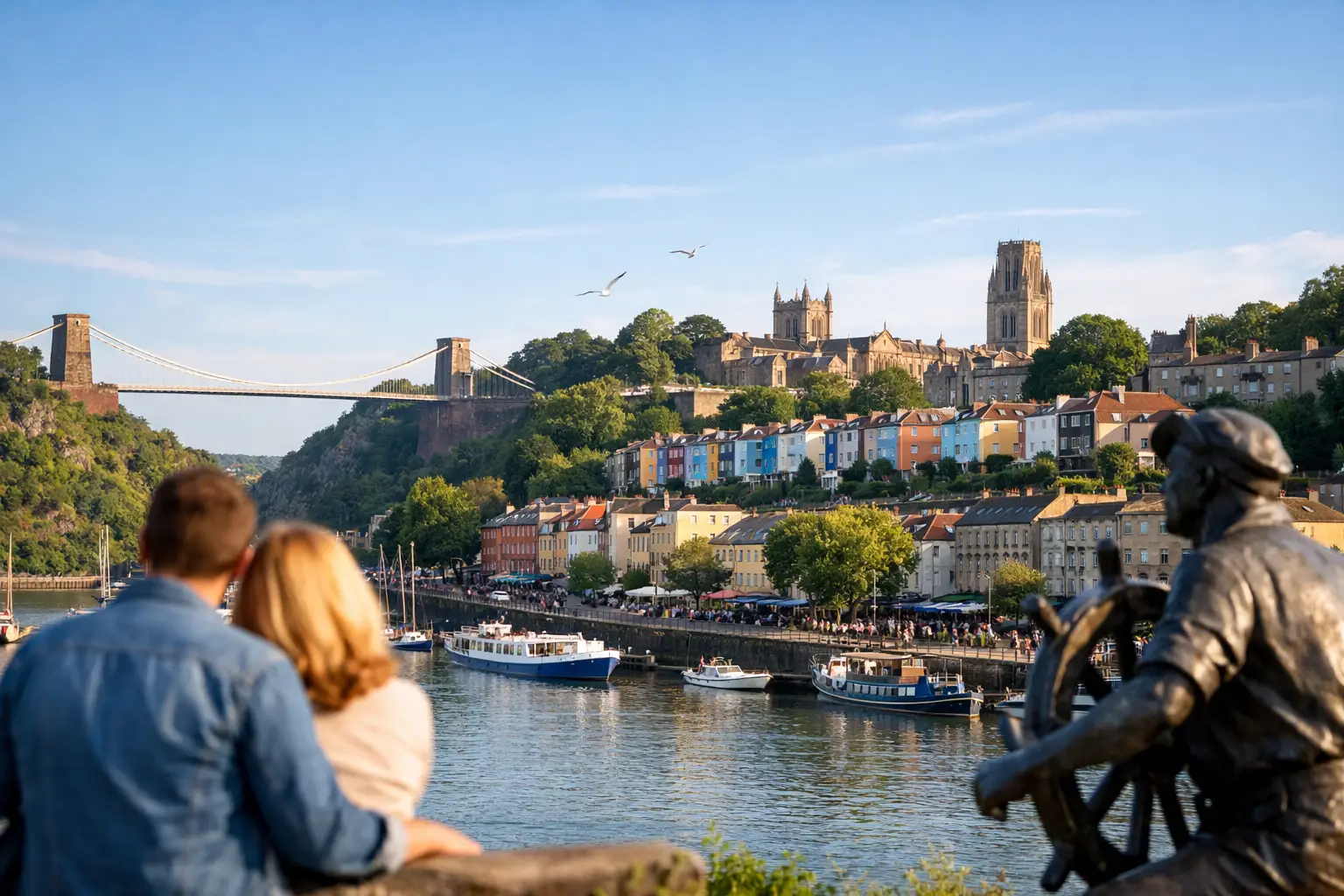
Bristol suits a short break unusually well. Give it 36 hours in Bristol and the city reveals itself in layers – maritime past, graffiti-spattered walls, fiercely independent food, handsome Georgian terraces and a creative energy that never feels staged. It is compact enough to tackle over a weekend, but varied enough that you can shape it around your own interests rather than following a dutiful checklist.
That matters here, because Bristol is not at its best when treated like a box-ticking city. Yes, there are obvious landmarks. But the real pleasure is in the shifts of mood from the harbourside to Clifton, from Stokes Croft to the Sunday calm of a neighbourhood café. If you only have a day and a half, the trick is to keep moving between the headline sights and the smaller moments that give the place its personality.
How to spend 36 hours in Bristol
Start with the water. Bristol’s Floating Harbour gives the city its shape and, in many ways, its story. Former warehouses now sit beside cafés, bars and cultural spaces, and the whole area makes for a relaxed introduction if you have arrived by train and want to get your bearings without charging straight into museum mode.
On your first afternoon, walk from the centre towards the harbourside and let the city ease you in. You might pass sleek new buildings, then turn a corner and find old brick, industrial edges and a view of boats bobbing where merchants once made fortunes. Bristol can feel polished in places, but never too polished. It still wears its history awkwardly, which is part of the appeal.
If you like a museum with a strong sense of place, the M Shed is worth your time. It tells Bristol’s story with enough texture to avoid feeling dutiful, and it is particularly useful at the start of a trip because it gives context to everything else you will see – trade, engineering, activism, migration and reinvention. If you would rather stay outside, simply continue along the water and watch the city in motion. On a decent day, that can be just as rewarding.
From there, make time for SS Great Britain. Even people who think they are only mildly interested in maritime history often come away impressed. Brunel’s ship is both an engineering marvel and a surprisingly immersive visit, not least because it taps into Bristol’s self-image as a city of ideas and industry. If your weekend is packed and you must choose between museums, this is probably the stronger single-site experience.
By early evening, Bristol’s food scene should take over. This is not a city where you need to chase formality to eat well. Some of the best meals feel informal, inventive and distinctly local in spirit. The strongest approach is to pick an area rather than obsess over one booking. Wapping Wharf is a good example – compact, lively and full of options that make it easy to eat according to mood, budget and appetite. If you want a long dinner and a bottle of wine, you can have that. If you want to graze and keep moving, Bristol is equally accommodating.
After supper, stay out for a drink. Bristol has long been associated with music, and even a casual evening can hint at that legacy. Depending on the night, you may find jazz, indie, DJ sets or something more experimental. The city’s nightlife is not all polished cocktail bars and late-night queues. It can be a little scruffier, a little more interesting, and often better for it.
Morning in Clifton and the Suspension Bridge
Day two should begin uphill. Clifton offers a different Bristol from the harbourside – elegant, leafy and quietly self-assured. The climb is worth it, whether on foot or by bus, because the area gives you one of the clearest contrasts in the city. Within a short stretch, Bristol shifts from post-industrial cool to Georgian poise.
Start with coffee and breakfast in Clifton Village, where the pace is slower and the architecture does much of the talking. There is an undeniable prettiness to this part of town, but it is not merely decorative. It also sets up one of Bristol’s defining sights, the Clifton Suspension Bridge.
Even if you have seen photographs, the bridge still tends to land properly in person. Brunel’s masterpiece spans the Avon Gorge with a kind of improbable grace, and the views do a lot to explain Bristol’s geography. On one side, elegant Clifton; on the other, the steep green drama of the gorge; below, the river cutting through it all. If the weather behaves, this is one of the most memorable stretches of a Bristol weekend.
There is a trade-off here. Clifton can feel a little genteel if what you love most about Bristol is its edge. But that is also why it works in a short itinerary. The city’s character lies partly in its contrasts, and a weekend should include both the grand and the gritty.
From the bridge, you could continue on foot into Leigh Woods if you want a dose of greenery and a wider panorama back towards the city. If your 36 hours in Bristol are more urban by design, head back towards the centre and aim for one of the areas where the city’s creative streak is more immediately visible.
Street art, independent Bristol and where the city loosens up
Stokes Croft remains the shorthand for Bristol’s countercultural instincts, and while shorthand can flatten a place, there is still something to be said for spending time here. The murals, independent shops and unvarnished atmosphere offer a useful corrective to the tidier image of Clifton. Bristol’s reputation for street art did not come from nowhere, and even when individual works change, the city’s visual language remains part of the experience.
It is tempting to turn this into a Banksy pilgrimage, but that can miss the point. Bristol’s street art scene is broader than one famous name, and the pleasure lies in looking up, turning side streets and noticing how art sits alongside ordinary life. A takeaway coffee, a painted wall, a record shop, a queue outside a bakery – this is the texture that gives the area life.
Nearby, Gloucester Road is another good stretch if you like independent businesses and neighbourhood atmosphere. It has the sort of appeal that frequent city-break travellers usually value most: not monumental, not over-curated, just lively and full of local rhythm. You can browse, eat, stop for another coffee and feel, for an hour or two, as though you are using the city rather than merely visiting it.
If museums are more your speed, the Bristol Museum and Art Gallery is a solid option, especially if the weather turns. It is broad rather than niche, and that can be useful on a weekend break when you do not want too much friction in the schedule. Bristol rewards wandering, but it also helps to have one or two anchors when the rain does what British rain does.
A final afternoon by the water
For the last part of your weekend, return to the harbourside. This is less about repetition and more about seeing the city differently after you have spent time in its other quarters. Places that seemed merely attractive on arrival often feel more legible once you understand the themes running through Bristol – industry, experimentation, protest, creativity and a certain refusal to become too neat.
A harbour ferry can be a smart move if you want to rest your feet while still sightseeing. It also shows off the city from an angle that ties the whole trip together. Bristol is, among other things, a city shaped by water, and seeing it from the harbour helps that fact click into place.
If you have time for one final stop, make it somewhere convivial rather than worthy. A late lunch, one last pint, a coffee before the train – Bristol lends itself to endings that feel relaxed rather than ceremonial. This is not a city that demands you finish with a grand flourish. It is better than that. It invites you to leave with a sense that there is more to return for.
That is perhaps the strongest argument for spending a weekend here. Bristol does not try too hard to impress, which is exactly why it often does. Give it 36 hours, keep your plans loose enough for a detour, and let the city show you whether you prefer its bridge views, its backstreet murals, its harbourside calm or its after-dark energy. Most likely, you will leave with a favourite version of Bristol – and a suspicion that another one is waiting next time.