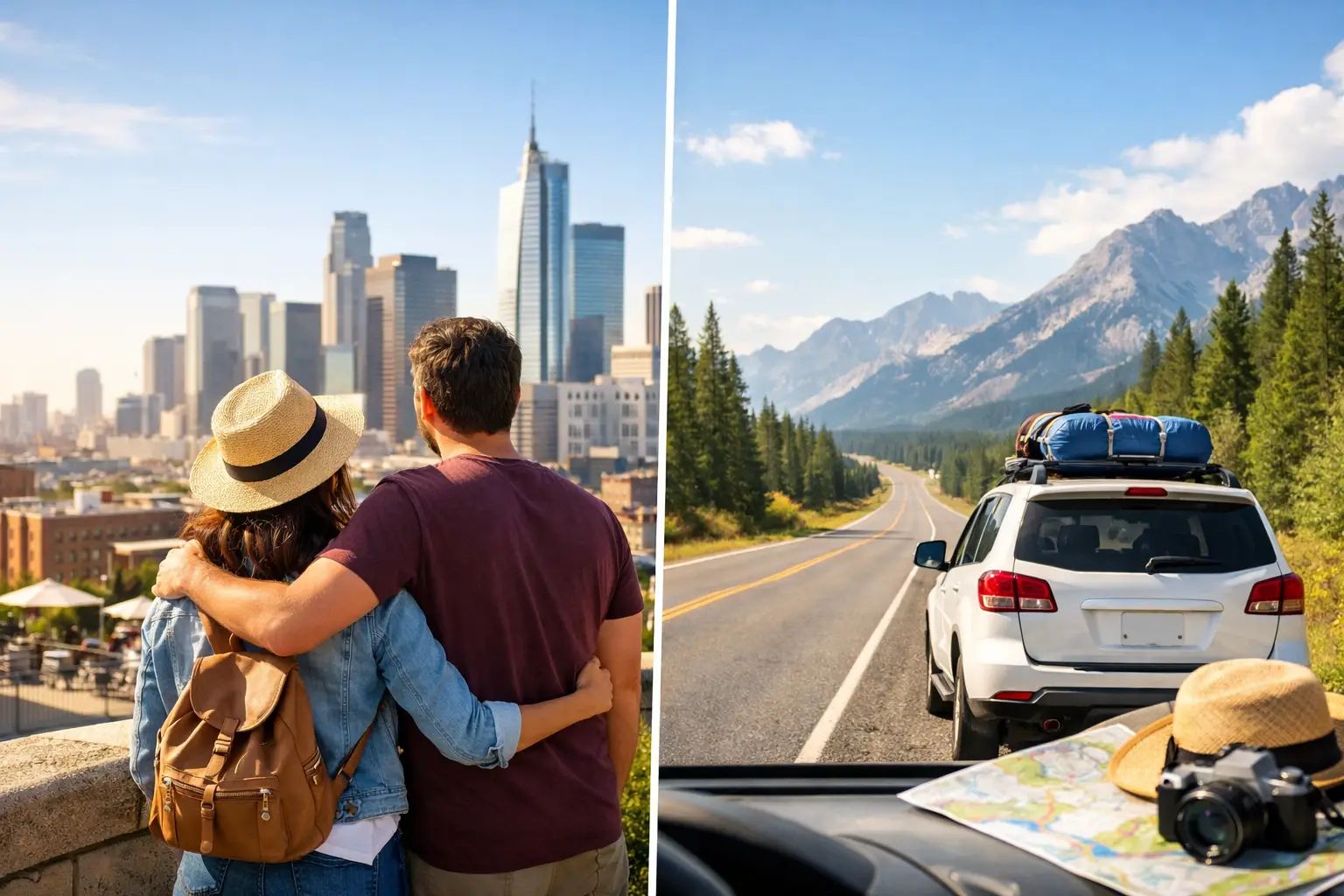
Friday afternoon, one eye on the weather forecast and the other on your annual leave balance, is when this question tends to appear: city break or road trip? Both promise escape, both can fit into a long weekend or stretch into something bigger, and both can be exactly what you need – or completely wrong for the mood you are in.
The real difference is not just transport. It is rhythm. A city break gives you density: galleries, cafés, neighbourhoods and late dinners all within a compact frame. A road trip gives you motion: changing landscapes, small surprises between stops, and the pleasure of not quite knowing what the next hour will look like. If you choose on rhythm rather than romance, you are far more likely to book the right trip.
City break or road trip: start with your energy
Before you think about destinations, ask a less glamorous question: how much decision-making do you want to do on holiday? A city break usually asks less of you once you arrive. You can base yourself in one hotel, get your bearings quickly and spend your time choosing between a market, a museum and a second coffee rather than comparing fuel stations and debating whether another two-hour drive is really sensible.
That makes cities particularly good when life has been noisy. If work has been relentless, if your group chat cannot agree on anything, or if you simply want a weekend that feels easy, a city can be the more restful option even if the streets themselves are busy. There is a reassuring logic to urban travel. You land, drop your bag, head out and start.
A road trip works differently. It suits travellers who find energy in movement and who do not mind small practical puzzles. The journey is part of the holiday, not the administrative bit before it. A winding coastal road in Slovenia, a stretch through Andalusia, or a meander across the Scottish Highlands can feel gloriously freeing – but only if changing plans on the hoof sounds exciting rather than mildly exhausting.
What kind of memories do you want?
City memories are often specific and human. A wine bar tucked down a side street in Seville. A bookseller in Bristol who sends you away with three recommendations and a pub tip. The view from a tram in Lisbon as the late light catches tiled facades. Cities are built for concentrated encounters, which is why they reward curiosity. Even a short stay can feel full.
Road trip memories tend to be more cinematic. The swimming spot you found because you took the wrong turning. The mountain pass that looked good on the map and better in real life. The bakery in a town you had never heard of and may never find again. If your favourite travel stories begin with, “We weren’t planning to stop, but…”, the road is probably calling.
Neither is inherently richer. It depends whether you want depth in one place or variety across several.
Budget is not as straightforward as it looks
There is a temptation to assume that road trips are the cheaper choice because they avoid expensive city hotels, or that city breaks are better value because you can do them without hiring a car. Both assumptions can fall apart quite quickly.
A city break can be excellent value if you choose somewhere with affordable public transport, plenty of free sights and good casual food. In parts of Europe, you can spend very little getting around and a great deal of pleasure simply walking. On the other hand, popular capitals can become startlingly expensive once accommodation, museum tickets and dinner in central areas start stacking up.
A road trip spreads costs differently. You may save on one expensive base by staying in smaller towns, but then you add fuel, tolls, parking and perhaps car hire. If you are travelling as a pair or a group, that can still work beautifully. If you are going solo, the maths can look less charming.
The hidden cost in either case is not money but waste. On a city break, waste looks like overpaying to stay in the obvious neighbourhood when a better area is ten minutes away by metro. On a road trip, it looks like trying to cram in too much distance and spending your holiday peering at road signs instead of scenery.
The destination matters less than the format
Travellers often fixate on where when the more useful question is how they want to experience a place. Barcelona as a city break is one trip. Catalonia by car is another. Reykjavik on a long weekend has one tempo. Iceland with a ring-road mindset has a completely different one.
This is where a little honesty helps. Some places are better sampled in one hit of urban intensity. Others make more sense when you give yourself room to roam. If a destination’s appeal lies in layered neighbourhoods, food culture and a sense of local life concentrated in a compact area, a city break makes sense. If the appeal lies in landscapes, regional contrasts and little-known stops between headline sights, the road trip format may reveal more.
That is also why good travel planning starts with voices, not just maps. Hearing how someone actually moves through a place – where they linger, what they skip, which detours are worth it – is often more useful than a list of top attractions. It is the difference between seeing a destination and understanding how to inhabit it for a few days.
City break or road trip for different trip lengths
For a weekend, the city usually wins. Not always, but usually. Two or three nights is enough to settle into a place, wander properly and still leave with the satisfying feeling that you have had a holiday rather than a transit exercise. Cities absorb short stays well because they offer instant access to culture, food and atmosphere.
A road trip can work over a weekend, especially close to home, but it needs discipline. One region, one or two bases, no heroic mileage. Otherwise your grand escape becomes a highly scenic logistics challenge.
Once you reach five days or more, the equation loosens. A road trip starts to make more sense because you have enough time for slow patches, diversions and the occasional weather-related rethink. A longer city break can still be wonderful, particularly in places with distinct neighbourhoods or easy day trips, but it helps if you genuinely enjoy urban immersion. Some travellers can spend a week drifting through one city and feel they have barely scratched the surface. Others start eyeing the railway timetable by day four.
Who are you travelling with?
This may be the decisive factor. A city break is often easier for mixed groups because everyone can split up and reconvene without much drama. One person can spend the morning in a gallery, another in a market, and by lunch the group is whole again. Couples also tend to do well in cities because the format leaves room for spontaneity without requiring endless practical negotiation.
Road trips can be brilliant with the right company and faintly maddening with the wrong company. Music, navigation, snack politics, punctuality, driving confidence – none of these matters until suddenly they matter a lot. The upside is that shared travel on the road can create the kind of stories that keep resurfacing for years. The downside is that one person’s charming spontaneity is another person’s complete lack of a plan.
If you are travelling solo, the decision comes down to temperament. A city can offer ease, anonymity and a steady flow of things to do. A road trip offers freedom and solitude, which can feel expansive or lonely depending on the day.
How to choose without overthinking it
If what you want is stimulation, a few excellent meals, and the sense of slipping briefly into another way of life, book the city. If what you want is spaciousness, a sequence of changing scenes, and the joy of travelling through rather than arriving at, take the road.
And if you are still torn, combine the two sensibly. Start with a city, then drive out into the surrounding region. Or do the opposite: a few days on the road, then finish in one place where you can hand back the keys and stay out late. Many of the best trips are hybrids, balancing urban character with the freedom of the in-between.
For readers of Destination Unlocked, that may be the most useful lens of all. The best holidays are rarely built around a format alone. They are built around what kind of version of yourself you want to be for a few days – the stroller, the wanderer, the meticulous planner, the happy opportunist. Choose the trip that gives that person room to appear, and the destination tends to open up around you.