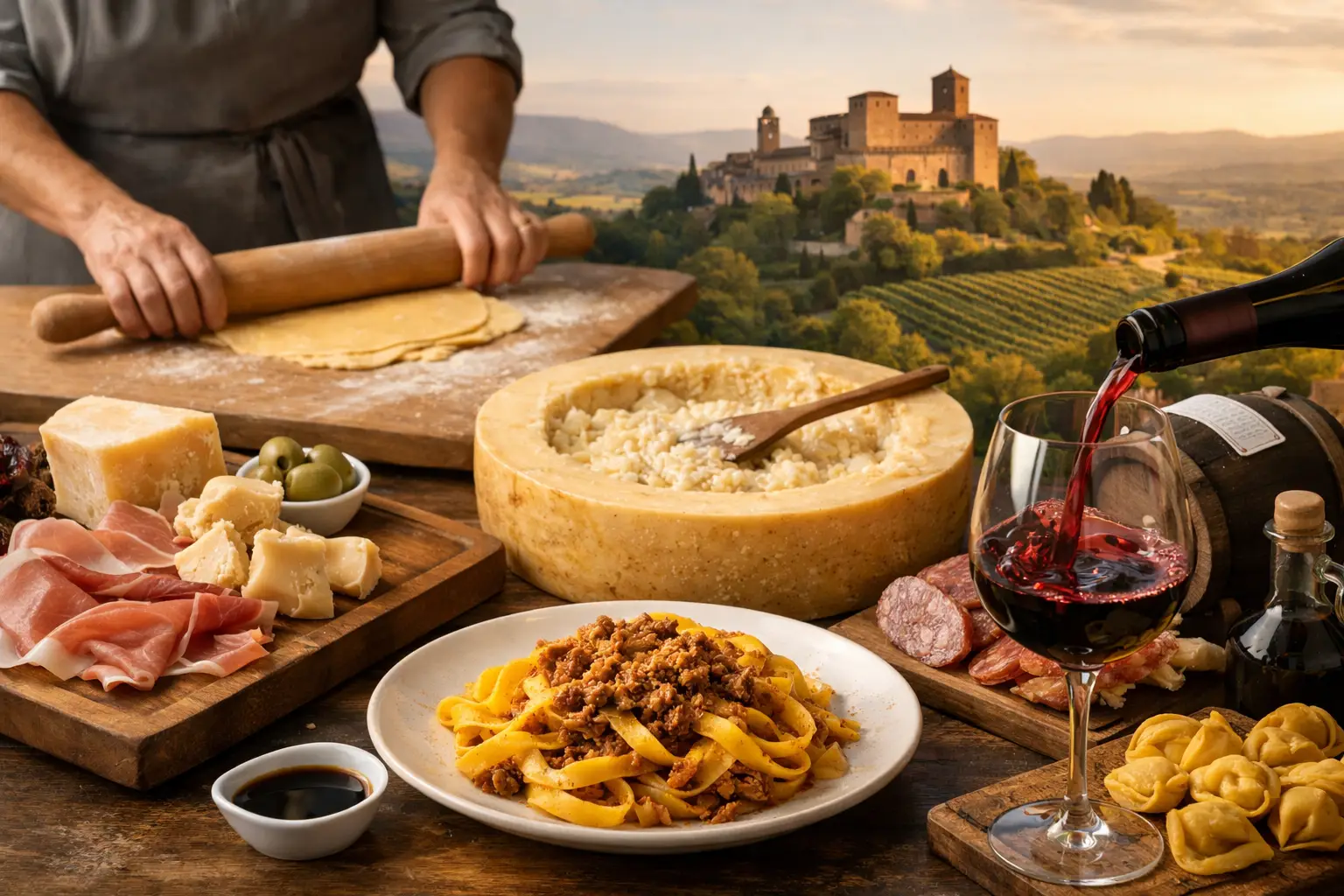
Order tagliatelle al ragù in Bologna and one thing becomes clear quite quickly – food experiences in Emilia Romagna are not designed to be rushed. This is a region that treats lunch with the seriousness some places reserve for opera, and frankly, that feels like the correct priority. For travellers who like their city breaks and road trips to come with substance, Emilia-Romagna is one of Italy’s richest culinary addresses.
What makes the region so compelling is not just the fame of its produce, although the roll call is absurdly strong. Parmigiano Reggiano, Prosciutto di Parma, traditional balsamic vinegar of Modena, mortadella, handmade pasta – most destinations would be thrilled to claim one of those. Emilia-Romagna has the lot, and then quietly gets on with serving lunch.
Why food experiences in Emilia Romagna feel different
There are plenty of places in Italy where you can eat well without trying very hard. Emilia-Romagna goes a step further. Here, the pleasure is in understanding where things come from, how they are made and why local people are mildly horrified when anyone gets the details wrong.
That means the best experiences are rarely about chasing the most expensive table. They are about context. A morning in a Parmigiano dairy, watching huge copper vats at work, tells you more about the region than a dozen souvenir shops ever could. So does sitting in a modest trattoria where the pasta arrives without ceremony because it does not need any.
There is also a useful trade-off to understand. The region’s culinary reputation can create unrealistic expectations of constant perfection. Not every meal will be transcendent, and the most famous names can attract slightly stage-managed tourism. The trick is to balance headline foods with smaller, more local moments.
Start in Bologna, where appetite is part of the itinerary
If you are choosing one base, Bologna makes a very strong case for itself. It is handsome, walkable and deeply edible, with the sort of covered markets, old-school delis and warmly lit dining rooms that make you start planning the next meal before finishing the current one.
The classic move is to try the city’s most emblematic dishes properly. Tagliatelle al ragù is the obvious one, though locals will point out, correctly, that spaghetti has no business being involved. Tortellini in brodo is another essential – delicate, rich and far more satisfying than its modest appearance suggests. Then there is mortadella, which deserves better than its international reputation. In Bologna, sliced fresh and eaten simply, it becomes something elegant rather than industrial.
What Bologna does especially well is combine accessible pleasures with a sense of culinary literacy. You can browse market stalls in the Quadrilatero, pause for an aperitivo, then settle into a dinner that feels rooted rather than performative. It suits travellers who enjoy food but do not want their holiday to feel like a competitive sport.
Take a pasta class, but choose the right one
A good pasta class in Bologna can be genuinely memorable, particularly if it is led by someone who treats technique as part of family culture rather than theatre for visitors. Learning to roll sfoglia by hand gives you a feel for the region’s domestic food traditions in a way that restaurant dining alone cannot.
That said, it depends what you want. Some classes are intimate and thoughtful; others are closer to crowd management with aprons. If your ideal food experience includes conversation, stories and the small corrections that make handmade pasta better, it is worth seeking something personal rather than purely polished.
Parma offers some of the region’s most iconic tastes
Parma has the advantage of immediate name recognition, but it is far more than a label on a deli counter. This is one of the best places in Italy to see how protected food traditions still shape daily life.
A visit to a Parmigiano Reggiano producer is one of the standout food experiences in Emilia Romagna because it gives scale to something most people only know in wedge form. The early start matters. Production happens in the morning, and seeing the curd lifted, divided and placed into moulds brings real texture to the process. Later, in the ageing rooms, the sheer number of wheels stacked in regimented rows is enough to convert even casual cheese enthusiasts into temporary evangelists.
The same applies to Prosciutto di Parma. In the hills around Langhirano, the landscape itself becomes part of the explanation. Air, altitude and time all play their part, and tasting the finished product close to where it is cured makes supermarket comparisons feel a bit bleak.
Parma also happens to be an elegant city for lingering. You can pair factory visits and tastings with unhurried walks, smart cafés and a pace that feels calmer than Bologna. If Bologna is the high-energy opening act, Parma is the more composed second half.
Modena is where patience becomes an ingredient
Modena’s great culinary treasure is traditional balsamic vinegar, and it is worth being precise here. The real thing is not the splashy condiment of casual salads but a patiently aged, intensely concentrated product that can spend decades in barrels before reaching a spoon.
Visiting an acetaia is one of the region’s most distinctive experiences because the story is so unlike industrial food production. Attics, wooden barrels, family histories, evaporation, ageing – the whole process feels intimate and slightly mysterious. The tasting itself can be a revelation. A few drops on Parmigiano Reggiano or even a spoonful on its own shows just how layered and complex it is.
Modena also gives you another side of Emilia-Romagna: refined, stylish and quietly self-assured. You can eat exceptionally well here, of course, but there is pleasure in understanding the city through its specialities rather than treating it as a trophy stop.
Don’t ignore the ordinary-looking places
One of the small joys of Modena, and the region generally, is that understated places often deliver the most convincing meals. A smart-looking dining room can be wonderful, but a family-run trattoria with excellent pasta and absolutely no interest in trends can be just as memorable. Emilia-Romagna rarely needs to oversell itself.
Smaller towns often deliver the most memorable meals
While Bologna, Parma and Modena take most of the attention, some of the best food moments come in smaller towns and rural settings. This is where the region’s agricultural depth becomes easier to feel. Vineyards, pig farms, cheese dairies and farm restaurants create a stronger sense of continuity between landscape and plate.
Places around Reggio Emilia are especially rewarding for travellers who like to get beyond the obvious route. You are still firmly in serious food territory, but often with fewer crowds and less performance. Agriturismi can be excellent here, particularly if you want a slower meal built around seasonal local cooking rather than a checklist of famous names.
The Romagna side of the region deserves attention too. In cities and coastal towns such as Ravenna, Forlì or Rimini’s hinterland, the culinary mood shifts slightly. You will find piadina, grilled meats, seafood on the coast and a style of hospitality that can feel more relaxed and less ceremonious than in the Emilian heartland. It is not better or worse, just different – and that difference is part of the pleasure of travelling across the region rather than treating it as one uniform food map.
How to plan your food experiences in Emilia Romagna
The best approach is to avoid overloading the schedule. This sounds obvious, but Emilia-Romagna is a region where trying to do too much can flatten the experience. A dairy visit at dawn, a long lunch, an afternoon transfer and a multi-course dinner may sound romantic in theory. In practice, that is a lot of cheese before sunset.
It is usually better to build one main food anchor into each day. That might be a Parmigiano producer near Parma, an acetaia in Modena or a pasta class in Bologna, with the rest of the day left open for markets, cafés and whatever catches your eye. Spontaneity matters here because some of the best moments are gloriously unplanned – an excellent salumi board, a bakery stop, a bottle of Lambrusco that proves unfairly underestimated.
Season matters as well. Autumn is particularly appealing, with cooler weather and a stronger appetite for richer dishes, though spring can be ideal for road-tripping and city wandering. Summer has its charms, especially if you combine inland food stops with time on the Adriatic, but heavy meals in high heat are not everyone’s idea of bliss.
If you are travelling without a car, Bologna works brilliantly as a hub, and Parma and Modena are easy additions by train. For rural producers, though, a car makes life simpler and opens up the smaller places where the region’s food culture often feels most alive.
Perhaps the best reason to go is that Emilia-Romagna rewards curiosity more than status. You do not need to chase the flashiest booking or the most photographed plate. Ask questions, leave room for lunch to run long, and treat the region less like a greatest-hits menu and more like a conversation. It tends to answer generously.