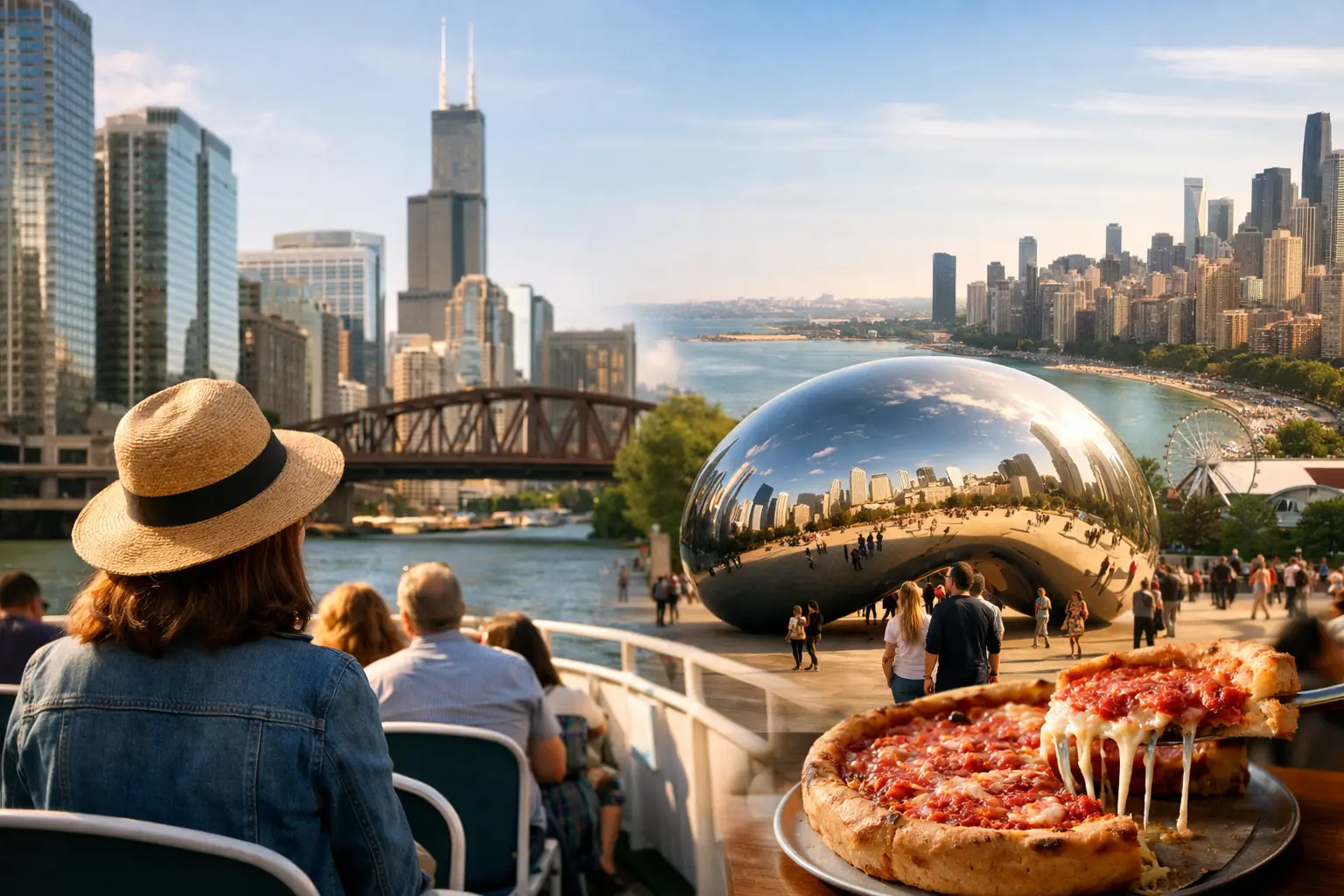
Chicago rewards travellers who like their city breaks with shape, swagger and a bit of weather. If you’re wondering how to spend 36 hours in Chicago, the trick is not trying to conquer all of it. This is a city of big statements – architecture, lakefront, sport, food – but the best short visit balances famous sights with a few neighbourhood moments that make the place feel lived in rather than merely ticked off.
For a first visit, it makes sense to base yourself in or around the Loop, River North or the Magnificent Mile. You will spend less time wrestling with logistics and more time actually seeing the city. Chicago is spread out, and while public transport is useful, 36 hours is not the moment for heroic cross-city missions unless there is something you desperately want to see.
How to spend 36 hours in Chicago without rushing it
The ideal Chicago weekend starts early. On your first morning, head straight for the river. The city’s architectural confidence is best understood at street level first, before you go indoors anywhere. Walk the Chicago Riverwalk with a coffee and let the skyline introduce itself properly. Glass towers catch the light, bridges frame the water, and the whole place feels surprisingly ordered for a city of this scale.
From here, take an architecture boat tour late morning if the weather behaves. It is one of those rare marquee activities that deserves the reputation. In a compact window of time, it explains why Chicago looks the way it does and why locals are so proud of it. You will leave with names, stories and a much better sense of place than you would get from simply craning your neck on the pavement.
If a boat tour is not realistic because of timing or winter conditions, swap it for the Chicago Architecture Centre or simply keep walking through the Loop. The trade-off is obvious – less drama, more context – but either option still grounds the trip in one of Chicago’s great strengths.
Lunch: choose your Chicago food moment carefully
There is a temptation to charge straight into deep-dish pizza at the first opportunity. Resist, at least for lunch. Deep dish is best treated as an event rather than a snack, and it can flatten the rest of your afternoon if badly timed.
Instead, go lighter and more local. An Italian beef sandwich is messy, excellent and far more manageable in the middle of the day. If that does not appeal, Chicago also does casual food very well, from hot dogs done properly to polished café lunches. This is not a city where you need to save every penny for dinner in order to eat well.
After lunch, point yourself towards Millennium Park and the Art Institute of Chicago. Yes, Cloud Gate is the obvious stop, and yes, it is still worth seeing. But do not linger too long trying to take the cleverest photo in the world. The Art Institute is where the afternoon should really unfold. Even travellers who do not usually build holidays around galleries tend to find something to hold onto here, whether that is American modernism, Impressionism or simply the pleasure of being in a major museum that is laid out with relative sanity.
If museums are not your thing, spend that stretch of the day by the lake instead. Walk through Grant Park and along the shoreline path. Lake Michigan has a strange sea-like force to it, and that scale is part of what makes Chicago feel distinct from other American cities. On a bright day it is magnificent. On a grey one it can feel cinematic in a completely different way.
An evening in Chicago: dinner, skyline, music
By early evening, give yourself a reset at your hotel before heading out again. Chicago after dark can be sleek or scruffy depending on your mood, and both versions are appealing.
For dinner, this is the right time for deep-dish pizza if you are determined to do it. Go in knowing what it is: rich, filling and not remotely subtle. Some travellers adore it, others feel they have respectfully completed the assignment and can move on. If you would rather save your appetite for a broader evening, book somewhere with a strong Midwestern menu instead – steak, seasonal produce and serious cocktails are all part of the city’s repertoire.
After dinner, choose between views and music. If this is your first time in Chicago and you want the full skyline thrill, head to an observation deck. The views are undeniably memorable, especially if the city is glittering and the lake has disappeared into darkness. The downside is that these experiences can feel a little transactional, particularly at peak times.
The more atmospheric option is to finish in a jazz club or a good bar in River North, the West Loop or Lincoln Park. Chicago’s musical heritage is not just a museum fact; it still gives the city a proper night-time pulse. For many visitors, a late set and a drink will feel more memorable than another lift ride to a panoramic window.
Day two: neighbourhoods over landmarks
The second day is where a short trip either gets more interesting or turns into pure box-ticking. If day one was about headline Chicago, day two should show you a little texture.
Start in Wicker Park or Logan Square for breakfast. These neighbourhoods offer a different rhythm from downtown – less polished, more local, with independent cafés, bookshops and the sort of streets you actually want to wander. Brunch culture is serious here, so expect queues at the most popular spots, especially at weekends. If you hate waiting for eggs, go early or have a backup in mind.
After breakfast, spend the late morning browsing rather than charging. This is the moment for record shops, bakeries, design stores and people-watching from a café window. Chicago is often sold through its giant attractions, but its appeal also lies in how comfortably neighbourhood life sits alongside all that scale.
If you would rather keep your 36 hours in Chicago tightly focused on classic sights, use this slot for one more major attraction. The Field Museum, Shedd Aquarium and Museum of Science and Industry all have their loyalists. Which one suits you depends on who you are travelling with and what tends to hold your attention. For adults on a city break, the Field Museum usually gives the strongest sense of reward for time spent. Families may feel differently.
Where to go on your final afternoon
A final Chicago afternoon works best when it has a bit of air in it. If the weather is kind, make for Lincoln Park. You can walk, browse, stop for coffee, dip into the conservatory or simply enjoy a stretch of the city that feels greener and more residential. This is a useful reminder that Chicago is not just a collection of skyscrapers and sports franchises.
Another strong option is to spend your last few hours around the lakefront near Oak Street Beach or Navy Pier, though the latter is very much a depends-on-your-tolerance sort of place. Some travellers enjoy the ferris wheel energy and easy views. Others find it overcooked. If you only have 36 hours, there are usually better uses of your time unless you are travelling with children or specifically want that classic waterfront amusement feel.
Before you leave, fit in one final meal that feels distinctly Chicago without repeating yourself. That might mean a tavern-style pizza instead of deep dish, a proper burger, or one more sandwich done better than it has any right to be. Chicago is a strong food city beyond the clichés, so it is worth leaving a little room for spontaneity.
Practical choices that make the trip smoother
A short break here is shaped as much by logistics as by taste. Choose a hotel with easy access to the ‘L’ or to central sights on foot. In a city this large, a cheaper room far from where you want to spend your time is often a false economy.
Weather also matters more than many visitors expect. Chicago can be glorious, but it can also be windy in a way that makes you question your life choices. If you are visiting in colder months, indoor anchors such as museums, food halls and music venues become more important. In summer, the lakefront and rooftop bars earn their place more easily.
And do not try to see every neighbourhood that someone on the internet swears is essential. Chicago is too substantial for that game. Better to have one excellent weekend with a clear shape than an exhausting blur of taxis, queues and half-enjoyed meals.
If you want a city break with architecture, serious culture, food that knows exactly what it is, and enough local character to justify a return trip, Chicago makes its case quickly. Spend your 36 hours well, and you will leave with that satisfying feeling that the city gave you a proper introduction – but not the whole story.